

Most American research teams are now closely tracking Retatrutide, a compound that marks a powerful shift in metabolic science. With clinical trials showing up to 24.2 percent body weight reduction in less than a year, this triple agonist is drawing serious attention in both academic and biotech settings. Understanding how Retatrutide’s unique receptor targeting sets it apart can help guide smarter lab decisions for researchers seeking the next big breakthrough.
Table of Contents
- Retatrutide Explained: Triple Agonist Chemistry
- Key Differences From Ozempic and Tirzepatide
- Why ‘Subject R’ Is Generating Lab Hype
- Potential Applications and Experimental Uses
- Risks, Controversies, and Regulatory Concerns
Key Takeaways
| Point | Details |
|---|---|
| Retatrutide as a Triple Agonist | Retatrutide uniquely targets GLP-1, GIP, and glucagon receptors, offering a novel approach in peptide research and potential for significant metabolic improvements. |
| Enhanced Dosing Convenience | With an extended half-life of approximately six days, Retatrutide allows for weekly administration, facilitating patient adherence to treatment. |
| Potential for Diverse Applications | Ongoing research suggests applications in type 2 diabetes management, obesity treatment, and even oncology, highlighting its versatility beyond traditional metabolic studies. |
| Regulatory Status and Future Outlook | Currently in Phase 2 and 3 trials, Retatrutide is anticipated to receive FDA approval around 2026–2027, pending comprehensive safety and efficacy evaluations. |
Retatrutide Explained: Triple Agonist Chemistry
Retatrutide represents a groundbreaking advancement in peptide research, emerging as a sophisticated triple-receptor agonist that challenges traditional molecular design approaches. Unlike single or dual-receptor compounds, this novel synthetic molecule simultaneously targets GIP, GLP-1, and glucagon receptors with remarkable precision and efficiency.
The molecular architecture of Retatrutide is particularly fascinating, featuring a unique C20 fatty diacid moiety that enables exceptional albumin binding characteristics. This structural innovation dramatically extends the compound’s half-life to approximately six days, allowing for convenient weekly dosing protocols. Researchers are especially intrigued by its stronger affinity for the GIP receptor compared to glucagon and GLP-1 receptors, which suggests nuanced potential in metabolic and physiological research domains.
Key features of this triple-agonist compound include:
- Simultaneous interaction with three critical metabolic receptors
- Enhanced molecular stability through advanced binding mechanisms
- Dose-proportional pharmacokinetic profile
- Potential for weekly administration protocols
Lab Protocol Pro Tip: Verify receptor interaction dynamics through systematic computational modeling before advanced research stages to ensure precise understanding of molecular engagement mechanisms.
Key Differences From Ozempic and Tirzepatide
Researchers are increasingly fascinated by the evolutionary progression of receptor agonist compounds, with Retatrutide representing a significant leap forward in molecular design. Unlike Tirzepatide and Ozempic, Retatrutide introduces a groundbreaking triple-receptor targeting approach that expands the potential research landscape for metabolic investigation.

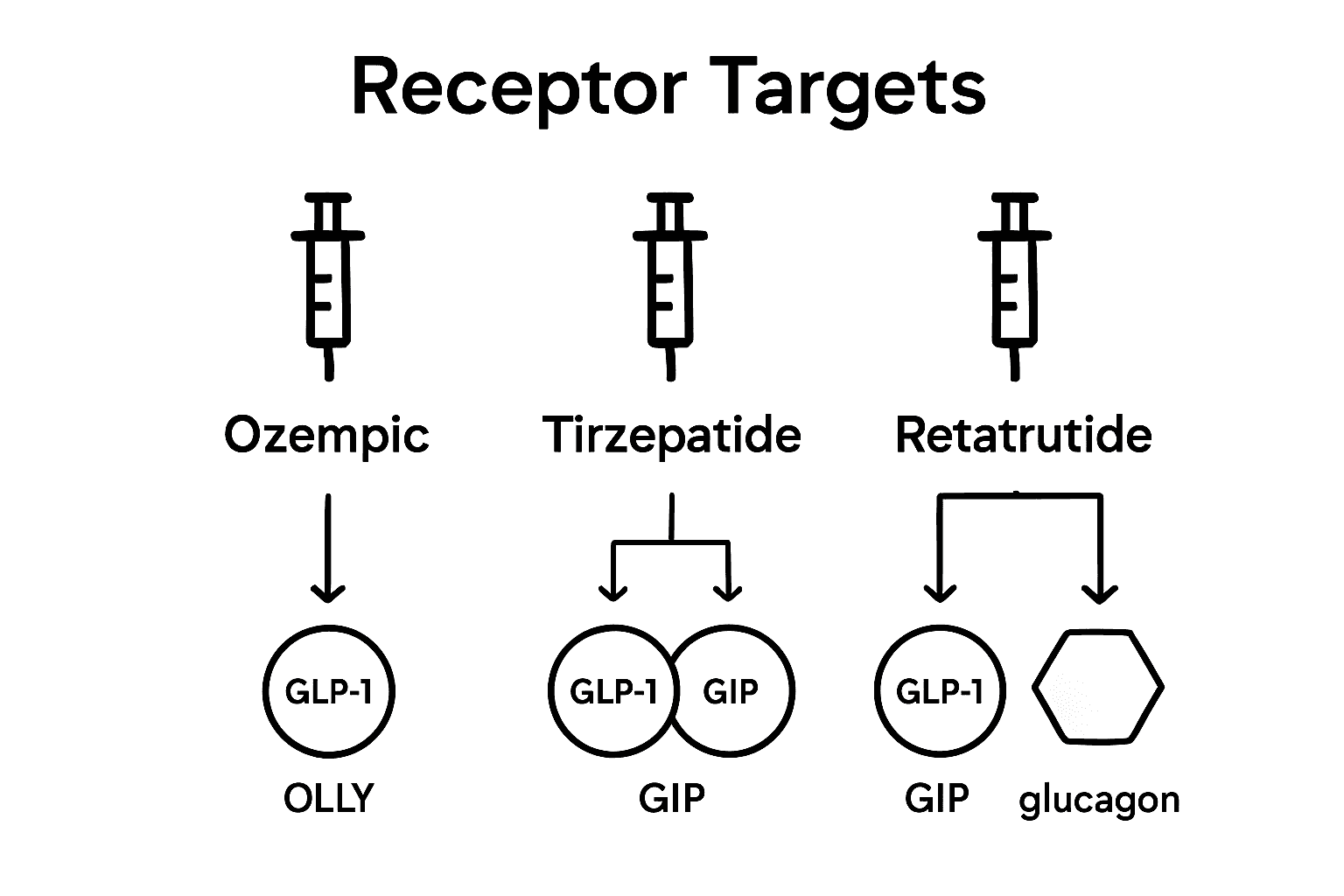
The key distinctions become immediately apparent when examining receptor interactions. While Ozempic functions as a single GLP-1 receptor agonist and Tirzepatide operates as a dual-receptor agonist, Retatrutide uniquely engages three critical metabolic receptors simultaneously: GLP-1, GIP, and glucagon. Clinical trials have demonstrated extraordinary potential, with participants achieving up to 24.2% body weight reduction over 48 weeks – a result that significantly outperforms previous compounds.
Comparative Breakdown:
Here is a structured comparison of Retatrutide, Tirzepatide, and Ozempic, focusing on their receptor targeting, molecular design, and clinical outcomes:
| Compound | Receptor Targets | Structural Distinction | Documented Weight Loss Effect |
|---|---|---|---|
| Ozempic | GLP-1 only | Single-agonist peptide | Up to 15% over 68 weeks |
| Tirzepatide | GLP-1, GIP | Dual-agonist configuration | Up to 22.5% over 72 weeks |
| Retatrutide | GLP-1, GIP, glucagon | Triple-agonist with C20 moiety | Up to 24.2% over 48 weeks |
- Ozempic: Single GLP-1 receptor agonist
- Tirzepatide: Dual receptor agonist (GLP-1, GIP)
- Retatrutide: Triple receptor agonist (GLP-1, GIP, glucagon)
Research Progression Pro Tip: Always cross-reference multiple receptor interaction studies to understand the nuanced molecular mechanisms driving emerging compounds’ performance.
Why ‘Subject R’ Is Generating Lab Hype
Subject R (Retatrutide) has electrified research laboratories with its revolutionary molecular design, promising unprecedented insights into metabolic interactions. The compound’s unique triple-agonist mechanism suggests a sophisticated approach to understanding complex physiological pathways, where multiple receptor interactions create a synergistic effect that goes far beyond traditional single-receptor compounds.
What truly sets this research compound apart are its groundbreaking potential implications across multiple scientific domains. Preclinical models have demonstrated profound anti-tumor effects, including significant reductions in pancreatic and lung tumor volumes, suggesting a complex interplay between metabolic regulation and cellular dynamics that could revolutionize our understanding of disease mechanisms.
Key Research Excitement Points:
- Simultaneous engagement of GIP, GLP-1, and glucagon receptors
- Potential for advanced metabolic pathway understanding
- Promising anti-tumor research implications
- Innovative molecular interaction mechanisms
Research Strategy Pro Tip: Develop comprehensive multi-receptor interaction models to fully explore the nuanced molecular mechanisms that make Subject R a potential game-changer in advanced scientific investigations.
Potential Applications and Experimental Uses
Researchers are exploring a diverse range of experimental applications for Retatrutide, extending far beyond traditional metabolic investigations. Clinical studies are examining potential indications for type 2 diabetes management and obesity research, with intriguing possibilities for addressing complex physiological challenges.
The compound’s multifaceted receptor engagement opens unprecedented research pathways. Most notably, early preclinical models suggest profound implications for liver health, including significant reductions in liver fat accumulation and potential interventions for non-alcoholic fatty liver disease. These discoveries hint at a broader spectrum of potential experimental uses that extend well beyond initial metabolic research frameworks.
Potential Experimental Research Domains:
The following table summarizes emerging research applications and scientific implications for Retatrutide:
| Research Area | Rationale for Interest | Notable Preliminary Findings |
|---|---|---|
| Metabolic diseases | Multi-receptor synergies | Enhanced glucose and weight control |
| Liver health | Fat metabolism modulation | Reduced liver fat in early trials |
| Oncology | Impact on cell signaling pathways | Decreased tumor volumes in preclinical models |
| Cardiovascular investigations | Potential risk reduction mechanisms | Still under early-stage exploration |
- Metabolic pathway dynamics
- Liver function and fat metabolism
- Cardiovascular risk reduction mechanisms
- Advanced molecular interaction studies
- Obesity-associated disease risk exploration
Research Design Pro Tip: Develop comprehensive multi-receptor interaction models that capture the nuanced molecular mechanisms unique to Retatrutide’s triple-agonist configuration.
Risks, Controversies, and Regulatory Concerns
Regulatory uncertainty currently surrounds Retatrutide, reflecting the complex landscape of emerging research compounds. The investigational drug developed by Eli Lilly remains in Phase 2 and 3 clinical trials, with no current FDA approval, placing it in a critical evaluation period that demands rigorous scientific scrutiny.
The compound’s unprecedented weight loss data generates both excitement and skepticism within the research community. Early clinical trials have demonstrated remarkable outcomes, with participants experiencing weight reductions averaging 17–24% over 24 to 48 weeks. Approval is tentatively expected around 2026–2027, but long-term safety and comprehensive efficacy profiles are still under intensive investigation, highlighting the critical need for comprehensive research protocols.
Key Regulatory Considerations:
- Current investigational drug status
- Ongoing Phase 2 and 3 clinical trials
- Potential FDA review timeline
- Need for extensive long-term safety data
- Complex multi-receptor interaction mechanisms
Research Ethics Pro Tip: Maintain comprehensive documentation and transparency throughout investigational stages, anticipating potential regulatory questions about novel multi-receptor compound interactions.
Unlock the Future of Metabolic Research with Retatrutide and Area 15 Labs
The article “Beyond Ozempic: Why Labs Crave Retatrutide Research” highlights a major challenge faced by cutting-edge researchers — accessing high-purity, triple-agonist compounds like Retatrutide quickly and reliably to explore its revolutionary metabolic receptor interactions. The demand for this complex peptide that targets GLP-1, GIP, and glucagon receptors simultaneously calls for a no-nonsense source that delivers exceptional quality without the wait or the sterile pharma vibe.
At Area 15 Labs, we get it. You need more than just another peptide supplier. You want a partner who moves faster than the usual overseas shipment lag, offers unmatched purity testing like the big institutional players, and embraces the bold, futuristic energy that your groundbreaking research deserves. With our Texas-based same-day fulfillment and verified research compounds like Retatrutide, you can accelerate your experimental studies with confidence and style. Say goodbye to the boring old suppliers and step into the “No-BS” choice for triple-agonist research.
Ready to dive deeper into the science but skip the fuss of sketchy shipping and slow support? Explore our exclusive Retatrutide offerings today and join the ranks of citizen scientists pioneering the future. Discover why Research with Swagger means getting your materials fast, pure, and with an alien-approved vibe. Don’t wait for the competition to catch up — lead your experiments with the cutting-edge compounds only available at Area 15 Labs.
Frequently Asked Questions
What is Retatrutide and how does it work?
Retatrutide is a novel triple-receptor agonist that targets GIP, GLP-1, and glucagon receptors simultaneously, enhancing its efficiency in metabolic regulation. Its unique molecular architecture allows for significant binding characteristics and an extended half-life, enabling weekly dosing.
How does Retatrutide compare to Ozempic and Tirzepatide?
Unlike Ozempic, which is a single GLP-1 receptor agonist, and Tirzepatide, which targets GLP-1 and GIP receptors, Retatrutide uniquely engages all three receptors. This triple-receptor mechanism has demonstrated superior performance in clinical trials, including higher weight loss percentages over a specified time period.
What are the potential applications of Retatrutide in research?
Retatrutide shows promise in various research areas, including type 2 diabetes management, obesity, liver health, and cancer. Early studies indicate potential metabolic benefits and anti-tumor effects, making it a significant focus of ongoing investigations.
What are the regulatory concerns surrounding Retatrutide?
Currently, Retatrutide is in Phase 2 and 3 clinical trials, awaiting FDA approval. There are concerns about long-term safety and efficacy, highlighting the need for extensive research and transparency regarding its multi-receptor interactions.

[…] Beyond Ozempic: Why Labs Crave Retatrutide Research […]
[…] Beyond Ozempic: Why Labs Crave Retatrutide Research […]
[…] Beyond Ozempic: Why Labs Crave Retatrutide Research […]