

Most American researchers exploring metabolic science are surprised to learn that the right peptide compound can dramatically shift research outcomes. With the arrival of Tirzepatide and Retatrutide, laboratories are witnessing a new era in receptor agonist development. These innovations matter because understanding nuanced differences in dual versus triple agonist mechanisms directly impacts the design of advanced American metabolic studies and experiments. Discover how these compounds redefine precision and potential in modern research.
Table of Contents
- Defining Tirzepatide And Retatrutide Compounds
- Dual Versus Triple Agonist Mechanisms Explained
- Receptor Affinity Profiles Compared Side by Side
- Key Implications For Laboratory Research
- Common Myths And Real-World Limitations
Key Takeaways
| Point | Details |
|---|---|
| Tirzepatide | A dual agonist peptide targeting GLP-1 and GIP receptors, designed for prolonged metabolic research. |
| Retatrutide | A triple agonist peptide that engages GLP-1, GIP, and glucagon receptors, enhancing metabolic signaling. |
| Research Implications | The move from dual to triple agonists offers broader insights into metabolic interactions and potential therapeutic applications. |
| Availability | Tirzepatide is approved for use, while Retatrutide remains investigational, impacting research applicability. |
Defining Tirzepatide And Retatrutide Compounds
In the rapidly evolving landscape of advanced research peptides, Tirzepatide and Retatrutide represent cutting-edge molecular engineering that pushes the boundaries of receptor interaction. These sophisticated compounds are not just another iteration of peptide research but represent a quantum leap in understanding receptor dynamics.
Tirzepatide is a groundbreaking dual agonist peptide targeting GLP-1 and GIP receptors, designed with remarkable biochemical precision. Its unique molecular architecture includes a C20 fatty diacid moiety attached to a 39-amino-acid sequence, which strategically extends its half-life for prolonged research potential. This sophisticated design enables researchers to explore intricate metabolic interactions with unprecedented stability and consistency.
By contrast, Retatrutide emerges as a triple agonist peptide developed by Eli Lilly, representing an even more complex molecular approach. Unlike Tirzepatide’s dual-receptor strategy, Retatrutide simultaneously targets GLP-1, GIP, and glucagon receptors. This triple-receptor engagement creates a multifaceted research tool that allows scientists to investigate more nuanced hormonal interactions and metabolic pathways.
Key distinguishing features of these advanced compounds include:
- Receptor Targeting: Tirzepatide (dual), Retatrutide (triple)
- Molecular Complexity: Sophisticated peptide sequences with strategic modifications
- Research Potential: Enhanced ability to model intricate biochemical interactions
- Structural Innovation: Unique fatty acid and amino acid configurations
Understanding these compounds requires recognizing them not just as molecules, but as sophisticated research instruments designed to unlock deeper insights into receptor dynamics and metabolic systems.
Dual Versus Triple Agonist Mechanisms Explained
The world of receptor agonism represents a fascinating molecular chess game, where dual and triple agonist compounds are strategic players designed to interact with specific cellular receptors. Understanding the nuanced differences between these mechanisms reveals the intricate ways researchers can potentially modulate metabolic pathways.
Dual agonists like Tirzepatide operate by simultaneously activating two critical hormone receptors – GLP-1 and GIP, creating a sophisticated biochemical interaction that enhances insulin secretion and suppresses appetite. This dual-receptor approach allows for more targeted metabolic interventions, providing researchers with a precise tool for investigating complex physiological responses.

Retatrutide takes this molecular strategy to the next level by engaging three distinct receptors, incorporating GLP-1, GIP, and glucagon receptor activation. This triple agonist mechanism introduces an advanced research approach that potentially amplifies metabolic signaling and energy expenditure. Mid-stage clinical trials have demonstrated promising outcomes, including significant reductions in triglycerides and liver fat.
Key Comparative Features:
- Dual Agonists (Tirzepatide)
- Target 2 hormone receptors
- Enhanced insulin secretion
- Appetite suppression
- Triple Agonists (Retatrutide)
- Target 3 hormone receptors
- Advanced metabolic signaling
- Potential for increased energy expenditure
The progression from dual to triple receptor engagement represents an exciting frontier in molecular research, offering increasingly sophisticated tools for understanding complex metabolic interactions.
Receptor Affinity Profiles Compared Side by Side
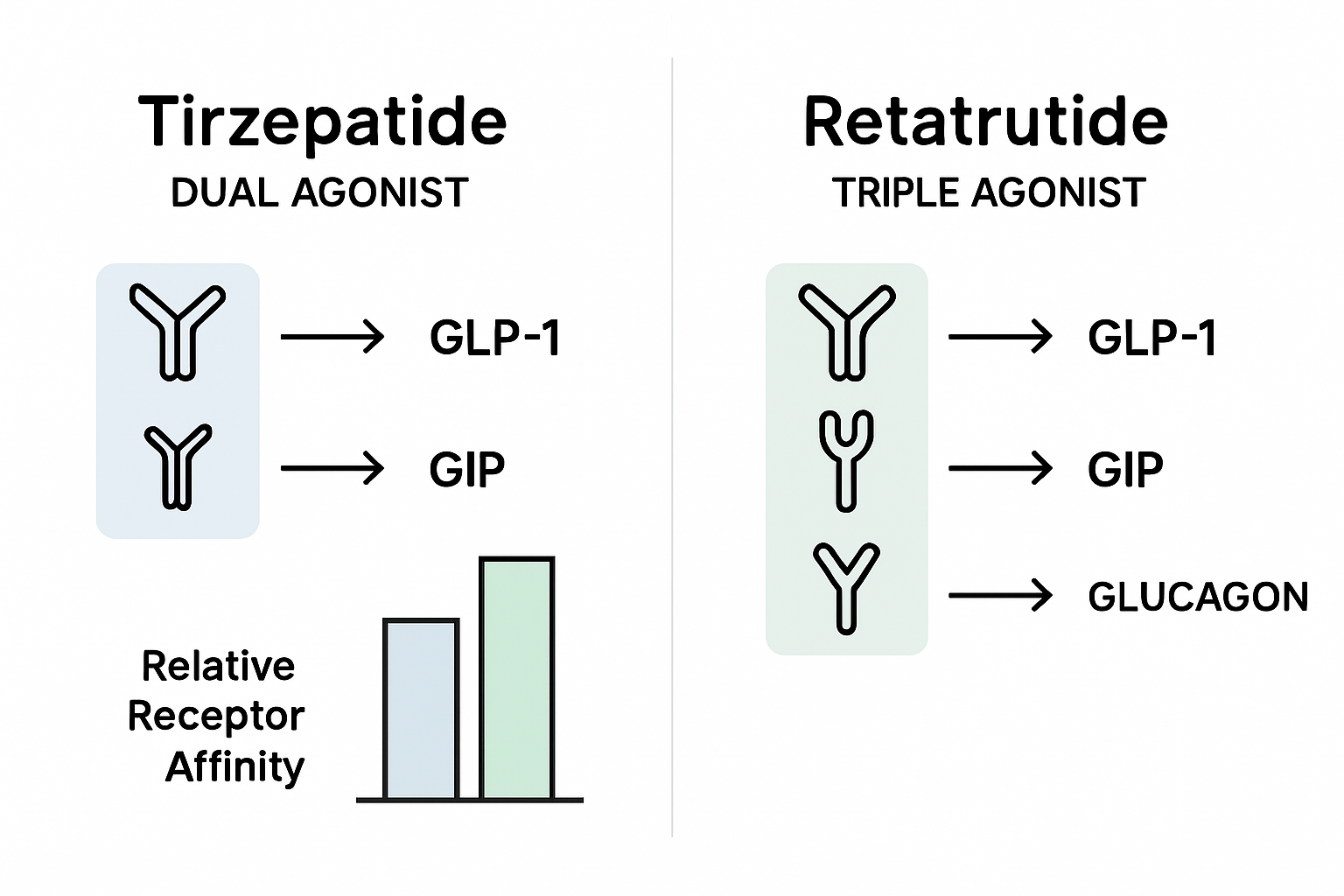
Receptor affinity represents the molecular dance of precision, where binding strength and interaction dynamics determine the potential impact of research compounds. Understanding the nuanced differences between Tirzepatide and Retatrutide requires a deep dive into their unique receptor engagement strategies.
Tirzepatide operates as a sophisticated dual-receptor agonist, targeting GLP-1 and GIP receptors with remarkable specificity. Its molecular design allows for precise interactions that modulate metabolic signaling pathways. By contrast, Retatrutide introduces a more complex molecular choreography, expanding the receptor engagement to include a third target – the glucagon receptor.
Clinical studies have revealed fascinating differences in receptor affinity and activation profiles, suggesting that Retatrutide demonstrates superior research potential across metabolic investigation domains. The additional receptor target provides a more comprehensive approach to understanding complex physiological interactions.
Comparative Receptor Engagement Profile:
- Tirzepatide (Dual Agonist)
- Targets GLP-1 receptor
- Targets GIP receptor
- Precise two-receptor interaction
- Retatrutide (Triple Agonist)
- Targets GLP-1 receptor
- Targets GIP receptor
- Targets glucagon receptor
- Enhanced multi-receptor signaling complexity
The progression from dual to triple receptor engagement represents a significant leap in molecular research sophistication, offering researchers increasingly nuanced tools for investigating intricate metabolic systems.
Key Implications For Laboratory Research
The landscape of molecular research continues to evolve, with receptor agonists representing a critical frontier in understanding metabolic complexity. These sophisticated compounds offer researchers unprecedented insights into intricate biological signaling mechanisms, pushing the boundaries of scientific investigation.
Tirzepatide and Retatrutide emerge as groundbreaking tools that fundamentally transform laboratory research approaches. While Tirzepatide provides a dual-receptor engagement model, Retatrutide introduces a more comprehensive triple-receptor strategy that significantly expands potential research trajectories.
Laboratory studies reveal compelling differences in metabolic research potential between these compounds, demonstrating that the inclusion of additional receptor targets dramatically enhances investigative capabilities. Comparative analyses suggest that the expanded receptor activation in Retatrutide may offer more nuanced insights into metabolic interactions.
Key Research Implications:
- Dual Agonist Limitations
- Restricted receptor interaction
- Narrower metabolic pathway exploration
- Limited signaling complexity
- Triple Agonist Advantages
- Comprehensive receptor engagement
- Enhanced metabolic pathway mapping
- More sophisticated research modeling
The progression from dual to triple receptor engagement represents a quantum leap in molecular research sophistication, providing scientists with increasingly powerful tools for decoding complex physiological systems.
Common Myths And Real-World Limitations
The realm of advanced receptor agonists is fraught with misconceptions and oversimplified narratives about scientific potential and research capabilities. Understanding the nuanced landscape requires critical examination of emerging molecular technologies like Tirzepatide and Retatrutide.
A prevalent misunderstanding surrounds the current availability of these research compounds, with many researchers assuming both are equally accessible. In reality, Tirzepatide has gained regulatory approval, while Retatrutide remains in the investigational phase, representing a significant distinction in their research applicability.
Ongoing clinical trials continue to evaluate the comprehensive effectiveness and safety profiles of these advanced molecular structures, challenging premature assumptions about their potential. The scientific community must maintain a rigorous and measured approach, recognizing that promising early data does not guarantee ultimate research success.
Key Myths and Limitations:
- Availability Misconception
- Tirzepatide: Currently approved
- Retatrutide: Still investigational
- Research Constraints
- Limited long-term data
- Ongoing safety evaluations
- Preliminary clinical insights
Navigating the complex landscape of molecular research demands intellectual humility and a commitment to empirical evidence, recognizing that scientific understanding evolves through meticulous investigation and critical analysis.
Unlock the Full Potential of Dual and Triple Agonist Research with Area 15 Labs
The article dives deep into the receptor affinity differences between Tirzepatide and Retatrutide revealing how dual and triple agonist peptides open new frontiers in metabolic research. If you are struggling with limited receptor engagement or want to broaden your investigative scope, understanding these molecular intricacies is just the start. You need reliable access to uncompromisingly pure compounds that let your research breathe and deliver results without the usual wait times.
At Area 15 Labs, we understand that speed, transparency, and quality are not optional. Whether exploring Tirzepatide’s dual GLP-1 and GIP targeting or pushing the envelope with Retatrutide’s triple receptor activation, our Texas-based lab ships same day to cut out the endless delays and questionable sources. Choose the “No-BS” choice that backs advanced research with verified purity and a futuristic vibe.
Ready to experience the cutting edge of receptor agonist research? Explore our collection of high-purity compounds and step up your lab game right now at Area 15 Labs. Dive into detailed research tools and claim your advantage with fast shipping, honest support, and the swagger every modern researcher deserves.
Start your next phase of discovery today and never settle for less than breakthrough quality from Area 15 Labs. For a deeper look at agonist compounds and their potential, check out our exclusive Alien Tech releases designed to keep you ahead of the pack.
Frequently Asked Questions
What is the primary difference between Tirzepatide and Retatrutide?
Tirzepatide is a dual agonist peptide that targets GLP-1 and GIP receptors, while Retatrutide is a triple agonist peptide that targets GLP-1, GIP, and glucagon receptors. This difference in receptor targeting represents a significant distinction in their mechanisms and research applications.
How do Tirzepatide and Retatrutide affect metabolic pathways?
Tirzepatide enhances insulin secretion and suppresses appetite by activating two hormone receptors, while Retatrutide amplifies metabolic signaling and may increase energy expenditure by engaging three receptors simultaneously, providing a more comprehensive approach to metabolic research.
What are the implications of dual versus triple agonist mechanisms in research?
Dual agonists like Tirzepatide allow for more targeted metabolic interventions, while triple agonists like Retatrutide provide more nuanced insights into metabolic interactions due to their ability to engage multiple receptors, which expands potential research trajectories and approaches.
Are there limitations to using Tirzepatide and Retatrutide in laboratory research?
Yes, Tirzepatide, while approved, may have restricted receptor interaction and narrower exploratory capabilities compared to Retatrutide, which is still investigational but offers enhanced multi-receptor engagement and broader mapping of metabolic pathways.
Recommended
- Battle of the Agonists: Semaglutide vs. Tirzepatide vs. Retatrutide | Research Peptides & News | Area 15 Labs
- Tirzepatide 30mg GLP-1/GIP Dual Agonist Research Peptide
- GLP-2 Tirzepatide 30 mg | Research Peptide | High-Purity Compound
- GLP-3 Retatrutide 10mg Research Peptide | Premium High-Purity Compound