

Nearly one in five American adults experiences symptoms linked to anxiety each year, driving a surge in research for novel, high-purity compounds. For both Citizen Scientists and laboratory researchers, understanding the unique neurochemical actions of Selank matters more than ever in a fast-evolving scientific field. This overview unpacks Selank’s molecular innovations, demystifies the myths, and equips you with the facts necessary for transparent sourcing and reliable experimental design.
Table of Contents
- What Is Selank? Core Concepts And Myths
- How Selank Reduces Anxiety Signals
- Comparing Selank To Traditional Anxiolytics
- Lab Modeling: Experimental Variables And Standards
- Legal Status And Safety In U.S. Research
- Pitfalls In Selank Research And What To Avoid
Key Takeaways
| Point | Details |
|---|---|
| Selank’s Mechanism | Selank modulates neurotransmitters like serotonin and dopamine, providing anxiety relief without sedation or cognitive impairment. |
| Comparison to Traditional Anxiolytics | Unlike benzodiazepines, Selank offers multi-pathway modulation with minimal dependency risks and preserved cognitive function. |
| Research Compliance | Navigating the regulatory landscape for peptide research like Selank requires strict adherence to federal guidelines and ethical standards. |
| Experimental Variability | Attention to methodological precision is crucial in Selank research to mitigate inconsistencies that can affect study outcomes. |
What Is Selank? Core Concepts and Myths
Selank is a groundbreaking synthetic heptapeptide that emerged from advanced neurological research, representing a sophisticated approach to understanding anxiety and cognitive function. Developed by Russian scientists, this remarkable molecule is a synthetic analog of tuftsin, an immunomodulatory peptide that offers intriguing potential for neurological exploration. Selank’s unique molecular structure enables it to interact with neurotransmitter systems in ways that distinguish it from traditional anxiety interventions.
At its core, Selank operates through complex neurochemical mechanisms, modulating key neurotransmitters like serotonin, dopamine, and norepinephrine. Unlike conventional pharmaceutical approaches, Selank demonstrates the ability to influence brain chemistry without inducing sedation or creating dependency risks. The peptide’s remarkable capability to elevate brain-derived neurotrophic factor (BDNF) in the hippocampus suggests potential implications for neuroplasticity and cognitive enhancement that extend far beyond traditional anxiolytic compounds.
The scientific community has observed several distinctive characteristics of Selank that challenge conventional myths about anxiety management. Contrary to popular pharmaceutical interventions, Selank provides anxiolytic effects without compromising cognitive performance. Its molecular design allows for nuanced interaction with neural systems, potentially offering a more sophisticated approach to managing stress and anxiety. Researchers have noted its potential to support neurological health by reducing inflammation and oxidative stress, positioning it as a compound of significant interest in advanced neurological research.
Pro tip: When reviewing research on advanced peptides like Selank, always prioritize peer-reviewed sources and understand the critical distinction between laboratory research and clinical applications.
How Selank Reduces Anxiety Signals
Selank represents a sophisticated molecular approach to anxiety management, targeting neurotransmitter systems with unprecedented precision. Advanced neurochemical signaling mechanisms reveal how this remarkable peptide interrupts anxiety pathways through strategic neurotransmitter modulation. By selectively enhancing GABAergic neurotransmission, Selank creates a unique neurological environment that reduces anxiety without inducing sedative effects or compromising cognitive function.
The peptide’s intricate interaction with neural systems involves multiple neurotransmitter pathways, including GABA, serotonin, and dopamine. Unlike traditional pharmaceutical interventions, Selank acts as a positive allosteric modulator, indirectly supporting inhibitory signaling mechanisms. This nuanced approach allows for a more balanced neurochemical response, effectively dampening excessive neuronal activity associated with anxiety states while simultaneously promoting neuroplasticity through increased brain-derived neurotrophic factor (BDNF) expression.

Researchers have discovered that Selank’s anxiety-reduction capabilities extend beyond immediate neurotransmitter manipulation. The compound demonstrates remarkable potential in managing stress responses by decreasing pro-inflammatory cytokines and supporting overall neurological resilience. Its ability to normalize brain chemistry without causing dependency or cognitive impairment positions Selank as a fascinating subject in advanced neurological research, offering a glimpse into more sophisticated approaches to managing emotional and neurological balance.
Pro tip: When exploring advanced neurochemical research, maintain a critical perspective and always prioritize peer-reviewed scientific sources that provide comprehensive molecular insights.
Comparing Selank to Traditional Anxiolytics
Anxiolytic Mechanisms represent a critical frontier in neurological research, and Selank emerges as a revolutionary compound that fundamentally challenges traditional pharmaceutical approaches. Comparative neurochemical analysis reveals Selank’s unique approach to anxiety management, distinguishing it from conventional benzodiazepines through its sophisticated multi-pathway intervention. While traditional anxiolytics typically rely on direct GABA-A receptor stimulation, Selank employs a more nuanced strategy of indirect neurotransmitter modulation.
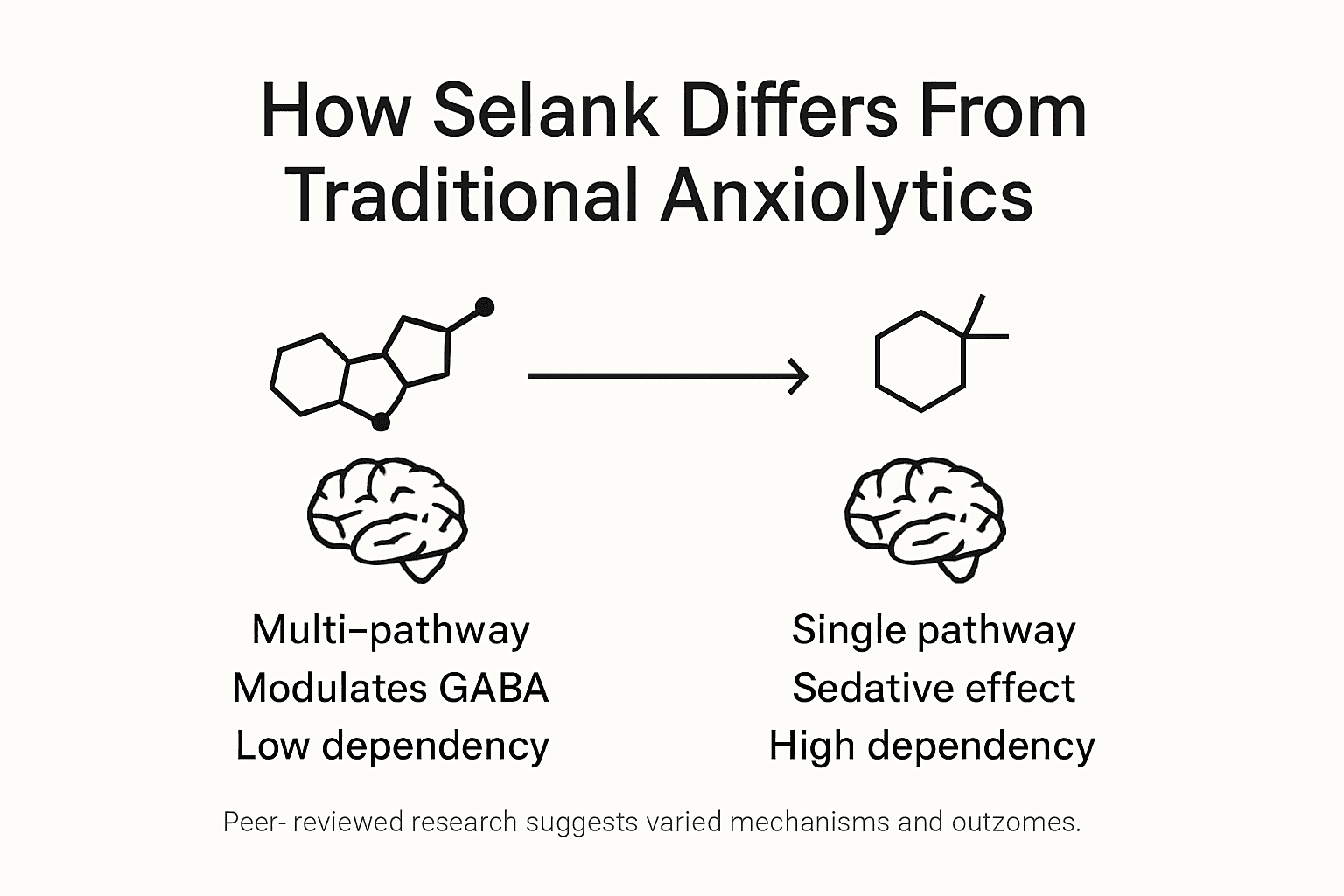
Traditional anxiolytics like benzodiazepines are characterized by significant drawbacks that limit their long-term therapeutic potential. These compounds often produce sedative effects, create substantial dependency risks, and compromise cognitive function. In stark contrast, Selank demonstrates a remarkable ability to provide anxiety relief without these problematic side effects. By simultaneously engaging serotonin, dopamine, and GABAergic pathways, Selank offers a more balanced neurochemical response that preserves mental clarity and reduces the likelihood of addiction.
The scientific community has increasingly recognized the limitations of conventional pharmaceutical interventions, and Selank represents a promising alternative in this evolving landscape. Its multi-mechanism approach allows for targeted anxiety reduction without the neurological compromise associated with traditional medications. The compound’s ability to modulate neurotransmitter systems indirectly suggests a more sophisticated understanding of anxiety’s complex neurochemical underpinnings, potentially opening new avenues for research and therapeutic intervention.
Here’s how Selank compares to traditional anxiolytics in research relevance:
| Criteria | Selank | Traditional Anxiolytics |
|---|---|---|
| Mechanism of Action | Multi-pathway modulation | Direct GABA receptor targeting |
| Cognitive Impact | Preserves mental clarity | Frequently impairs cognition |
| Dependency Risk | Minimal with proper use | High, especially long-term |
| Common Side Effects | Low, typically non-sedating | Sedation, cognitive dulling |
Pro tip: When exploring advanced neurochemical research, maintain a critical perspective and seek comprehensive, peer-reviewed sources that provide detailed molecular insights.
Lab Modeling: Experimental Variables and Standards
Experimental Design represents the critical foundation of rigorous scientific investigation, particularly when exploring complex neurochemical compounds like Selank. Precision in laboratory modeling demands meticulous attention to variables that could potentially influence research outcomes. Researchers must establish robust experimental protocols that control for environmental factors, sample preparation techniques, and measurement methodologies to ensure reproducible and meaningful results.
The intricate nature of peptide research requires a multilayered approach to standardization. Key experimental variables include temperature control, sample storage conditions, preparation techniques, and the specific analytical instruments used for molecular characterization. Researchers must carefully document every procedural detail, from peptide synthesis parameters to storage conditions, to create a transparent and replicable experimental framework. Consistent methodology becomes paramount when investigating nuanced neurochemical interactions that can be disrupted by even minor procedural variations.
Advanced laboratory modeling of Selank demands sophisticated analytical techniques that provide comprehensive molecular insights. Researchers typically employ multiple complementary methods such as high-performance liquid chromatography (HPLC), mass spectrometry, and nuclear magnetic resonance (NMR) spectroscopy to validate peptide purity, molecular structure, and potential interactions. Rigorous analytical protocols ensure that each research batch maintains the highest standards of scientific integrity, allowing for meaningful comparative studies and deeper understanding of the compound’s complex neurochemical mechanisms.
Key experimental variables crucial for valid Selank research are summarized below:
| Variable | Why It Matters | Example Control Technique |
|---|---|---|
| Temperature Stability | Avoids peptide degradation | Use calibrated lab incubators |
| Sample Preparation | Ensures reproducible dosing | Employ standardized protocols |
| Analytical Method | Confirms molecular identity | Apply HPLC or mass spectrometry |
| Storage Conditions | Maintains compound integrity | Store at specified temperature |
Pro tip: Maintain meticulous laboratory documentation and develop standardized protocols that can be precisely replicated across multiple research environments.
Legal Status and Safety in U.S. Research
Research Compliance represents a complex landscape for advanced peptide investigations in the United States, particularly for compounds like Selank that occupy a nuanced regulatory space. The legal framework surrounding research peptides demands rigorous adherence to federal guidelines and institutional protocols. Researchers must navigate a sophisticated ecosystem of regulatory requirements that prioritize scientific integrity, ethical standards, and comprehensive safety protocols.
The regulatory environment for peptide research involves multiple federal agencies, including the Food and Drug Administration (FDA), the Drug Enforcement Administration (DEA), and institutional review boards. Each research institution maintains specific guidelines for handling advanced molecular compounds, requiring comprehensive documentation, controlled storage conditions, and strict tracking mechanisms. Laboratory research standards mandate detailed protocols that ensure the highest levels of scientific transparency and ethical conduct, with particular emphasis on preventing unauthorized use or distribution.
Unique challenges emerge when investigating novel peptide compounds like Selank, which exist in a regulatory gray zone. U.S. research institutions must balance scientific curiosity with stringent compliance requirements, ensuring that all investigational work remains strictly within approved research parameters. This involves creating robust documentation systems, maintaining secure storage protocols, and implementing comprehensive tracking mechanisms that demonstrate responsible scientific exploration. Researchers must consistently demonstrate that their work serves legitimate scientific purposes and adheres to the most exacting professional standards.
Pro tip: Always consult institutional review boards and maintain meticulous documentation to ensure full compliance with federal research regulations.
Pitfalls in Selank Research and What to Avoid
Experimental Variability represents one of the most significant challenges in comprehensive Selank research, demanding meticulous attention to methodological precision. Navigating the complex landscape of nootropic investigation requires researchers to recognize and systematically control multiple potential confounding factors that could compromise study outcomes. Critical variables such as animal strain differences, stress conditions, dosage parameters, and specific administration routes can dramatically influence research results and create misleading interpretations.
Researchers must develop sophisticated strategies to mitigate inherent experimental inconsistencies. Potential pitfalls include inconsistent neurotransmitter level measurements, variability in cognitive domain assessments, and challenges in standardizing stress response evaluations. Advanced experimental design demands comprehensive protocols that account for genetic variability, environmental influences, and precise measurement techniques. Replication becomes paramount, with researchers required to develop robust methodological frameworks that can consistently validate initial findings across diverse experimental conditions.
The complexity of Selank’s neurochemical interactions necessitates a multifaceted approach to research validation. Researchers must remain vigilant against oversimplification, recognizing that the peptide’s interactions with neurotransmitter systems involve intricate, nuanced mechanisms that cannot be reduced to simplistic linear models. Comprehensive research requires integrating multiple analytical techniques, maintaining rigorous documentation, and developing sophisticated computational models that can capture the compound’s multidimensional neurological effects. Transparency, methodological precision, and a commitment to scientific skepticism become essential in advancing understanding of Selank’s potential therapeutic applications.
Pro tip: Develop comprehensive research protocols that include multiple independent verification steps and maintain meticulous documentation of all experimental variables.
Unlock New Frontiers in Anxiolytic Research with Area 15 Labs
The article dives deep into Selank’s complex neurochemical dance that calms anxiety without dulling cognitive function or risking dependency. If you are grappling with the challenge of finding high-purity compounds that match Selank’s sophisticated multi-pathway modulation, you know the pain points: inconsistent quality, slow overseas shipping, and sterile branding that feels disconnected from real research excitement. Selank’s unique ability to influence serotonin, dopamine, and GABA pathways demands research materials that deliver uncompromised integrity and fast access to accelerate your breakthroughs.
Area 15 Labs is the “No-BS” choice from Texas for cutting-edge peptides like Selank and beyond. We guarantee lightning-fast same-day shipping right from the heart of Texas, so you don’t wait weeks for your vital research tools. Our rigorously third-party verified high-purity compounds arrive in futuristic packaging that speaks your language. Say goodbye to boring suppliers. Whether you are modeling advanced neurochemical signals or exploring novel anxiolytic mechanisms, we offer unparalleled speed, transparency, and swag.
Ready to upgrade your Selank research with reliable purity and rapid delivery? Discover the difference of research with swagger at Area 15 Labs. Dive into the future of peptide research with confidence and speed by checking out our premium selection at https://area15labs.com and explore our lab-tested peptide inventory. Stop waiting and start researching smarter today.
Frequently Asked Questions
What is Selank and how does it function as an anxiolytic?
Selank is a synthetic heptapeptide developed from tuftsin, designed to modulate neurotransmitters like serotonin, dopamine, and norepinephrine, effectively reducing anxiety without sedation or dependency risks.
How does Selank compare to traditional anxiolytics like benzodiazepines?
Unlike traditional anxiolytics, which directly target GABA-A receptors, Selank employs a multi-pathway approach, preserving cognitive function and demonstrating minimal dependency risks while providing anxiety relief.
What are the potential benefits of using Selank for anxiety management?
Selank may reduce anxiety signals, elevate brain-derived neurotrophic factor (BDNF) for improved neuroplasticity, and decrease pro-inflammatory cytokines, contributing to overall neurological resilience without significant side effects.
What experimental variables should researchers consider when studying Selank?
Researchers should control for temperature stability, sample preparation methods, analytical techniques, and storage conditions to ensure reproducibility and validity of Selank research outcomes.