

Regulatory changes can spark anxiety among American citizen scientists and peptide researchers who rely on fast shipping and pure, well-sourced compounds. With over 700 new bills introduced to Congress every session, most never become law, yet online forums often magnify confusion and fear. Understanding what the SAFE Drugs Act really means helps American labs separate fact from rumor. This guide brings clarity on regulatory definitions and offers real-world advice to safeguard your research workflow.
Table of Contents
- SAFE Drugs Act: What It Really Means
- How Research Peptides Differ From Drugs
- Decoding Legislative Panic and Online Hype
- Legislative Process: Why Panic Is Premature
- Key Tips For Citizen Scientists And Labs
Key Takeaways
| Point | Details |
|---|---|
| ** SAFE Drugs Act of 2025** | The proposed legislation aims to enhance FDA oversight on compounded medications to protect patient safety and ensure greater transparency in the pharmaceutical supply chain. |
| Research Peptides vs. Pharmaceuticals | Research peptides serve as investigational tools in scientific studies and are not subject to the same regulatory requirements as traditional drugs, which are designed for therapeutic use. |
| Legislative Process Awareness | Understanding the legislative process is crucial; most bills, including the SAFE Drugs Act, have a low chance of becoming law and require careful monitoring for developments. |
| Best Practices for Citizen Scientists | Researchers should maintain rigorous documentation, stay informed about regulatory changes, and utilize high-purity materials to uphold research integrity. |
SAFE Drugs Act: What It Really Means
The SAFE Drugs Act of 2025 is emerging as a potential game-changer in pharmaceutical regulation, targeting the murky world of compounded medications. Introduced by Congressmen Rudy Yakym and Andre Carson, this proposed legislation aims to tighten FDA oversight and protect patients from potentially dangerous mass-produced medications.
At its core, the bill represents a critical response to growing concerns about unregulated drug compounding. The Partnership for Safe Medicines supports the legislation, emphasizing its potential to prevent illegal mass compounding of unapproved drug versions and restore transparency to the prescription drug supply chain. The proposed act would require more rigorous inspections of compounding facilities, potentially reducing risks associated with unverified pharmaceutical production.
Key features of the proposed legislation include:
- Enhanced FDA inspection protocols
- Stricter requirements for compounding facilities
- Increased transparency in pharmaceutical production
- Mandatory reporting of compounding activities
While the bill has garnered initial support, its journey through the legislative process remains uncertain. Historically, only 5-7 percent of introduced bills become law, and this act currently lacks the urgent momentum typically required for rapid passage. Researchers and pharmaceutical professionals should closely monitor its progress without succumbing to premature panic.
Pro Tip – Stay Informed: Subscribe to official government legislative tracking services and follow reputable pharmaceutical policy newsletters to get real-time updates on the SAFE Drugs Act’s development and potential implications for the research community.
How Research Peptides Differ From Drugs
Research peptides are fundamentally different from traditional pharmaceuticals, representing a unique class of molecular tools used exclusively in scientific investigation. Peptides are short chains of amino acids, typically containing fewer than 50 amino acids, which distinguishes them from more complex protein structures and regulated drug compounds. Unlike prescription medications, these specialized molecules serve critical roles in understanding biological mechanisms without being designed for direct therapeutic application.

The key distinctions between research peptides and pharmaceutical drugs are profound and multifaceted. Where traditional drugs are formulated to treat specific medical conditions and undergo extensive clinical trials, peptides in the research context are investigative tools designed to explore cellular processes, molecular interactions, and fundamental biological pathways. Researchers use these compounds to map intricate biochemical networks, understand genetic expressions, and develop foundational scientific knowledge.
Key differences include:
- Regulatory Status: Research peptides are not approved for human use
- Purpose: Investigative tools vs. therapeutic treatments
- Oversight: Minimal FDA intervention compared to pharmaceutical drugs
- Production Standards: Laboratory-grade purity vs. medical-grade manufacturing
The legal landscape surrounding research peptides is dramatically different from pharmaceutical regulations. Research peptides operate in a specialized scientific domain, where they are treated as experimental compounds intended solely for in-vitro laboratory studies. This critical distinction means they are not subject to the same stringent approval processes as medications designed for human consumption.
Pro Tip – Research Protocol: Always document your research peptide acquisition, storage, and experimental conditions with meticulous scientific precision to maintain the integrity of your scientific investigation.
To better understand the unique qualities of research peptides versus traditional drugs, see the comparison below:
| Aspect | Research Peptides | Pharmaceutical Drugs |
|---|---|---|
| Intended Use | Laboratory investigation only | Treat or manage medical conditions |
| Regulatory Oversight | Minimal, mostly documentation | Extensive FDA approval required |
| Purity Standard | Laboratory grade | Medical grade, tightly controlled |
| Legal Status | Not for human use | Prescribed for humans, regulated |
| Manufacturing Environment | Research laboratories | Licensed pharmaceutical facilities |
Decoding Legislative Panic and Online Hype
The recent buzz around the SAFE Drugs Act has generated a tsunami of online speculation and panic within research communities, most of which dramatically misinterprets the bill’s actual scope and intent. The Partnership for Safe Medicines emphasizes that the legislation primarily targets compounded pharmaceutical drugs, not the specialized world of research peptides that has many online forums in an uproar.
Representatives Yakym and Carson introduced the bill with a clear focus on protecting patients from potentially dangerous mass-produced medications, not dismantling legitimate scientific research infrastructure. The legislative language specifically addresses concerns about unregulated pharmaceutical compounding, which is fundamentally different from controlled laboratory peptide research.
Key misconceptions fueling online panic include:
- Assuming all regulatory changes impact research peptides
- Conflating medical drugs with research compounds
- Overestimating the bill’s potential immediate impact
- Misunderstanding the distinct regulatory categories
The digital rumor mill tends to amplify fears without providing context. Statistically, fewer than 7 percent of introduced bills become law, and this particular legislation shows no signs of targeting the research peptide ecosystem. Researchers should remain calm, continue their work, and rely on official sources rather than speculative online discussions.
Pro Tip – Information Hygiene: Always cross-reference legislative information with official government sources and avoid making strategic decisions based on social media speculation.
Legislative Process: Why Panic Is Premature
Understanding the complex journey of proposed legislation reveals why premature panic about the SAFE Drugs Act is fundamentally misguided. The bill is currently under consideration by the House Energy & Commerce Committee, representing just the initial stage of a lengthy and unpredictable legislative process where most proposed bills never become law.
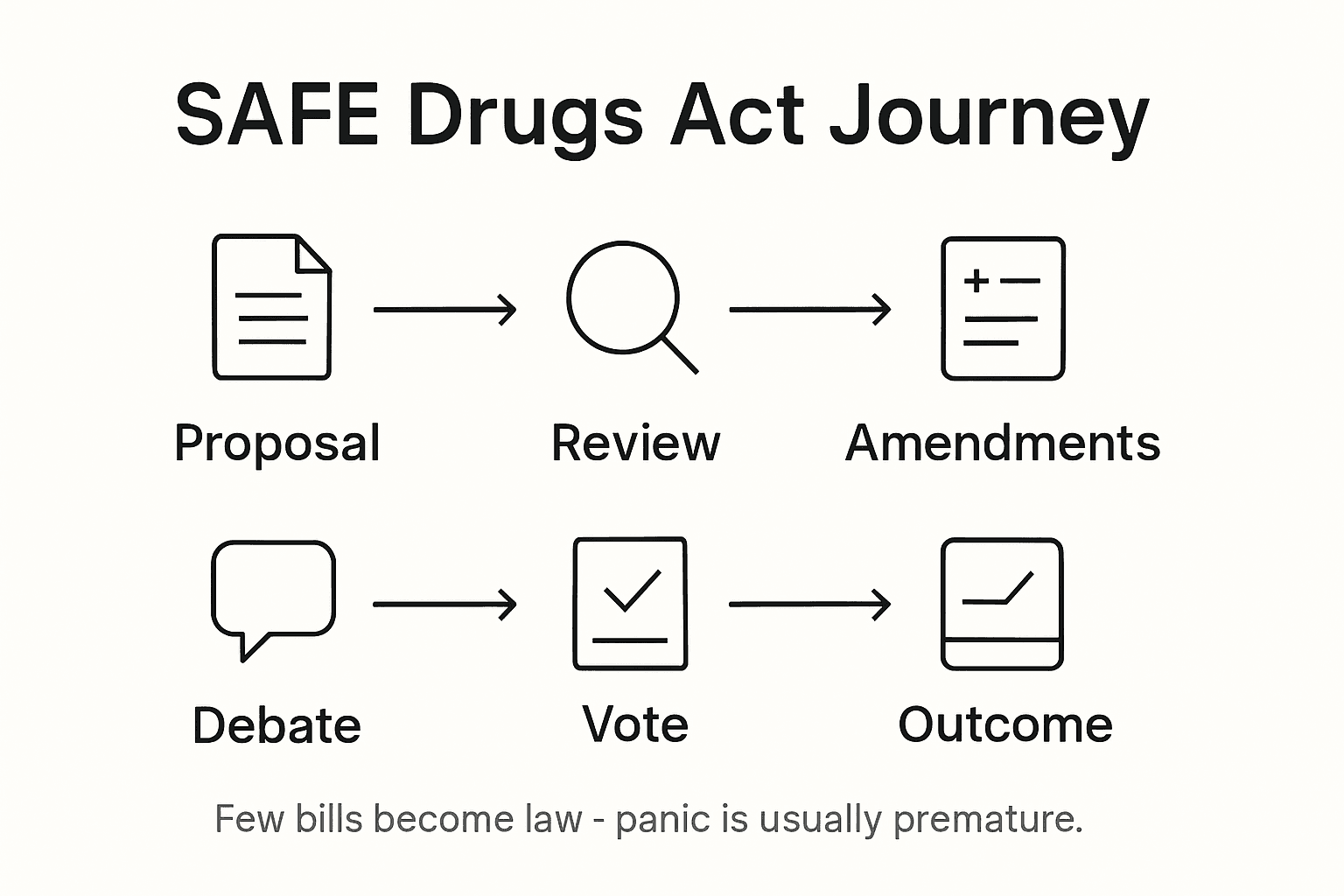
Representatives Yakym and Carson’s introduction of the bill marks merely the beginning of a multi-step journey that involves extensive review, potential amendments, committee hearings, and multiple voting stages. Historically, less than 7 percent of introduced bills successfully navigate this complex pathway to become actual legislation, making immediate alarm both premature and statistically unwarranted.
Critical stages in the legislative process include:
- Bill introduction
- Committee review and potential modifications
- Subcommittee hearings
- Full chamber vote
- Potential conference committee reconciliation
- Presidential signature
The legislative landscape is characterized by deliberate complexity, designed to prevent hasty or poorly considered regulatory changes. Each stage provides multiple opportunities for scrutiny, modification, and potential rejection. Researchers and stakeholders should view this bill as a preliminary proposal subject to extensive potential transformation, not an imminent threat to their work.
Pro Tip – Legislative Tracking: Subscribe to official government tracking services and follow reputable policy newsletters to receive objective, real-time updates about the bill’s progression without succumbing to online speculation.
Key Tips for Citizen Scientists and Labs
Navigating the complex landscape of research peptides requires strategic insight and methodical approach. Understanding the structural nuances between peptides and proteins is crucial for maintaining research integrity and avoiding potential regulatory pitfalls in an increasingly scrutinized scientific environment.
The modern citizen scientist must adopt a proactive stance toward research protocols, particularly in light of potential legislative changes. Exploring the key benefits of peptide research demands a comprehensive approach that prioritizes documentation, transparency, and rigorous scientific methodology.
Key strategic recommendations include:
- Maintain meticulous research documentation
- Stay informed about legislative developments
- Prioritize high-purity research materials
- Establish robust quality assurance protocols
- Network with professional research communities
- Continuously update scientific knowledge
The evolving regulatory landscape requires researchers to be adaptive and well-informed. Successful scientific investigation depends not just on technical skill, but on understanding the broader context of research ethics, legal frameworks, and institutional guidelines. Citizen scientists must view themselves as responsible stewards of scientific knowledge, committed to maintaining the highest standards of research integrity.
Pro Tip – Research Resilience: Develop a comprehensive tracking system for all research materials, including source documentation, purity certificates, and detailed experimental logs to ensure transparency and scientific credibility.
Here’s an overview of critical research practices for citizen scientists and labs:
| Best Practice | Description | Benefit |
|---|---|---|
| Documentation | Record all material sourcing and experiments | Ensures traceability and compliance |
| Material Purity | Use verified, high-purity compounds | Improves data reliability |
| Legislative Tracking | Monitor regulatory updates regularly | Prevents unintentional violations |
| Community Networking | Engage with professional networks | Access guidance and shared resources |
Navigate Research Challenges with the No-BS Texas Lab Partner
The SAFE Drugs Act of 2025 shines a spotlight on the need for clarity and trust in research materials. If you are a Citizen Scientist worried about legislative confusion or compromised peptide quality, you deserve a supply chain that delivers speed and verified purity straight from Texas. Area 15 Labs understands your need for lightning-fast shipping and transparent sourcing so you can focus on real lab work without the panicked hype.
Why settle for uncertainty when you can get:
- High-purity compounds rigorously tested to industry-leading standards
- Same-day fulfillment that beats slow overseas competitors
- Real American customer support that speaks your language
Stop wasting time on questionable vendors and join the ranks of researchers who choose the “No-BS” option. Dive into our cutting-edge peptides and next-gen stacks designed for modern research with swagger at Area 15 Labs. Stay ahead of regulatory noise and fuel your discoveries with confidence.
Explore the future of research now at Area 15 Labs and see why we are the trusted choice for Citizen Scientists across the US. Your lab deserves it.
Frequently Asked Questions
What is the SAFE Drugs Act of 2025?
The SAFE Drugs Act of 2025 is a proposed legislation aimed at enhancing FDA oversight of compounded medications to protect patients from dangerous mass-produced drugs. It focuses on increasing inspection protocols and transparency in pharmaceutical production.
How do research peptides differ from pharmaceutical drugs?
Research peptides are short chains of amino acids used strictly for scientific investigation rather than therapeutic purposes, whereas pharmaceutical drugs are formulated to treat specific medical conditions and undergo extensive approval processes.
Is the SAFE Drugs Act related to research peptides?
No, the SAFE Drugs Act primarily targets compounded pharmaceutical drugs, not research peptides. The bill seeks to enhance regulations for mass-produced medications rather than impacting the research peptide ecosystem.
Why is there concern about the SAFE Drugs Act causing panic in the research community?
There is concern because online speculation has led to misunderstandings about the bill’s impact. Many are conflating the regulatory changes for compounded drugs with potential implications for research peptides, which are not addressed by the act.