
Most American researchers are surprised to learn that a small difference in peptide cost per milligram can alter research outcomes in big ways. The real catch is not just the price tag but what it tells you about purity and scientific reliability. With up to 80 percent of lab errors traced back to poor materials, understanding this measurement becomes crucial. This article uncovers how cost per milligram shapes the integrity of every American scientific study and helps you see beyond surface-level savings.
Table of Contents
- What Does ‘Cost Per Milligram’ Really Mean?
- How Low Prices Hide Low Purity Risks
- Why ‘Cheap Peptides’ Rarely Add Up
- Common Quality Traps And Hidden Costs
- Smart Strategies For Research Buyers
Key Takeaways
| Point | Details |
|---|---|
| Purity Is Critical | Higher purity in peptides significantly enhances research quality and reduces contamination risks. |
| Consider Total Costs | Focus on potential long-term expenses rather than just initial purchase price to safeguard research integrity. |
| Request Certificates | Always obtain a comprehensive Certificate of Analysis to verify purity and manufacturing details before buying. |
| Evaluate Suppliers | Select suppliers based on quality and transparency, not just price, to ensure reliable research outcomes. |
What Does ‘Cost Per Milligram’ Really Mean?
The “cost per milligram” isn’t just a boring pricing metric—it’s the secret weapon smart researchers use to decode peptide quality. Think of it like buying coffee: anyone can sell you beans, but the real question is whether you’re getting specialty grade or gas station sludge. In the world of research peptides, cost per milligram reveals the hidden story behind those sleek little vials.
Understanding this metric requires breaking down multiple factors. Peptide pricing analysis from ProImmune demonstrates how complexity dramatically impacts cost. Purity levels, manufacturing scale, and amino acid composition aren’t just technical details—they’re the DNA of peptide pricing. A high-purity peptide at a 10-14 mg scale might cost $42.00 per amino acid, while a lower-grade compound could be significantly cheaper. But cheaper isn’t always better.
Here’s what separates the pros from the amateurs when evaluating cost per milligram:
- Purity Matters: Higher purity means fewer contaminants
- Scale Impacts Price: Larger production runs reduce per-milligram costs
- Amino Acid Complexity: More intricate peptide structures increase manufacturing expense
The real rookie mistake? Choosing the lowest price tag without understanding what you’re actually purchasing. A few dollars saved could mean compromised research integrity. Professional researchers know that precision has a price—and that price is reflected in the cost per milligram.
For a quick overview, here’s how key peptide pricing factors influence research outcomes:
| Pricing Factor | Influence on Cost | Impact on Research Quality |
|---|---|---|
| Purity Level | Higher purity costs more | Reduces experimental contamination |
| Production Scale | Higher scale lowers cost | Improves batch consistency |
| Amino Acid Complexity | Increases manufacturing expense | Enhances result specificity |
Pro Research Hack: Always request a complete Certificate of Analysis (COA) before purchasing. This document reveals the true quality behind the price tag, showing purity percentages, manufacturing details, and potential trace contaminants that could derail your entire research project.
How Low Prices Hide Low Purity Risks
Cheap peptides are like bargain sushi—they might look tempting, but the risks can be devastating. When it comes to research materials, a few dollars saved could torpedo your entire project. Offshore supplier guides consistently warn that low prices often mask significant quality compromises that can derail even the most meticulously planned research.
The hidden dangers of budget peptides extend far beyond initial cost savings. Manufacturers operating on razor-thin margins frequently cut corners in critical areas like chemical synthesis, purification, and quality control. Detailed manufacturer research reveals that seemingly attractive pricing frequently includes hidden costs like:
- Potential import complications
- Increased likelihood of batch failures
- Additional retesting expenses
- Compromised molecular integrity
Researchers who prioritize price over quality are essentially gambling with their scientific integrity. Molecular precision isn’t negotiable—trace contaminants can completely invalidate research outcomes, turning what seemed like a smart financial decision into a costly mistake. Professional laboratories understand that the true expense isn’t the initial purchase price, but the potential research disruption caused by substandard materials.
Pro Research Shield: Always request a comprehensive Certificate of Analysis before purchasing, comparing not just price but detailed purity metrics, molecular composition, and independent verification data to protect your research investment.
Why ‘Cheap Peptides’ Rarely Add Up
The illusion of savings in peptide research is like a financial mirage—what appears cost-effective at first glance often evaporates under closer scrutiny. Comprehensive peptide guides consistently demonstrate that higher-priced peptides aren’t just expensive; they represent a robust investment in research reliability. The price tag isn’t arbitrary—it reflects critical quality control processes that budget alternatives simply cannot match.
Breaking down the true cost reveals a complex landscape of hidden expenses. Cheap peptides frequently come with substantial unseen risks:
- Compromised molecular purity levels
- Increased probability of batch inconsistencies
- Additional verification and retesting requirements
- Potential research invalidation
Manufacturer research extensively documents how offshore suppliers cutting corners can transform initial savings into significant long-term expenses. Professional researchers understand that molecular precision isn’t a luxury—it’s a fundamental requirement. A few percentage points of impurity can transform a promising research trajectory into a costly dead end, making the cheapest option exponentially more expensive when research outcomes are considered.

The scientific community knows that research integrity cannot be discounted. What appears to save money upfront often creates exponential downstream costs through unreliable data, repeated experiments, and potential publication challenges. Quality isn’t an accessory—it’s the foundation of credible scientific exploration.
Pro Research Strategy: Always calculate the total potential research cost, not just the initial purchase price. Factor in potential do-overs, verification expenses, and the academic opportunity cost of compromised data when evaluating peptide suppliers.
Common Quality Traps and Hidden Costs
Research peptide procurement is a minefield where budget-conscious choices can detonate expensive consequences. Offshore supplier investigations reveal that seemingly attractive pricing often conceals a complex landscape of potential quality disasters waiting to ambush unsuspecting researchers.
The most critical quality traps emerge through several key mechanisms:
- Contamination Risk: Manufacturers cutting corners frequently compromise molecular purity
- Batch Inconsistency: Lower-tier suppliers struggle with reproducible synthesis processes
- Documentation Gaps: Incomplete or missing certificates of analysis
- Shipping Integrity: Potential degradation during transit from unregulated manufacturers
Comprehensive manufacturer research consistently demonstrates that hidden costs extend far beyond the initial price tag. What appears to be a smart financial decision can quickly transform into a research nightmare. Import duties, mandatory retesting, potential batch failures, and the potential invalidation of entire research protocols create a financial sinkhole that swallows any initial savings.
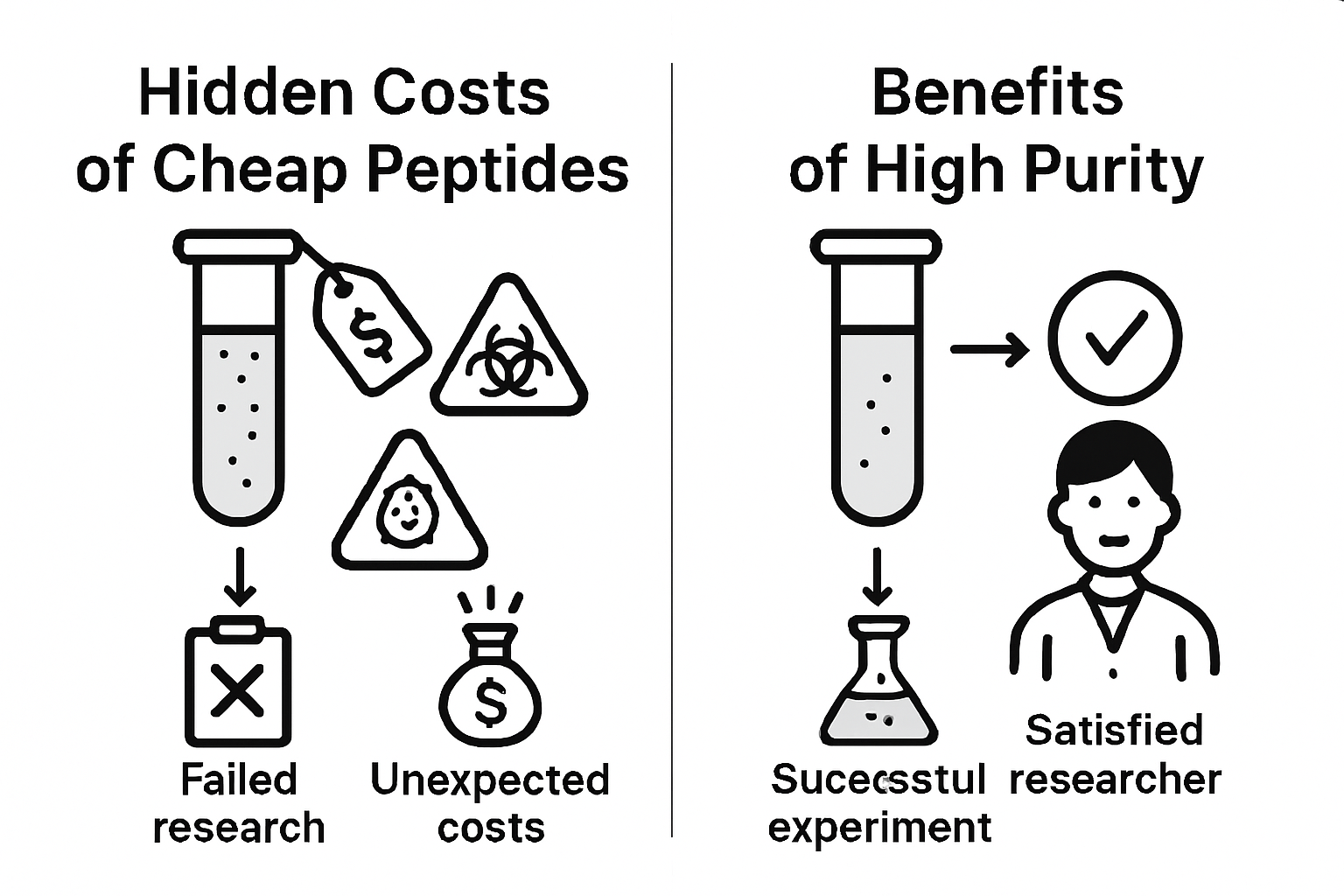
The most sophisticated researchers understand that quality is not negotiable. Each percentage point of molecular impurity represents a potential cascade of research complications—delayed timelines, repeated experiments, and potentially compromised academic credibility. Budget peptides are essentially scientific russian roulette, where the stakes are your research integrity.
Here’s a summary of hidden risks and costs associated with budget peptide suppliers:
| Hidden Risk | Example Consequence | Long-Term Cost Impact |
|---|---|---|
| Import Complications | Delayed shipments due to customs issues | Project timelines extended |
| Poor Batch Consistency | Need for repeated synthesis or retesting | Increases research expenses |
| Incomplete Documentation | Missing COA or purity data | Results may be invalidated |
Pro Research Shield: Always demand a comprehensive Certificate of Analysis that includes detailed purity metrics, molecular composition verification, and independent testing documentation before committing to any peptide purchase.
Smart Strategies for Research Buyers
Navigating the peptide research marketplace requires more tactical intelligence than a military operation. Comprehensive supplier investigations demonstrate that successful researchers don’t just buy—they strategically select suppliers with the precision of a special forces team conducting a mission-critical procurement.
The ultimate research buyer’s playbook includes these non-negotiable strategies:
- Demand Transparency: Request full Certificates of Analysis
- Validate Reputation: Research supplier track records extensively
- Compare Molecular Specifications: Don’t just compare prices
- Understand Lead Times: Factor in production and shipping complexities
- Check Independent Verification: Seek third-party testing documentation
Manufacturer research consistently reveals that smart buyers prioritize long-term research reliability over short-term cost savings. The most sophisticated researchers treat peptide procurement like a strategic investment—each decision impacts potential research outcomes. Cheap isn’t just ineffective; it’s potentially destructive to entire research trajectories.
The most advanced research buyers understand that supplier selection is a critical scientific skill. They look beyond surface-level pricing and dive deep into molecular consistency, manufacturing processes, and comprehensive documentation. A truly intelligent procurement strategy treats each peptide acquisition as a precision instrument, not a commodity.
Pro Research Ninja: Create a standardized supplier evaluation matrix that scores potential vendors across multiple dimensions—purity metrics, documentation quality, shipping reliability, and customer support responsiveness.
Choose Speed and Purity Over Cheap Peptide Scams
The article breaks down the hidden risks behind choosing peptides based solely on low cost. You learned that “cost per milligram” is not just about price but purity, batch consistency, and documented quality. Cutting corners on these critical factors means risking research havoc with contamination, inconsistent results, and costly delays. If you are tired of sketchy overseas suppliers who hide their shortcuts behind cheap price tags, it is time to rethink your research supply chain.
Area 15 Labs offers a bold Texan alternative that fights back against the quality traps outlined in the article. We ship fast from Texas with same-day fulfillment so you get your high-purity peptides without waiting weeks or navigating import headaches. Every batch undergoes rigorous third-party verification and comes with a complete Certificate of Analysis giving you full transparency and confidence. Our “No-BS” promise means zero hassle, real US support, and research-grade consistency for Citizen Scientists who demand reliability and swagger.
Ready to escape the “cost per milligram” scam and actually invest in research integrity? Explore our selection of verified peptides and lab essentials at Area 15 Labs. Discover how we bring speed, honesty, and pure quality to your research with our Alien Tech & Next-Gen Stacks and No-BS Knowledge Hub. Get the trusted, fast, Texas-shipped peptides your experiments deserve today.
Frequently Asked Questions
What does ‘cost per milligram’ mean in peptide research?
Cost per milligram refers to the pricing metric that helps researchers assess the quality of peptides. It factors in elements like purity levels, manufacturing scale, and amino acid complexity, ultimately influencing research integrity and outcomes.
Why is purity important when considering peptide prices?
Purity is crucial because higher purity levels mean fewer contaminants, which leads to more reliable research results. Lower purity can compromise experimental integrity and result in invalid data.
How can choosing low-priced peptides backfire?
Choosing low-priced peptides can lead to issues such as contamination risks, batch inconsistencies, and incomplete documentation. These can cause increased long-term costs and potentially invalidate research outcomes.
What should researchers look for in a Certificate of Analysis (COA)?
Researchers should ensure the COA includes detailed purity metrics, molecular composition verification, and independent testing documentation. This information confirms the quality and reliability of the peptides before purchase.

[…] Cost Per Milligram Scam—Why Cheap Peptides Backfire […]