

Searching for high-purity peptides with rapid delivery is now more than just a convenience for Texas researchers—it is an expectation shaped by modern breakthroughs in computational modeling and AI-driven design. As laboratories across Texas adopt advanced technologies and demand transparency in sourcing, the race to achieve precision in molecular engineering becomes the new standard. This overview uncovers how cutting-edge peptide research in 2025 is empowering citizen scientists to innovate faster, with stylish American branding meeting the needs of a bold research community.
Table of Contents
- Defining Peptide Research In 2025
- Emerging Peptide Types And Blends
- Tech And Transparency: The Quality Revolution
- Legal Landscape And Compliance Shifts
- Community Influence And Market Disruption
Key Takeaways
| Point | Details |
|---|---|
| AI Integration | The use of AI in peptide research enhances molecular design capabilities, expediting discovery processes and reducing research timelines. |
| Innovation in Peptide Engineering | Advanced techniques, such as programmable peptides and macrocyclic frameworks, are creating new therapeutic options and improved specificity in treatments. |
| Quality and Transparency Standards | The introduction of digital tracking and certification technologies ensures greater quality assurance and research integrity in peptide production. |
| Regulatory Compliance | Adhering to multifaceted regulatory requirements is essential for researchers to maintain compliance and safeguard their scientific investigations. |
Defining Peptide Research in 2025
The landscape of peptide research is undergoing a revolutionary transformation, driven by groundbreaking computational and technological advancements. As we enter 2025, researchers are witnessing an unprecedented convergence of chemical synthesis and computational modeling that is fundamentally reshaping our understanding of molecular design. Computational modeling techniques are now enabling scientists to propose sophisticated molecular structures with unprecedented precision.
Key developments in peptide research for 2025 include:
- AI-guided molecular design strategies
- Advanced macrocyclic framework development
- Programmable peptide molecule engineering
- Computational prediction of molecular interactions
- Enhanced synthesis techniques for complex peptide structures
The emergence of artificial intelligence has been particularly transformative. Researchers can now leverage machine learning algorithms to accelerate discovery processes, moving beyond traditional incremental analog synthesis towards direct molecular proposition based on sophisticated design principles. Emerging peptide research trends highlight how computational tools are dramatically reducing research timelines and expanding potential applications.
Understanding peptide molecular design requires recognizing the intricate interplay between chemical synthesis and computational modeling. Modern labs are integrating advanced software platforms that can predict molecular behaviors, simulate interaction potentials, and generate novel peptide configurations with remarkable accuracy. These technological leaps are not just improving research efficiency but are fundamentally reimagining what’s possible in molecular engineering.
Pro tip: Invest in continuous computational training for your research team to stay ahead of rapidly evolving peptide design technologies.
Here’s a summary highlighting business impacts of modern peptide research breakthroughs:
| Innovation | Research Efficiency Impact | Commercial Application Potential | Collaboration Benefit |
|---|---|---|---|
| AI molecular design | Accelerates discovery cycles | Enables rapid drug prototyping | Fosters interdisciplinary work |
| Macrocyclic frameworks | Expands molecular properties | Unlocks new classes of therapeutics | Promotes university-industry ties |
| Programmable peptides | Improves target specificity | Customizes treatment for complex issues | Enhances team specialization |
| Multi-peptide blends | Boosts experimental versatility | Increases compound market diversity | Encourages global research sharing |
Emerging Peptide Types and Blends
The peptide research landscape in 2025 is experiencing unprecedented innovation, with scientists developing increasingly sophisticated molecular combinations that address critical research challenges. Emerging peptide drug discoveries are now expanding potential applications across multiple therapeutic domains, pushing the boundaries of molecular engineering and biomedical research.
Key emerging peptide types and blends include:
- Dual-agonist metabolic peptides
- Multi-functional regenerative peptide complexes
- Advanced macrocyclic peptide frameworks
- Computationally designed hybrid molecules
- High-stability engineered peptide structures
Researchers are particularly excited about blended peptide configurations that offer enhanced molecular stability and expanded functional potential. Peptide stacking research demonstrates how strategic molecular combinations can amplify research capabilities, creating more versatile and potent experimental compounds.

The most promising developments involve sophisticated peptide engineering techniques that address traditional limitations in molecular design. By integrating computational modeling with advanced synthesis strategies, labs can now create peptide blends with unprecedented precision, targeting specific molecular interactions and expanding research possibilities across metabolic, oncological, and infectious disease domains.
Pro tip: Invest in computational modeling software that supports multi-peptide interaction simulations to maximize your research efficiency and explore novel molecular configurations.
Tech and Transparency: The Quality Revolution
The peptide research industry is experiencing a radical transformation, with innovative approaches to manufacturing and supply chain management redefining quality standards. US-based manufacturing platforms are now providing unprecedented visibility into peptide production processes, challenging the previous paradigm of opaque international sourcing.
Key transparency innovations in 2025 include:
- Real-time production tracking systems
- Comprehensive digital certification protocols
- End-to-end molecular traceability
- Blockchain-verified quality documentation
- Direct sequence-to-product documentation
The emerging quality assurance ecosystem represents a significant leap forward for research laboratories. Advanced technological platforms now enable researchers to access detailed molecular characterization data, ensuring that every peptide compound meets rigorous scientific standards. These developments are critical for maintaining research integrity and supporting reproducible scientific investigation.
Researchers are increasingly demanding complete visibility into peptide development processes. By integrating advanced verification technologies, laboratories can now validate molecular structures, purity levels, and manufacturing conditions with unprecedented precision. This transparency not only builds trust but also accelerates scientific discovery by providing researchers with comprehensive, verifiable data about their research materials.
Pro tip: Request comprehensive digital certificates with every peptide order to ensure maximum transparency and research reliability.
This comparison illustrates how advanced transparency tools enhance peptide research reliability:
| Technology | Transparency Gain | Trust Outcome | Regulatory Support |
|---|---|---|---|
| Digital certificates | Verifies purity and origin | Greater researcher trust | Eases documentation burden |
| Blockchain tracking | Immutable production records | Guarantees data integrity | Speeds compliance audits |
| Sequence-to-product docs | Links design to result | Enables reproducibility | Supports legal traceability |
Legal Landscape and Compliance Shifts
The peptide research community is navigating an increasingly complex regulatory environment that demands unprecedented attention to legal nuances and compliance protocols. Peptide regulatory frameworks have become significantly more sophisticated, requiring researchers to maintain rigorous documentation and adhere to intricate regional and international statutes.
Key compliance considerations in 2025 include:
- Multi-jurisdictional regulatory tracking
- Comprehensive documentation protocols
- Regional compound restriction monitoring
- Advanced legal risk assessment strategies
- Proactive compliance management systems
The regulatory complexity landscape represents a critical challenge for modern research laboratories. Navigating these intricate legal frameworks requires a strategic approach that combines meticulous record-keeping, continuous legal education, and sophisticated compliance infrastructure. Researchers must remain adaptable, understanding that regulatory requirements can vary dramatically across different geographic regions and research domains.
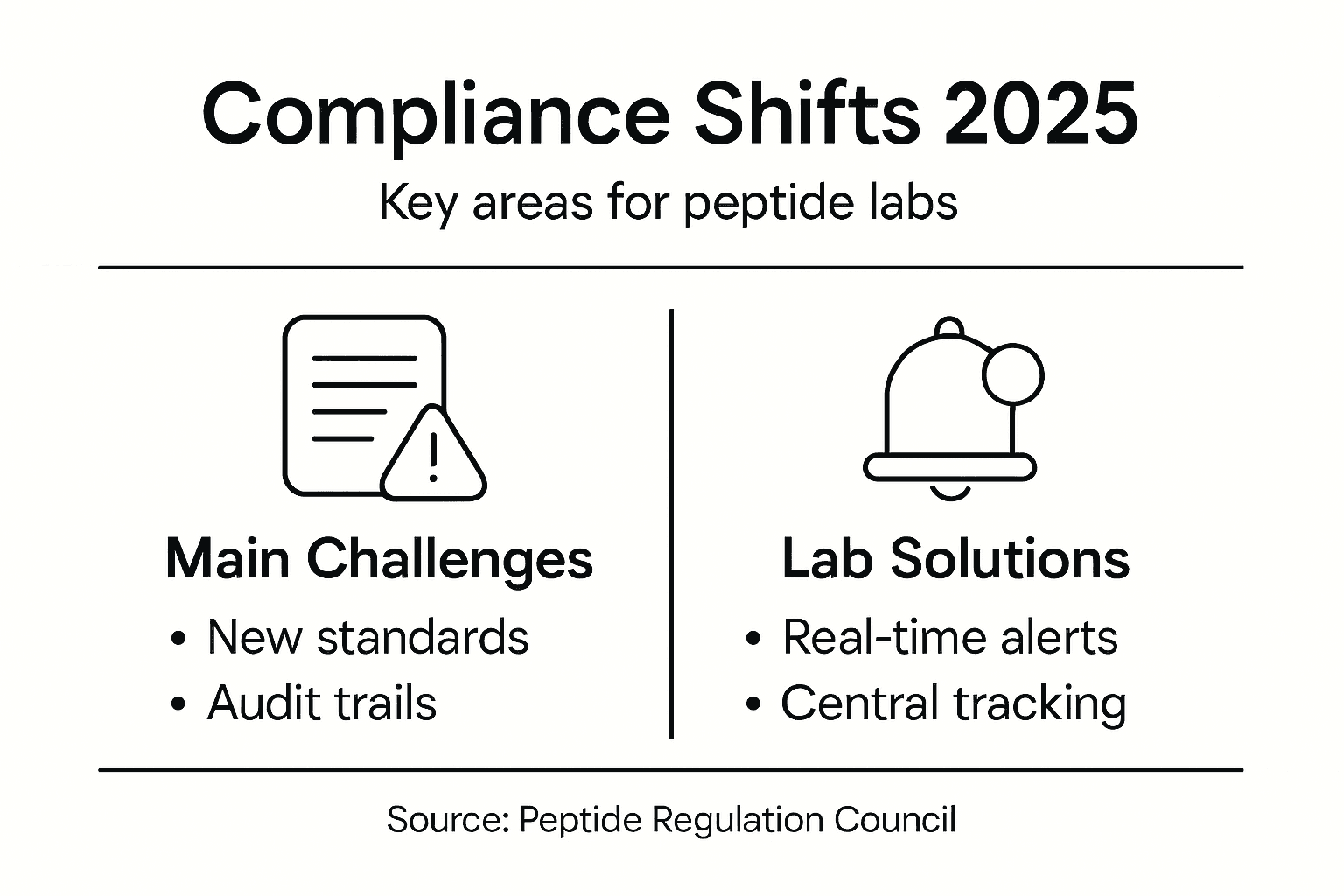
Understanding legal risk mitigation has become a fundamental skill for peptide researchers. By developing robust compliance strategies, laboratories can protect themselves from potential legal challenges while maintaining the integrity of their scientific investigations. This involves not just understanding current regulations, but also anticipating potential future shifts in the complex global regulatory environment.
Pro tip: Develop a dedicated compliance tracking system that provides real-time updates on regulatory changes across relevant jurisdictions.
Community Influence and Market Disruption
The peptide research landscape is undergoing a remarkable transformation driven by collaborative innovation and community-powered technological advancement. Peptide therapeutics market dynamics reveal an unprecedented shift towards community-driven research models that are dismantling traditional drug development paradigms.
Key market disruption indicators include:
- Accelerated cross-sector collaborative platforms
- Decentralized research funding models
- Increased biopharma investment in targeted therapies
- Community-driven data sharing initiatives
- Rapid translational research ecosystems
The collaborative research ecosystem represents a fundamental reimagining of scientific discovery. Researchers are no longer working in isolated laboratories but are instead participating in dynamic, interconnected networks that rapidly share insights, challenge existing methodologies, and accelerate technological breakthroughs. This shift is democratizing scientific innovation and creating more transparent, efficient research environments.
Understanding community-powered innovation has become critical for modern research institutions. By embracing open-source principles and fostering collaborative platforms, laboratories can tap into collective intelligence, share resources more effectively, and drive unprecedented acceleration in peptide research capabilities. The future of scientific discovery lies not in individual achievements, but in our collective ability to collaborate and challenge existing boundaries.
Pro tip: Actively participate in online research communities and collaborative platforms to exponentially expand your knowledge and research potential.
Elevate Your Peptide Research with Texas-Speed Transparency and Alien Tech
As peptide research surges into 2025 with AI-based design, advanced blends, and groundbreaking transparency, labs face challenges like lengthy overseas shipping, unreliable purity data, and opaque supply chains. If accelerating discovery while maintaining uncompromised quality and crystal-clear documentation sounds like your goal, you are exactly who we built Area 15 Labs for—your No-BS Texas command center for high-purity, research-grade compounds.
We ship same-day from Texas, slashing wait times that currently hold back your cutting-edge projects. Every batch passes third-party verification with our signature “Glass Box” transparency, putting digital certificates and blockchain traceability right at your fingertips. Whether you seek sophisticated peptide blends or next-gen agonists, we combine rigorous science with a rebel scientist swagger that makes research feel alive again.
Stay ahead of the peptide revolution and turn complex molecular engineering into your lab’s secret weapon. Explore our full lineup of verified compounds and see the difference that fast, honest, and visually stunning research supplies can make at Area 15 Labs. Dive deeper into the future of peptide innovation and transparency in our Knowledge Hub where science meets swagger. Don’t settle for slow, confusing, or sketchy—choose the “No-BS” Choice from Texas and power your research with speed and confidence today.
Frequently Asked Questions
What are the key advancements in peptide research expected in 2025?
Key advancements include AI-guided molecular design strategies, advanced macrocyclic framework development, programmable peptide engineering, computational prediction of molecular interactions, and enhanced synthesis techniques for complex structures.
How is artificial intelligence impacting peptide molecular design?
Artificial intelligence is accelerating the discovery process by enabling researchers to move beyond traditional synthesis methods, allowing for more direct molecular proposition based on sophisticated design principles, thereby reducing research timelines significantly.
What role does transparency play in the peptide research supply chain?
Transparency enhances research reliability by providing detailed molecular characterization data, ensuring that peptide compounds meet rigorous scientific standards and aiding in maintaining research integrity.
Why is it important for researchers to understand compliance in peptide research?
Compliance is vital as the regulatory environment for peptide research is complex and continuously evolving. Understanding these regulations helps researchers maintain rigorous documentation, mitigate legal risks, and ensure the integrity of their scientific work.

[…] Peptide Research Trends 2025: What’s Next for Labs […]