

Missteps in peptide research can turn a promising investigation into a frustrating setback. Peptides serve as crucial tools for understanding biological functions, acting as sophisticated messengers in hormone regulation, immune response, and cell signaling. For citizen scientists and new researchers seeking reliable results, mastering the basics means focusing on molecular purity, precise handling, and proper storage to prevent errors and ensure experiments reflect accurate biological insights.
Table of Contents
- What Are Research Peptides And Their Role
- Types Of Errors In Peptide Research
- Peptide Purity And Supplier Pitfalls
- Reconstitution, Calculation, And Storage Errors
- Contamination Risks And Lab Safety Measures
- Data Recording Errors And Research Integrity
Key Takeaways
| Point | Details |
|---|---|
| Research Peptides are Essential | They facilitate vital communication in biological systems through cellular interactions and signaling. |
| Precision is Crucial | Errors in peptide handling, storage, and measurement can significantly impact research integrity and results. |
| Supplier Transparency is Vital | Researchers should ensure suppliers provide thorough testing documentation and certificates of analysis to avoid impurities. |
| Robust Data Management is Necessary | Accurate data recording and digital documentation are imperative to maintain research integrity and reproducibility. |
What Are Research Peptides and Their Role
Research peptides are microscopic molecular powerhouses that serve as fundamental building blocks in scientific investigation. These short chains of amino acids play critical roles across multiple biological systems, functioning as sophisticated communication and regulatory molecules. Peptides represent intricate biological messengers that enable complex cellular interactions and signaling processes.
Peptides exhibit remarkable versatility in research applications, with key characteristics including:
- Precise molecular targeting capabilities
- High specificity for biological interactions
- Rapid cellular communication mechanisms
- Potential for advanced therapeutic investigations
- Minimal systemic interference compared to larger molecular structures
Their significance spans multiple research domains, acting as crucial tools for understanding biological mechanisms. Molecular signaling represents one primary function, where peptides transmit critical information between cells and biological systems. Some prominent peptide research categories include neurotransmitter regulation, immune system modulation, and complex cellular communication pathways.
Researchers utilize peptides across diverse scientific disciplines, ranging from molecular biology to advanced pharmaceutical research. Their unique properties enable precise investigations into cellular processes, providing insights that larger molecular structures cannot achieve. By manipulating these compact amino acid sequences, scientists can explore intricate biological interactions with unprecedented granularity.
Pro tip: Always verify peptide purity and molecular integrity before commencing complex research protocols.
Types of Errors in Peptide Research
Peptide research demands meticulous precision, with even minor errors potentially derailing entire experimental protocols. Research peptide handling requires strategic best practices to minimize critical mistakes that could compromise scientific outcomes. Understanding these potential errors becomes paramount for maintaining research integrity and generating reproducible results.
Common categories of peptide research errors include:
- Contamination risks: Introducing external molecular compounds
- Storage temperature miscalculations: Degrading peptide structural integrity
- Reconstitution technique failures: Improper solvent interactions
- Measurement precision errors: Inaccurate quantification methods
- Cross-contamination between sample batches: Compromising experimental controls
Precision in peptide preparation involves multiple intricate steps where researchers must remain vigilant. Molecular stability represents a critical factor, with environmental conditions like humidity, temperature, and light exposure potentially causing significant molecular degradation. Sophisticated researchers implement rigorous quality control protocols to mitigate these systemic risks and ensure experimental reliability.
Advanced laboratories prioritize comprehensive error prevention strategies, including documented standard operating procedures, regular equipment calibration, and systematic validation processes. By recognizing potential failure points and implementing proactive monitoring techniques, researchers can significantly reduce the likelihood of experimental contamination or data invalidation.
Pro tip: Maintain a detailed laboratory log documenting every step of peptide handling and storage to track potential error sources.
Peptide Purity and Supplier Pitfalls
Navigating the complex landscape of peptide research requires extreme vigilance, particularly when selecting suppliers and assessing product purity. Regulatory expectations emphasize thorough impurity profiling through advanced analytical techniques that can make or break experimental integrity. The stakes are high, with impure peptides potentially introducing significant variability and compromising research outcomes.
Key red flags when evaluating peptide suppliers include:
- Lack of comprehensive third-party testing documentation
- Absence of detailed high-performance liquid chromatography (HPLC) purity reports
- Inconsistent batch-to-batch molecular characterization
- Minimal transparency regarding synthesis and purification processes
- Limited or non-existent certificate of analysis (COA)
Molecular contamination represents a critical concern in peptide research, where even minute impurities can dramatically skew experimental results. Sophisticated researchers demand granular insights into peptide composition, including detailed information about potential aggregates, truncated sequences, and unexpected molecular variants. Advanced laboratories implement rigorous verification protocols that go beyond surface-level quality assessments.

The most reputable suppliers differentiate themselves through comprehensive analytical documentation, demonstrating molecular characterization using orthogonal techniques like mass spectrometry and advanced chromatographic methods. By prioritizing suppliers who provide transparent, detailed quality control data, researchers can mitigate risks associated with suboptimal peptide materials and ensure the reproducibility of their scientific investigations.
Pro tip: Always request and thoroughly review the complete certificate of analysis before selecting a peptide supplier.
Reconstitution, Calculation, and Storage Errors
Peptide research demands precision at every step, with proper reconstitution protocols critical for experimental success. The smallest miscalculation or mishandling can compromise molecular integrity, rendering weeks of scientific effort potentially invalid. Researchers must navigate a complex landscape of technical requirements with surgical-like attention to detail.
Common reconstitution and storage errors include:
- Solvent incompatibility: Using inappropriate dissolution agents
- Volumetric miscalculations: Incorrect concentration preparations
- Temperature inconsistency: Exposing peptides to unstable environments
- Contamination risks: Introducing external molecular compounds
- Repeated freeze-thaw cycles: Degrading peptide structural composition
Molecular stability represents the cornerstone of successful peptide research, with environmental conditions playing a crucial role in maintaining compound integrity. Sophisticated researchers implement multi-layered verification protocols that account for subtle variations in storage conditions, solvent interactions, and potential degradation mechanisms. The difference between a successful experiment and a failed investigation often hinges on these microscopic details.
Advanced laboratories develop comprehensive standard operating procedures that minimize human error and maximize reproducibility. By establishing rigorous protocols for peptide handling, calculation, and storage, researchers can significantly reduce the likelihood of experimental contamination or data invalidation. Precise documentation, calibrated equipment, and systematic validation processes become the defensive line against potential research-sabotaging errors.
Pro tip: Create a dedicated storage log tracking each peptide sample’s environmental conditions, reconstitution date, and handling protocol.
Contamination Risks and Lab Safety Measures
Maintaining a sterile research environment represents the foundation of reliable scientific investigation. The microscopic world of peptide research demands extraordinary vigilance, where even the smallest environmental intrusion can compromise months of meticulous work. Advanced lab safety protocols protect experimental integrity through comprehensive contamination prevention strategies.
Primary contamination risks in peptide research include:
- Airborne particulate exposure: Microscopic dust and environmental debris
- Cross-sample transfer: Unintentional molecular mixing between research specimens
- Equipment surface contamination: Residual molecular compounds on laboratory instruments
- Improper personal protective equipment (PPE): Inadequate barrier protection
- Poor sterilization techniques: Insufficient decontamination procedures
Molecular sterility demands a multifaceted approach to laboratory management. Sophisticated researchers implement layered protection strategies that extend beyond traditional cleaning protocols. This includes specialized air filtration systems, dedicated workstations with controlled environments, and rigorous personal hygiene standards that minimize potential molecular interference.
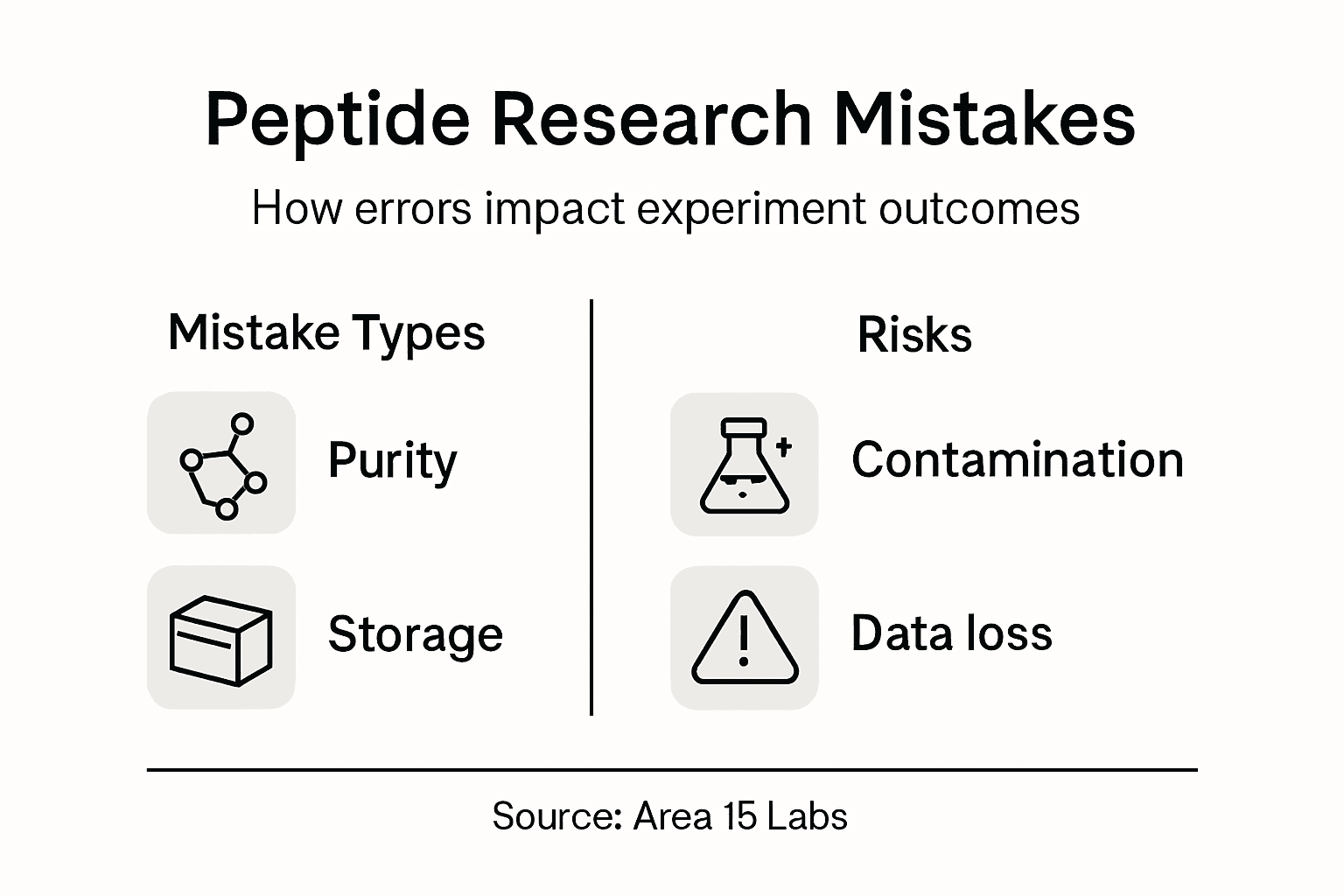
Comprehensive contamination prevention requires systematic approaches that integrate advanced technological solutions with human precision. Researchers must develop holistic protocols that address environmental factors, equipment maintenance, and personal behavior. Cutting-edge laboratories utilize advanced filtration technologies, specialized surface treatments, and continuous monitoring systems to create research environments that minimize potential molecular disruptions.
Pro tip: Implement a strict color-coded equipment system to prevent cross-contamination between different research stations and sample types.
Data Recording Errors and Research Integrity
Research integrity hinges on the meticulous documentation and transparent reporting of scientific investigations. Precise data recording methods serve as the foundational bedrock of credible scientific exploration, where even the smallest transcription error can cascade into significant experimental misinterpretations. The margin between breakthrough insight and complete research invalidation often resides in the minutiae of data management.
Common data recording errors that compromise research integrity include:
- Manual transcription mistakes: Introducing human error during data transfer
- Inconsistent measurement units: Creating ambiguity in quantitative analysis
- Inadequate metadata documentation: Losing critical contextual information
- Unstructured digital record-keeping: Compromising data retrievability
- Insufficient statistical validation: Failing to establish robust analytical frameworks
Digital documentation has revolutionized research practices, yet simultaneously introduced complex challenges in maintaining data authenticity. Sophisticated researchers implement multi-layered verification strategies that combine automated logging systems, redundant recording protocols, and systematic cross-referencing mechanisms. These advanced approaches minimize the potential for human error and create transparent, reproducible scientific records.
Cutting-edge laboratories now leverage sophisticated digital infrastructure that includes real-time data validation, automated error detection algorithms, and comprehensive audit trails. By integrating technological solutions with rigorous human oversight, researchers can create an ecosystem of scientific documentation that prioritizes accuracy, transparency, and reproducibility. The future of research integrity lies in developing intelligent systems that can automatically flag potential recording inconsistencies before they propagate through scientific literature.
Pro tip: Implement a standardized digital template with built-in validation checks to automatically detect and prevent common data recording errors.
The following table compares traditional and advanced approaches in peptide laboratory management:
| Approach Type | Error Detection | Contamination Prevention | Data Integrity Maintenance |
|---|---|---|---|
| Traditional Labs | Manual spot checks | Basic cleaning protocols | Paper records, manual review |
| Advanced Labs | Automated systems | HEPA filters, digital tracking | Real-time logging, audit trails |
Here’s a summary of research peptide challenges and the strategies used to overcome them:
| Research Challenge | Underlying Risk | Laboratory Mitigation Strategy |
|---|---|---|
| Molecular instability | Degradation from temperature/light | Controlled storage, equipment calibration |
| Supplier inconsistency | Impurities, poor batch records | Third-party testing, COA verification |
| Cross-contamination | Mixing between samples | Color-coded tools, separate workspaces |
| Data recording errors | Transcription or metadata mistakes | Automated logs, standardized templates |
Take Control of Your Peptide Research with Area 15 Labs
Peptide research mistakes like contamination risks, purity issues, and data recording errors can sabotage your results and waste precious time. You need a partner who understands the high stakes of molecular integrity and precision handling. At Area 15 Labs we get it. We offer vetted, high-purity compounds that come with transparent third-party testing. Our Texas-based command center means lightning-fast shipping and zero hassle, so you can focus on the science without worrying about slow overseas deliveries or sketchy suppliers.
Don’t let molecular instability or supplier pitfalls undercut your experiments. Join the modern wave of citizen scientists who demand quality and speed paired with a bold, no-nonsense vibe. Ready to upgrade your peptide research game? Explore our exclusive catalog of high-purity products and next-gen stacks now at Area 15 Labs. Get the clear-cut quality and rapid delivery your protocols deserve. Review our rigorous purity standards and fearless research tools today by visiting Area 15 Labs Quality Control and discover why we are the “No-BS” choice from Texas. Take the guesswork out of research and start making discoveries faster.
Frequently Asked Questions
What common errors occur in peptide research?
Common errors in peptide research include contamination risks, improper storage temperature, reconstitution technique failures, measurement precision errors, and cross-contamination between sample batches. These errors can significantly compromise experimental integrity.
How can I ensure the purity of research peptides?
To ensure peptide purity, always choose suppliers that provide comprehensive third-party testing documentation, high-performance liquid chromatography (HPLC) purity reports, and a certificate of analysis (COA) detailing the peptide’s molecular characterization.
What are the proper storage conditions for peptides?
Peptides should be stored in a controlled environment, typically at low temperatures and protected from light, to maintain their molecular stability and prevent degradation. Record environmental conditions consistently to ensure integrity.
Why is accurate data recording important in peptide research?
Accurate data recording is essential for maintaining research integrity, as even small transcription errors can lead to significant misinterpretations of experimental results. Implementing standardized digital templates and automated logging systems can help minimize these risks.

[…] noise—they are potential landmines that can catastrophically compromise experimental integrity. Peptide research mistakes underscore the critical importance of understanding and mitigating molecular contamination […]