

Sorting fact from fiction in peptide research can feel like a maze for Texas citizen scientists and online investigators. Misconceptions about peptide purity and performance often lead to unreliable results and wasted resources. Understanding peptide authenticity means looking past chemical formulas and digging into molecular precision, structural integrity, and thorough documentation. This article clears up common myths, highlights key features of genuine peptides, and shares practical methods for verifying the reliability of your research materials.
Table of Contents
- Defining Peptide Authenticity And Common Myths
- Types And Methods Of Authenticity Testing
- Key Features Of Genuine Peptides
- Risks Of Inauthentic Peptide Research
- How Labs And Researchers Verify Authenticity
Key Takeaways
| Point | Details |
|---|---|
| Authenticity is Crucial | Ensuring peptide authenticity involves meticulous verification of molecular precision, structural integrity, and third-party testing documentation. |
| Common Myths to Avoid | Misconceptions about peptide effectiveness and stability can lead to flawed research; factual understanding is essential. |
| Advanced Testing Methods | Employ multiple analytical techniques like HPLC and Mass Spectrometry for comprehensive peptide authenticity verification. |
| Risks of Inauthentic Peptides | Using inauthentic peptides can result in unreliable data, experimental contamination, and significant resource waste. |
Defining Peptide Authenticity and Common Myths
In the complex world of peptide research, authenticity isn’t just a buzzword—it’s the foundation of scientific integrity. Persistent myths around peptide compounds continue to cloud researchers’ understanding of what truly constitutes a reliable molecular sample.
Authenticity in peptide research goes far beyond simple chemical composition. It encompasses multiple critical factors that distinguish genuine, high-quality research materials from potentially compromised substances. These key elements include:
- Molecular Precision: Exact amino acid sequence matching
- Structural Integrity: Proper folding and configuration
- Purity Levels: Minimal contaminant presence
- Manufacturing Consistency: Reproducible synthesis protocols
- Verifiable Documentation: Comprehensive third-party testing results
Many researchers fall prey to common misconceptions that can derail their scientific investigations. Debunking peptide myths reveals that assumptions about peptide stability, effectiveness, and usability often stem from incomplete understanding.
Authenticity is not a destination, but a rigorous, continuous validation process that demands scientific skepticism and meticulous verification.
The most dangerous myths revolve around oversimplified assumptions about peptide performance. Researchers must recognize that identical peptide sequences can demonstrate dramatically different bioactivities based on subtle manufacturing variables. This complexity demands a nuanced approach to authenticity verification.
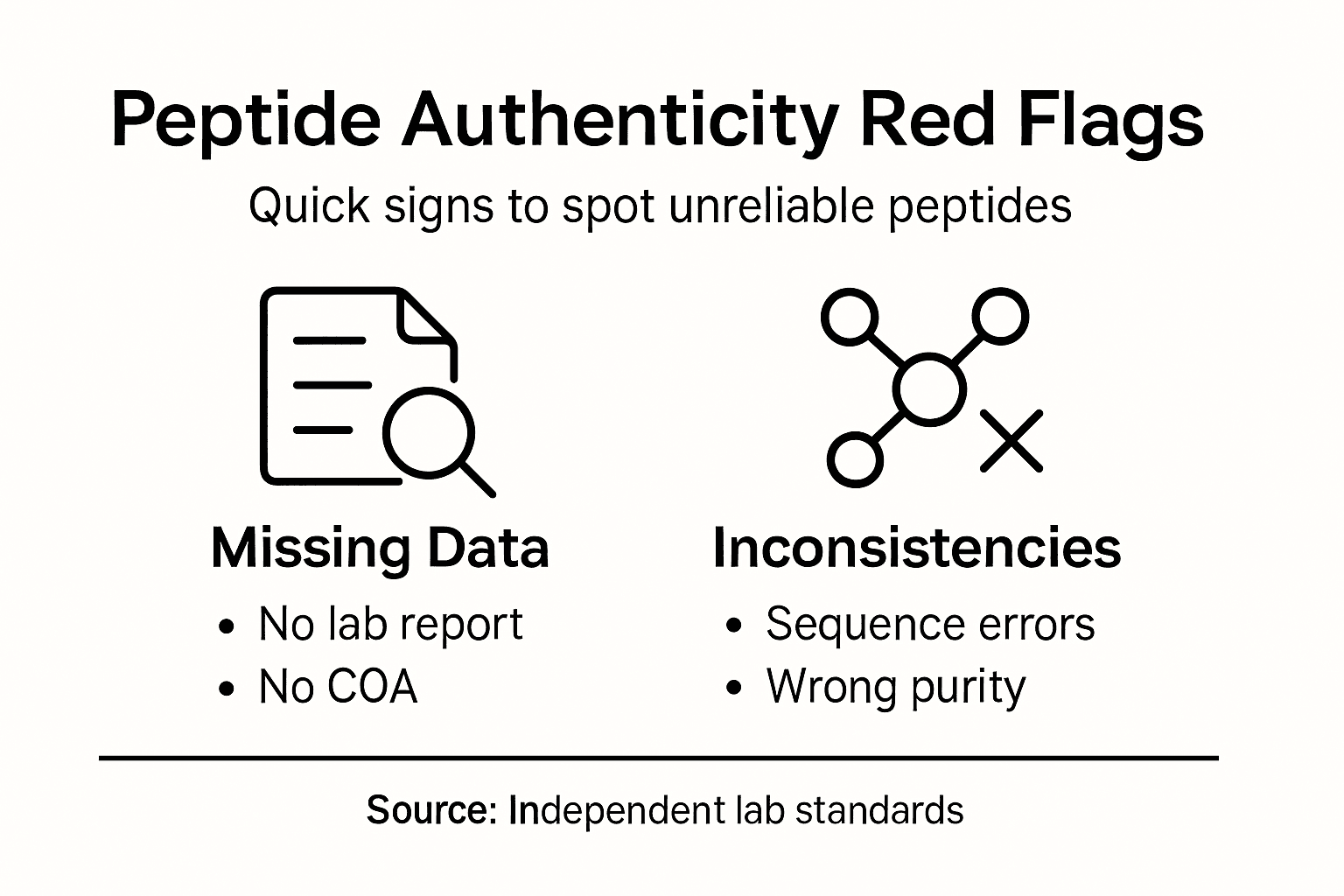
Critical red flags that signal potential peptide inauthenticity include:
- Lack of comprehensive third-party testing documentation
- Inconsistent molecular weight specifications
- Absence of precise purity percentage reports
- Vague or non-specific sourcing information
- Pricing that seems unrealistically low
Pro tip: Always request and thoroughly review a comprehensive Certificate of Analysis before incorporating any peptide into your research workflow.
Types and Methods of Authenticity Testing
Peptide authenticity verification requires a sophisticated, multi-layered approach to ensure scientific reliability. Advanced analytical techniques play a critical role in confirming the molecular integrity of research compounds.
Researchers rely on several key testing methodologies to validate peptide authenticity and quality:
Here’s a clear comparison of peptide authenticity verification methods and their strengths:
| Method | Primary Purpose | Key Advantage |
|---|---|---|
| HPLC | Component separation | Detects impurities quickly |
| Mass Spectrometry | Molecular weight analysis | Reveals exact mass and structure |
| NMR | Configuration analysis | Visualizes folding and interactions |
| Amino Acid Sequencing | Sequence confirmation | Ensures precise molecular identity |
| Stability Testing | Preservation assessment | Identifies degradation risks |
- High-Performance Liquid Chromatography (HPLC): Separates and quantifies peptide components
- Mass Spectrometry: Determines precise molecular weight and structural composition
- Nuclear Magnetic Resonance (NMR): Analyzes molecular configuration and interactions
- Amino Acid Sequencing: Confirms exact peptide sequence
- Stability Testing: Evaluates long-term molecular preservation
Comprehensive peptide authentication involves more than just chemical analysis. It requires a holistic evaluation of multiple quality indicators that extend beyond laboratory testing.
Authenticity is not a single test, but a comprehensive validation process that demands rigorous scientific scrutiny.
The most advanced authentication protocols incorporate multiple testing stages. These include initial packaging inspection, detailed molecular characterization, and extensive batch verification processes that leave no room for uncertainty.
Key validation techniques can be categorized into primary assessment methods:
- Physical Inspection
- Molecular Structural Analysis
- Purity Percentage Determination
- Stability and Degradation Assessment
- Third-Party Verification
Pro tip: Request a complete Certificate of Analysis that includes multiple testing methodologies, not just a single analytical approach.
Key Features of Genuine Peptides
Bioactive peptide characteristics represent the gold standard of molecular precision in research compounds. Understanding these critical features separates authentic scientific materials from potentially compromised substances.
Genuine peptides demonstrate several fundamental characteristics that define their scientific integrity:
- Molecular Specificity: Precisely defined amino acid sequence
- Structural Consistency: Uniform three-dimensional configuration
- Purity Metrics: Minimal contaminant presence (>98% pure)
- Reproducible Synthesis: Consistent manufacturing protocols
- Functional Specificity: Predictable biological interaction patterns
Peptide-based therapeutic research emphasizes the importance of comprehensive molecular characterization beyond simple chemical composition. Authentic peptides must demonstrate verifiable performance across multiple scientific parameters.
Molecular precision is not a luxury—it’s the fundamental requirement of legitimate scientific investigation.
Researchers must scrutinize multiple dimensions of peptide quality to ensure reliable results. This holistic approach involves evaluating not just chemical composition, but also molecular stability, interaction potential, and manufacturing transparency.

Key performance indicators for genuine peptides include:
To help researchers identify genuine peptides, here’s a summary of essential quality indicators:
| Indicator | Why It Matters | Impact on Research |
|---|---|---|
| Exact Molecular Weight | Ensures compound match | Minimizes result errors |
| Purity Above 98% | Reduces contaminants | Improves experiment reliability |
| Biological Activity Consistency | Predicts outcomes accurately | Supports reproducible findings |
| Manufacturing Transparency | Traces production details | Enables source validation |
- Exact Molecular Weight Confirmation
- Precise Amino Acid Sequencing
- Comprehensive Stability Testing
- Consistent Biological Activity
- Transparent Manufacturing Documentation
Pro tip: Request detailed spectroscopic analysis reports that provide comprehensive molecular characterization beyond standard purity percentages.
Risks of Inauthentic Peptide Research
Immunogenicity risks from peptide impurities can devastate research integrity, turning potentially groundbreaking investigations into scientific dead ends. The consequences of using compromised molecular compounds extend far beyond simple experimental error.
Inauthentic peptides introduce multiple critical risks to scientific research:
- Experimental Contamination: Unpredictable molecular interactions
- Data Invalidation: Unreliable or misleading results
- Reproducibility Challenges: Inconsistent experimental outcomes
- Potential Immune Response: Unexpected biological reactions
- Financial Waste: Substantial resource expenditure on unreliable materials
Researchers must understand that inauthentic peptides are not merely a technical inconvenience—they represent a fundamental threat to scientific methodology. The molecular imprecision can create cascading failures across multiple research dimensions.
Compromised peptides are scientific landmines, capable of destroying months or years of meticulous investigative work.
The most significant risks emerge from subtle molecular variations that might appear inconsequential but can dramatically alter experimental outcomes. These variations can introduce:
- False Positive Signals
- Misinterpreted Biological Interactions
- Unintended Immunological Responses
- Systemic Measurement Errors
- Catastrophic Research Invalidation
Pro tip: Always triangulate peptide authenticity through multiple independent testing methods before committing significant research resources.
How Labs and Researchers Verify Authenticity
Peptide quality verification methods represent the frontline defense against compromised scientific research. Laboratories employ sophisticated techniques that go far beyond basic visual inspection to ensure molecular integrity.
Authenticity verification involves multiple strategic approaches:
- Physical Inspection: Examining packaging and container integrity
- Batch Traceability: Tracking molecular origin and manufacturing details
- Spectroscopic Analysis: Confirming precise molecular characteristics
- Third-Party Testing: Independent validation of molecular composition
- Documentation Review: Comprehensive Certificate of Analysis (COA) evaluation
Researchers utilize advanced analytical techniques to deconstruct and validate peptide molecular profiles with surgical precision. These methods transform abstract quality claims into measurable, reproducible scientific data.
Molecular authentication is not a single step, but a comprehensive investigative process that demands scientific skepticism and meticulous verification.
The most rigorous verification protocols incorporate multiple complementary testing methodologies to eliminate potential blind spots in molecular characterization:
- High-Performance Liquid Chromatography (HPLC)
- Mass Spectrometry
- Amino Acid Sequencing
- Stability Profile Assessment
- Contamination Screening
Pro tip: Request a complete Certificate of Analysis that includes multiple independent testing results, not just a single analytical approach.
Unlock True Peptide Authenticity with the No-BS Texas Lab Team
Struggling with murky peptide quality and unreliable documentation The article highlights the critical need for rigorous testing and transparency to separate genuine molecules from fakes. At Area 15 Labs we match that toughest standard with our high-purity compounds verified through multiple testing methods. We ship from Texas for lightning-fast delivery that beats the wait times of overseas alternatives. Our ethic is clear: no fluff just real science fueled by transparency and speed
Don’t let inauthentic peptides derail your research trust the brand built by citizen scientists for citizen scientists. Explore our lineup of verified peptides and next-gen stacks including exclusive blends curated for precision study at Area 15 Labs. Dive deeper into why quality and rapid fulfillment matter for real research in Our Quality Promise and see how we bring the “no-nonsense” attitude to every batch. Your next breakthrough deserves the speed and swagger only a Texas-based leader can deliver
Step up your peptide game today and experience why researchers choose the No-BS Choice from Texas to power exploration with confidence. Are you ready to research harder with a lab partner who gets it and ships same day Visit Area 15 Labs now.
Frequently Asked Questions
What defines peptide authenticity in research?
Peptide authenticity is defined by several critical factors, including molecular precision (exact amino acid sequence), structural integrity (proper folding and configuration), purity levels (minimal contaminants), manufacturing consistency (reproducible protocols), and verifiable documentation (comprehensive third-party testing results).
How can I identify potential inauthentic peptides?
Key red flags for inauthentic peptides include lack of comprehensive third-party testing documents, inconsistent molecular weight specifications, absence of precise purity percentage reports, vague sourcing information, and pricing that seems unrealistically low.
What methods are commonly used to verify peptide authenticity?
Common methods for verifying peptide authenticity include High-Performance Liquid Chromatography (HPLC), Mass Spectrometry, Nuclear Magnetic Resonance (NMR), Amino Acid Sequencing, and Stability Testing. Each method serves a unique purpose in validating molecular integrity and quality.
Why is it important to have a Certificate of Analysis for peptides?
A Certificate of Analysis (COA) provides essential information on the peptide’s molecular characteristics, purity levels, and test results. It ensures transparency in the research process and validates the quality and authenticity of the peptide being used, thereby supporting reliable experimental outcomes.

[…] expected composition, any known synthesis conditions, and your desired test parameters. Labs with peptide authenticity testing protocols can cross-verify your molecular identity using multiple independent […]