

Finding clarity in peptide signaling can be overwhelming for even experienced American researchers pushing metabolic science forward. As studies uncover the dual receptor activation power of oxyntomodulin and compounds like Mazdutide, understanding these complex pathways is more vital than ever. This article demystifies how advanced agonists function, providing practical insights for citizen scientists and independent researchers working to elevate the quality and transparency of their lab studies.
Table of Contents
- Oxyntomodulin Signaling Defined and Debunked
- Mazdutide Variants and Dual Agonist Mechanisms
- High-Potency Lab Signaling: Key Characteristics
- Critical Assessment Techniques for Citizen Science
- Risks, Limitations, and Research Ethics
Key Takeaways
| Point | Details |
|---|---|
| Oxyntomodulin as a Dual Agonist | Oxyntomodulin interacts with GLP-1 and glucagon receptors, enhancing metabolic regulation through appetite suppression and improved insulin release. |
| Mazdutide’s Therapeutic Potential | Mazdutide’s dual receptor mechanism offers significant advantages in glycemic control and weight management, emphasizing the importance of receptor-specific pharmacodynamics. |
| Significance of High-Potency Compounds | High-potency dual agonists exhibit improved receptor binding and sustained activation, enhancing their effectiveness in metabolic signaling. |
| Ethical Considerations in Citizen Science | Collaborative research requires transparency, ethical data management, and reciprocal relationships to ensure participant trust and scientific integrity. |
Oxyntomodulin Signaling Defined and Debunked
Oxyntomodulin (OXM) represents a fascinating peptide with extraordinary metabolic signaling capabilities. As a dual receptor agonist, it interacts simultaneously with two critical metabolic pathways – the glucagon-like peptide-1 receptor (GLP-1R) and the glucagon receptor (GCGR), creating a unique biochemical profile that distinguishes it from other metabolic signaling molecules.
The core mechanism of OXM involves complex receptor interactions that produce multiple physiological responses. Dual receptor activation enables OXM to simultaneously trigger different metabolic processes, including:
- Anorexigenic effects (appetite suppression)
- Enhanced insulin release
- Increased energy expenditure
- Glucose homeostasis regulation
Understanding OXM’s signaling pathway reveals its sophisticated molecular design. Unlike single-receptor peptides, OXM’s ability to interact with two different receptors provides a nuanced approach to metabolic regulation. Enteroendocrine L-cells produce this peptide, strategically releasing it to modulate energy balance and metabolic function.
Metabolic research indicates that OXM levels correlate significantly with various metabolic risk factors. Its complex signaling mechanism suggests potential implications for understanding obesity, insulin resistance, and energy metabolism disorders. The peptide’s dual activation strategy allows for a more sophisticated intervention compared to traditional single-receptor approaches.
Pro tip: When exploring peptide signaling mechanisms, always consider the multi-receptor interaction potential, as single-pathway models might oversimplify complex biochemical processes.
Mazdutide Variants and Dual Agonist Mechanisms
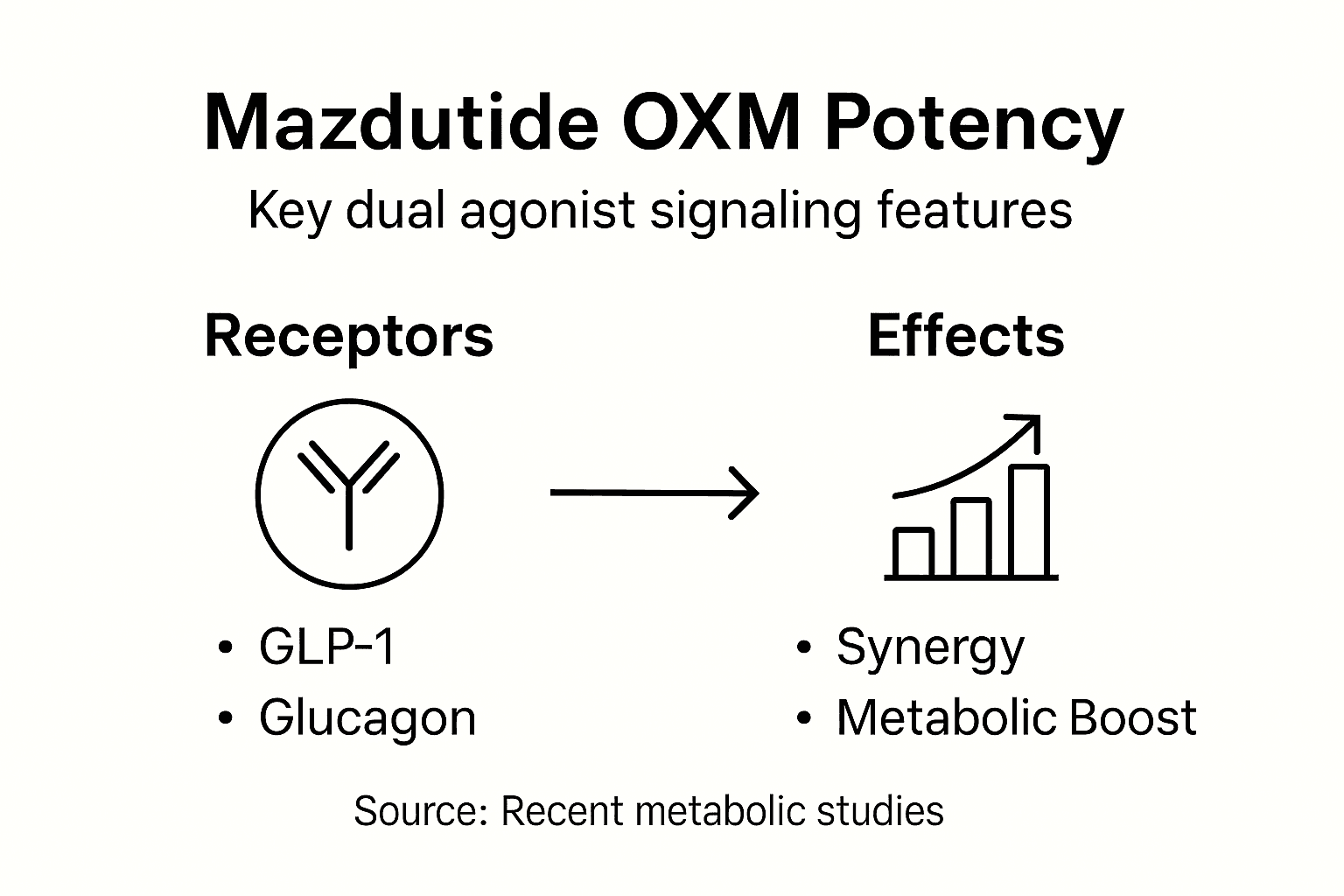
Mazdutide represents a groundbreaking approach in metabolic research, distinguished by its innovative dual receptor agonist mechanism. Advanced metabolic research reveals its unique ability to simultaneously target two critical metabolic receptors – the glucagon-like peptide-1 (GLP-1) and glucagon receptors – creating a sophisticated signaling pathway with remarkable therapeutic potential.
The dual agonist mechanism of Mazdutide offers several key advantages in metabolic regulation:
- Simultaneous engagement of GLP-1 and glucagon receptors
- Enhanced glycemic control
- Potent weight reduction capabilities
- Improved energy metabolism
- Dose-dependent therapeutic benefits
Clinical investigations have demonstrated that different dose variants can optimize therapeutic outcomes by strategically modulating receptor interactions. Receptor-specific pharmacodynamics play a crucial role in determining the compound’s effectiveness, with each variant presenting unique characteristics that target specific metabolic pathways.
The complexity of Mazdutide’s signaling mechanism lies in its ability to produce synergistic effects across multiple metabolic endpoints. By simultaneously activating GLP-1 and glucagon receptors, the compound can potentially address metabolic challenges more comprehensively than single-receptor approaches, offering a nuanced intervention strategy for researchers exploring metabolic regulation.

Here is a comparison of dual receptor agonists and single receptor approaches in metabolic research:
| Approach | Target Receptors | Mechanistic Complexity | Potential Clinical Advantages |
|---|---|---|---|
| Dual receptor agonist | GLP-1 and glucagon receptors | High, with synergistic effects | Improved glycemic control, weight reduction |
| Single receptor agonist | GLP-1 or glucagon (not both) | Lower, direct activation | Limited metabolic impact |
Pro tip: When analyzing dual agonist mechanisms, always consider the intricate receptor interactions and dose-dependent responses to fully understand their complex metabolic signaling potential.
High-Potency Lab Signaling: Key Characteristics
High-potency dual agonists represent a sophisticated approach to molecular signaling, characterized by intricate receptor interactions and advanced pharmacological mechanisms. Innovative receptor binding techniques reveal complex strategies for optimizing intracellular signal transduction and achieving sustained metabolic responses.
Key characteristics of high-potency lab signaling include:
- Robust receptor binding affinities
- Prolonged receptor activation
- Enhanced signal transduction efficiency
- Minimal receptor desensitization
- Sustained cyclic AMP responses
Molecular engineering plays a crucial role in developing compounds with superior signaling capabilities. GLP-1 receptor signaling research demonstrates that high-potency compounds can generate sustained cellular responses by implementing advanced molecular design strategies that minimize receptor fatigue and maximize therapeutic potential.
The complexity of high-potency signaling extends beyond simple receptor activation. Sophisticated molecular mechanisms enable rapid receptor recycling, creating a more dynamic and responsive cellular environment. This approach allows researchers to develop compounds with enhanced specificity, potentially revolutionizing our understanding of metabolic regulation and cellular communication.
Pro tip: When evaluating high-potency signaling mechanisms, focus on the compound’s ability to maintain consistent receptor engagement and minimize adaptive cellular responses.
Critical Assessment Techniques for Citizen Science
Citizen science demands a rigorous and strategic approach to research methodology, blending public engagement with scientific precision. Comprehensive assessment frameworks provide researchers with critical tools to navigate the complex landscape of collaborative scientific exploration.
Essential techniques for maintaining research integrity include:
- Feasibility analysis before project initiation
- Participatory co-design strategies
- Robust data-validation protocols
- Ethical data management practices
- Continuous participant training
Methodological rigor is paramount in citizen science research. Standardized survey protocols ensure that volunteer-collected data meets professional scientific standards, incorporating FAIR data principles (Findable, Accessible, Interoperable, Reusable) to enhance research credibility.
Successful citizen science projects require a delicate balance between accessibility and scientific precision. Advanced tools like mobile applications, comprehensive training materials, and integrated data repositories enable researchers to maintain high-quality standards while fostering broad public participation. This approach transforms traditional research models by democratizing scientific inquiry while preserving methodological integrity.
The table below summarizes the essential components required for successful citizen science project execution:
| Component | Description | Example Tool or Practice |
|---|---|---|
| Data Validation | Ensures reliability of collected data | Standardized survey protocols |
| Participant Training | Educates volunteers for consistency | Step-by-step online tutorials |
| Ethical Management | Protects participant rights and data | Informed consent documentation |
Pro tip: Develop clear, step-by-step training protocols and create multiple verification checkpoints to ensure data quality and participant engagement.
Risks, Limitations, and Research Ethics
Research ethics represent a critical foundation for maintaining scientific integrity and participant trust. Ethical challenges in collaborative research reveal complex dynamics that extend far beyond traditional research methodologies, demanding a nuanced approach to participant interactions.
Key ethical considerations include:
- Preventing extractive research relationships
- Ensuring reciprocal knowledge exchange
- Recognizing participant expertise
- Mitigating data misinterpretation risks
- Maintaining transparent communication
Institutional accountability plays a pivotal role in addressing potential ethical vulnerabilities. Responsible research frameworks emphasize the importance of developing comprehensive guidelines that protect both research participants and scientific integrity.
Navigating ethical limitations requires a proactive, transparent approach. Researchers must continuously evaluate power dynamics, create accessible consultation mechanisms, and develop embedded policies that prioritize mutual respect. By reorienting research strategies to center participant contributions, scientific inquiry can become more collaborative, inclusive, and socially responsible.
Pro tip: Develop a clear ethical protocol that explicitly outlines participant rights, potential risks, and mechanisms for ongoing consent and engagement.
Boost Your Metabolic Research With Mazdutide Potency and Area 15 Labs
The article “Mazdutide Signaling: Why Oxyntomodulin Potency Matters” highlights the powerful impact of dual receptor agonists like Mazdutide in revolutionizing metabolic regulation research. If you are diving into complex signaling pathways involving GLP-1 and glucagon receptors, you understand the need for ultra-pure, reliable compounds that support sophisticated metabolic studies. Key challenges include maintaining receptor-specific pharmacodynamics and exploring dose-dependent therapeutic benefits, all while relying on top-tier materials to produce valid, reproducible results.
At Area 15 Labs, we embrace this cutting-edge research frontier with zero-nonsense, high-purity peptides shipped lightning fast from Texas. Our alien-aesthetic vials and verified testing protocols ensure you access Mazdutide variants and advanced dual agonists ready to fuel your lab breakthroughs. Why settle for slow overseas suppliers when you can partner with the fastest, most transparent no-BS lab supplier on the planet? Dive deeper and equip your research for success with compounds optimized for metabolic complexity.
Explore our exclusive Mazdutide and Dual Agonist Catalog and discover how our unique high-purity assurance and responsive support help you push past research limits. Ready to upgrade your metabolic studies? Head to Area 15 Labs now and experience the speed and swag of Texas-based scientific innovation.
Frequently Asked Questions
What is Mazdutide and how does it function?
Mazdutide is a dual receptor agonist that targets both glucagon-like peptide-1 (GLP-1) and glucagon receptors, creating a unique signaling pathway that enhances glycemic control and supports weight reduction.
Why is the potency of oxyntomodulin significant in metabolic signaling?
The potency of oxyntomodulin is crucial because it enhances the overall efficacy of metabolic interventions by activating multiple receptors simultaneously, leading to improved appetite suppression, insulin release, and energy expenditure.
How do dual receptor agonists like Mazdutide differ from single receptor agonists?
Dual receptor agonists like Mazdutide engage both GLP-1 and glucagon receptors, resulting in more complex metabolic effects and better therapeutic outcomes compared to single receptor agonists that only target one pathway.
What potential benefits does Mazdutide offer in the treatment of metabolic disorders?
Mazdutide offers enhanced glycemic control, significant weight reduction capabilities, and improved energy metabolism, addressing metabolic disorders more comprehensively than traditional approaches.