

Sorting fact from fiction in peptide COA documentation is a challenge many American citizen scientists face. One error can derail months of experimental work or lead to costly setbacks. With over 80 percent of lab errors linked to questionable purity or documentation, understanding what makes a reliable Certificate of Analysis is critical. This guide helps you compare Janoshik and Freedom Diagnostics head to head, revealing practical ways to spot red flags and vet your sources before the next experiment.
Table of Contents
- Peptide COA Basics and Common Myths
- Janoshik vs Freedom Diagnostics: Testing Methods
- How to Verify Authentic COA Documentation
- Purity Standards and Batch Traceability Explored
- Risks of Reused or Fake COAs in Research
Key Takeaways
| Point | Details |
|---|---|
| Importance of COAs | Certificates of Analysis (COAs) are essential for verifying peptide quality, including purity and contamination levels. Researchers should prioritize obtaining detailed and legitimate COAs before purchasing materials. |
| Testing Methodologies | Different labs, like Janoshik and Freedom Diagnostics, use varied testing methodologies that impact the accuracy and reliability of results. Understanding these differences is crucial for selecting the right supplier. |
| Verification Procedures | Conduct a thorough verification of COA documentation, including batch identifiers and lab credentials, to ensure materials’ authenticity. Employ digital verification to guard against potential fraud. |
| Risks of Poor Quality Control | Using fake or reused COAs can compromise research integrity, lead to untrustworthy data, and damage institutional credibility. Implement strict verification protocols to prevent these risks. |
Peptide COA Basics and Common Myths
When diving into peptide research, understanding Certificate of Analysis (COA) documentation is like decoding the secret sauce of scientific integrity. These critical documents aren’t just fancy paperwork—they’re the research world’s ultimate purity passport. Peptide Quality Control: Complete Guide for Researchers reveals why smart scientists treat COAs like gold.
A Certificate of Analysis essentially serves as a molecular report card, detailing critical attributes like peptide purity, molecular weight, and potential contaminants. Most researchers mistakenly believe all COAs are created equal—but spoiler alert: they’re not. Companies like Janoshik and Freedom Diagnostics approach quality verification with dramatically different levels of rigor. The primary red flags to watch for include incomplete testing protocols, lack of third-party verification, and vague purity percentages.
Key elements every legitimate peptide COA must contain include:
- Precise molecular weight measurements
- Exact peptide sequence verification
- HPLC purity percentage
- Batch-specific testing data
- Mass spectrometry confirmation
- Potential microbial contamination screening
Researchers frequently fall for common myths that can compromise their entire experimental framework. One persistent misconception is that higher cost automatically guarantees better quality—a dangerous assumption in the world of peptide procurement. Peptides 101: The No-BS Guide to What They Actually Are demolishes several prevalent myths about peptide sourcing and quality verification.
Pro Research Tip: Always request the full, unredacted COA directly from the manufacturer before purchasing, and cross-reference testing methodologies to ensure comprehensive quality assessment.
Janoshik vs Freedom Diagnostics: Testing Methods
In the high-stakes world of peptide research, testing methodologies can make or break scientific credibility. Comprehensive peptide authentication techniques reveal the critical differences between Janoshik and Freedom Diagnostics’ approach to quality verification. These labs represent the gold standard in molecular scrutiny, each wielding sophisticated analytical tools that go far beyond basic quality checks.

Janoshik distinguishes itself through meticulous reverse-phase high-performance liquid chromatography (RP-HPLC) and advanced mass spectrometry protocols. Their testing philosophy centers on granular identification, with multi-parameter reporting that provides researchers unprecedented insight into peptide molecular characteristics. Freedom Diagnostics, by contrast, prioritizes rapid batch analysis and comprehensive safety screening, with a particular emphasis on detecting potential endotoxin contamination—a critical consideration for research-grade materials.
Key comparative testing methods include:
- Reverse-Phase HPLC (RP-HPLC)
- Janoshik: Detailed peak analysis and purity quantification
- Freedom Diagnostics: Rapid screening with broad spectrum assessment
- Mass Spectrometry
- Janoshik: Precise molecular weight confirmation
- Freedom Diagnostics: Structural integrity verification
- Endotoxin Screening
- Janoshik: Selective testing
- Freedom Diagnostics: Comprehensive safety protocols
Researchers must recognize that while both labs maintain high standards, their methodological nuances can significantly impact experimental outcomes. The choice between Janoshik and Freedom Diagnostics isn’t about superior versus inferior—it’s about understanding their unique analytical strengths and aligning those with specific research requirements.
Here’s a side-by-side comparison highlighting the unique strengths of Janoshik and Freedom Diagnostics for peptide verification:
| Feature | Janoshik | Freedom Diagnostics |
|---|---|---|
| Purity Assessment Accuracy | High, with detailed chromatogram data | Rapid, broad-spectrum analysis |
| Structural Confirmation | Advanced mass spectrometry verification | Focused on structural and integrity check |
| Endotoxin Detection | Selective and targeted | Extensive, batch-wide screening |
| Reporting Depth | Multi-parameter, highly granular | Comprehensive safety and compliance |
| Best Fit For | Molecular characterization needs | Safety and contamination emphasis |
Pro Research Tip: Always cross-reference testing method details in the Certificate of Analysis, paying special attention to the specific analytical techniques used for molecular characterization and purity assessment.
How to Verify Authentic COA Documentation
In the world of peptide research, a Certificate of Analysis (COA) is more than just paperwork—it’s your molecular forensics toolkit. Authentic COA verification techniques represent the critical line of defense against potentially compromised research materials. Savvy researchers know that not all documentation is created equal, and the devil is truly in the details.
Authentic COA documentation demands a methodical, multi-step verification process. Key elements to scrutinize include:
- Batch-Specific Identifiers
- Unique batch number
- Precise manufacturing date
- Lot-specific tracking codes
- Laboratory Credentials
- Accreditation details
- Third-party verification stamps
- Analyst contact information
- Analytical Method Documentation
- Specific testing protocols used
- Detailed chromatography results
- Mass spectrometry confirmation data
Researchers must recognize that legitimate COAs are living documents, not static pieces of paper. The most robust documentation will include digital verification links, QR codes, or direct contact methods for independent confirmation. Companies like Janoshik and Freedom Diagnostics understand that transparency isn’t just a buzzword—it’s the foundation of scientific integrity. Sophisticated labs provide comprehensive reporting that goes beyond basic compliance, offering researchers a transparent window into their rigorous quality control processes.
Pro Research Tip: Create a personal verification checklist that includes batch number cross-referencing, digital signature validation, and direct laboratory contact confirmation to ensure the absolute authenticity of your COA documentation.
For successful peptide research, consider these essential COA verification steps:
| Checklist Step | Why It Matters | Common Oversight |
|---|---|---|
| Match batch details | Confirms sample identity | Ignoring unique codes |
| Validate lab accreditation | Ensures testing credibility | Overlooking accreditation marks |
| Examine testing methods | Indicates result reliability | Reliance on vague method names |
| Use digital verification | Prevents document forgery | Skipping signature or QR code |
Purity Standards and Batch Traceability Explored
In the precision-driven world of peptide research, purity standards are the bedrock of scientific credibility. International quality standards for synthetic peptide verification represent a complex ecosystem of analytical rigor that separates exceptional research from potentially compromised investigations. Batch traceability isn’t just a technical requirement—it’s the molecular fingerprint that guarantees reproducibility and scientific integrity.
The gold standard for peptide purity involves a multi-layered verification process that goes far beyond simple percentage reporting. Key analytical techniques include:
- High-Performance Liquid Chromatography (HPLC)
- Separates molecular components
- Quantifies precise purity levels
- Identifies potential contaminants
- Mass Spectrometry
- Confirms exact molecular weight
- Validates peptide sequence
- Detects structural variations
- Batch Uniformity Testing
- Validates consistent molecular characteristics
- Ensures reproducibility across samples
- Tracks manufacturing consistency
Researchers must understand that true purity isn’t a binary metric, but a sophisticated spectrum of molecular verification. Companies like Janoshik and Freedom Diagnostics differentiate themselves through increasingly sophisticated traceability protocols. The most advanced laboratories now provide comprehensive documentation that reads like a molecular passport, complete with detailed testing methodologies, reference material comparisons, and digital verification mechanisms.
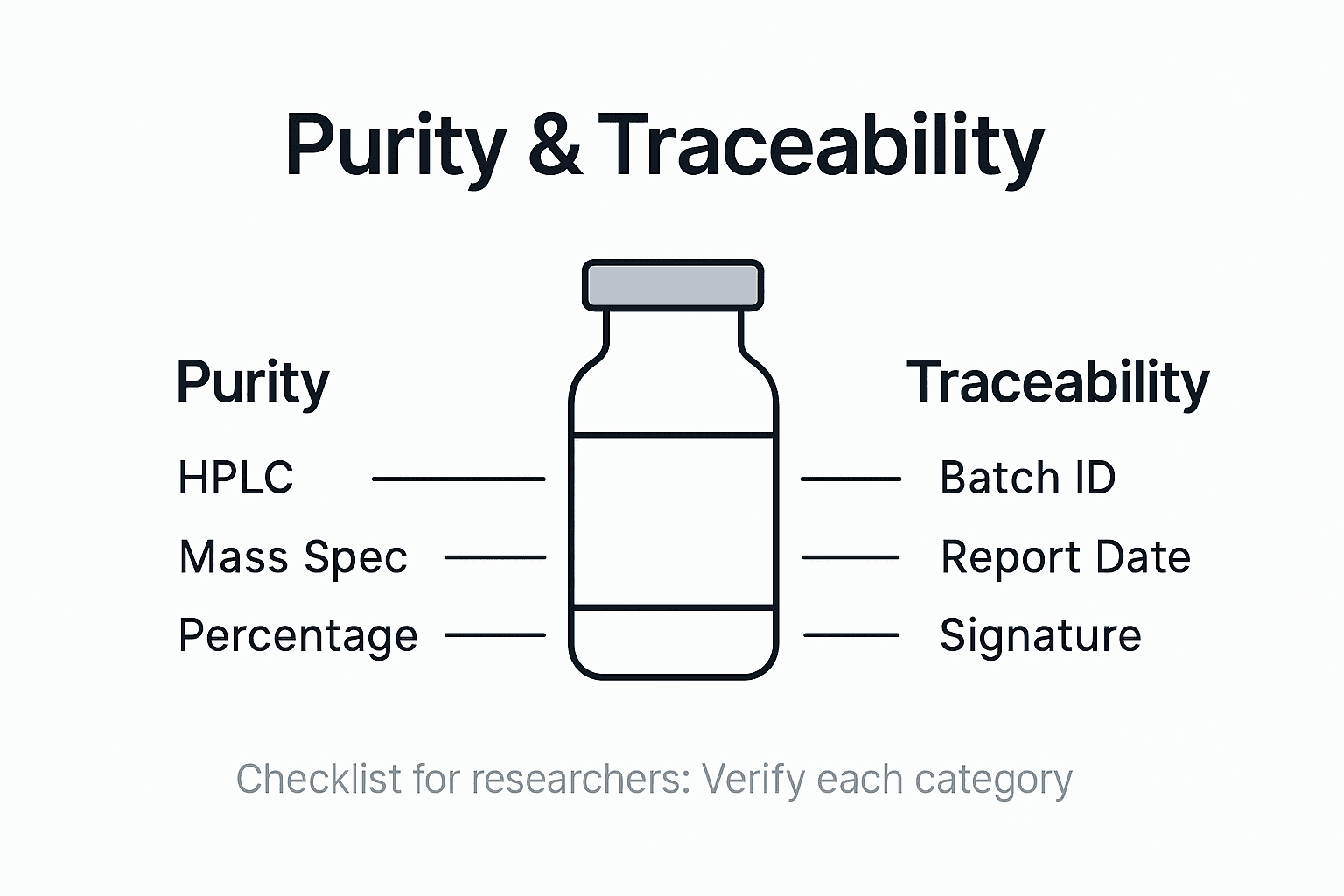
Pro Research Tip: Develop a personal traceability rubric that evaluates COA documentation across multiple dimensions, including analytical method diversity, reference standard alignment, and digital verification capabilities.
Risks of Reused or Fake COAs in Research
In the precision-driven landscape of peptide research, fake or reused Certificates of Analysis (COAs) represent a molecular minefield that can completely derail scientific investigations. While no specific external citation exists, the risks are profound and multifaceted, threatening the fundamental integrity of research at every level. Sophisticated researchers understand that a single compromised document can transform meticulously planned experiments into potentially worthless data streams.
The primary risks associated with fraudulent or recycled COAs include:
- Data Integrity Compromise
- Potentially incorrect molecular characterization
- Unverified purity percentages
- Misrepresented testing methodologies
- Experimental Reproducibility Challenges
- Inconsistent molecular batch characteristics
- Unpredictable research outcomes
- Potential cross-contamination risks
- Institutional Credibility Destruction
- Research publication rejection
- Potential academic disciplinary actions
- Loss of funding or research grants
Companies like Janoshik and Freedom Diagnostics have built their reputations on rigorous documentation practices that minimize these risks. The most advanced laboratories implement multi-layered verification protocols that make document fraud exponentially more difficult. Digital verification systems, unique batch tracking, and comprehensive molecular profiling have transformed COAs from simple paperwork into dynamic, traceable scientific instruments.
Pro Research Tip: Implement a zero-tolerance verification protocol that requires independent confirmation of every COA through direct laboratory contact, digital signature validation, and cross-referencing multiple analytical methodologies before accepting any research material.
Choose the No-BS Texas Advantage for Your Peptide COA Needs
Navigating the peptide COA showdown between Janoshik and Freedom Diagnostics proves that understanding testing methods and authenticity is crucial. At Area 15 Labs we get the pain of waiting weeks for overseas shipments and getting lost in boring clinical jargon. Our solution? A lightning-fast Texas-based command center that ships research-grade peptides with verified purity and batch traceability the moment you order. No fluff no guesswork just brutally honest COA documentation vetted by pros who know what matters in molecular characterization and endotoxin screening.
If you want to stop worrying about vague purity percentages or reused COAs and start trusting your research materials take a look at our Texas Shipped Peptide Collection. We blend radical transparency with a radical aesthetic so your research doesn’t just work it looks like science with swagger. Get real US support and same-day fulfillment unlike the big pharma clones and overseas slowpokes. Get your hands on peptides tested with the rigorous standards highlighted in the coveted Peptide Quality Control Guide so you can research harder and faster.
Ready to ditch the hassle and level up your research pipeline today Visit Area 15 Labs and experience the no-BS advantage from Texas designed for citizen scientists who refuse to settle for less.
Frequently Asked Questions
What is a Certificate of Analysis (COA) for peptides?
A Certificate of Analysis (COA) is a document that provides detailed information about the quality and purity of a peptide, including molecular weight, peptide sequence verification, and results from various testing protocols.
How do Janoshik and Freedom Diagnostics differ in their testing methodologies?
Janoshik focuses on meticulous reverse-phase high-performance liquid chromatography (RP-HPLC) and detailed mass spectrometry, while Freedom Diagnostics prioritizes rapid batch analysis and comprehensive endotoxin screening.
What key elements should be included in a legitimate peptide COA?
A legitimate COA should include precise molecular weight measurements, exact peptide sequence verification, HPLC purity percentage, batch-specific testing data, mass spectrometry confirmation, and potential microbial contamination screening.
Why is batch traceability important in peptide research?
Batch traceability ensures consistency and reproducibility in research by allowing scientists to track the unique characteristics of each batch of peptides, confirming their identity and integrity throughout the research process.
Recommended
- Don’t Get Fooled: Your “USA Peptides” Likely Started in China (and that’s OK!) | Research Peptides & News | Area 15 Labs
- Battle of the Agonists: Semaglutide vs. Tirzepatide vs. Retatrutide | Research Peptides & News | Area 15 Labs
- New Peptide Trends: What’s Hot on Social Media Peptides • Area 15 Labs
- Area 15 Labs: High-Purity Research Peptides

[…] should never settle for ambiguous documentation. When comparing peptide analysis standards, look for these key verification […]
[…] Janoshik vs Freedom Diagnostics: Peptide COA Showdown […]