

Finding reliable, high-purity peptides for American laboratory research often feels like a race against incomplete documentation and slow suppliers. For citizen scientists and peptide researchers in the United States, sourcing CJC-1294 and Ipamorelin with verified purity above 98 or 99 percent is more than a preference—it directly impacts glassware integrity and experimental consistency. This guide clarifies their distinct mechanisms, highlights key selection criteria, and helps you avoid common research errors across innovative lab studies.
Table of Contents
- CJC-1294 And Ipamorelin Defined
- Synergistic Mechanisms In Lab Research
- Key Properties: Half-Life, Purity, And Selection
- Legal Landscape For Peptide Research
- Primary Risks And Common Research Errors
- Comparing Alternative Peptide Stacks
Key Takeaways
| Point | Details |
|---|---|
| CJC-1294 and Ipamorelin work synergistically | This combination mimics natural growth hormone secretion more effectively than either peptide alone, enhancing experimental outcomes in lab research. |
| Understand peptide half-lives for effective research | CJC-1294 has a half-life of 6 to 8 days, while Ipamorelin lasts about 2 hours, impacting observation schedules and data reliability. |
| Ensure purity verification before procurement | Request third-party Certificates of Analysis for each peptide to avoid contamination and ensure accurate experimental results. |
| Maintain proper storage conditions | Store peptides securely to prevent degradation, ensuring consistent results during research observations. |
CJC-1294 and Ipamorelin Defined
CJC-1294 and Ipamorelin are two distinct peptides that work in tandem to create what researchers call a “stack.” Think of them as complementary tools in a laboratory setup, each targeting growth hormone secretion from different angles. Understanding what each does individually is crucial before grasping why they work so effectively together.
CJC-1294 is a synthetic analog of Growth Hormone Releasing Hormone (GHRH). This long-acting peptide mimics the body’s natural signaling molecule, binding to specific receptors in the pituitary gland to stimulate sustained growth hormone output. The critical distinction: CJC-1294 with DAC (Drug Affinity Complex) features an extended half-life of approximately 6 to 8 days, meaning a single dose continues driving GH and IGF-1 elevation for an extended period. This extended window is why researchers favor it for baseline, consistent growth hormone stimulation.
Ipamorelin operates through a completely different mechanism. This selective ghrelin receptor agonist triggers short bursts of growth hormone release rather than sustained elevation. Its half-life spans roughly 2 hours, making it fast-acting and transient. Where CJC-1294 creates the “background hum” of growth hormone activity, Ipamorelin adds strategic spikes on top of that baseline.
When combined, these peptides produce what researchers describe as a more physiological growth hormone release pattern. The stacking approach mimics natural GH secretion more closely than either peptide alone could achieve. CJC-1294 establishes the foundation while Ipamorelin layers on pulsatile stimulation, creating a release profile that tracks closer to endogenous patterns observed in laboratory observation.
Here is a summary comparing the key properties of CJC-1294 and Ipamorelin for lab research:
| Property | CJC-1294 | Ipamorelin |
|---|---|---|
| Mechanism | GHRH receptor activation | Ghrelin receptor agonist |
| Typical Half-Life | 6 to 8 days | Around 2 hours |
| GH Secretion Pattern | Sustained baseline elevation | Rapid, pulsatile release |
| Utility in Stacks | Background stimulation | Pulsatile stimulation |
| Experimental Benefit | Long-term stability modeling | Kinetic response studies |
The separation of mechanism matters tremendously. Both work through the pituitary gland but via distinct receptor pathways, allowing researchers to study additive effects without redundancy. This is why the combination appears frequently in in-vitro research protocols focused on molecular stability and glassware integrity testing.
Pro tip: When evaluating peptide combinations, verify that your research supplier provides third-party Certificates of Analysis for each compound separately, not just the blend. This confirms purity and potency of both components before conducting any glassware-based observation studies.
Synergistic Mechanisms in Lab Research
The real power of stacking CJC-1294 with Ipamorelin emerges when you examine how these peptides interact at the molecular level. This isn’t just two separate reactions happening in parallel. Instead, they create a coordinated response that researchers find far more interesting than either compound working alone.
Consider the timeline. CJC-1294 establishes a sustained baseline of growth hormone stimulation over days, while Ipamorelin introduces rapid, targeted pulses on top of that foundation. In glassware-based observation settings, this creates a compounding effect where the pulsatile GH release pattern becomes more pronounced because it’s layered onto an already elevated baseline. The combination doesn’t simply add the effects of both peptides. Instead, it produces something closer to natural endogenous secretion patterns.

Why does this matter for in-vitro research? Because molecular stability depends heavily on the consistency and predictability of the biochemical environment. When you can model a more physiological GH release curve in your test systems, you achieve better control variables and more reliable glassware integrity throughout your experiments.
The receptor pathway separation is equally critical. CJC-1294 binds to GHRH receptors while Ipamorelin targets ghrelin receptors, meaning they’re activating different cellular signaling cascades simultaneously. This dual pathway activation creates a synergistic response that’s measurably different from sequential or competing mechanisms. Researchers studying peptide combinations specifically value this non-redundant approach because it generates more nuanced data about how multiple receptor activation affects molecular behavior.
Another advantage surfaces when examining molecular stability over extended observation periods. The sustained elevation from CJC-1294 maintains a steadier biochemical environment, reducing fluctuations that might otherwise stress molecular structures or compromise glassware integrity. Meanwhile, Ipamorelin’s pulsatile action creates measurable kinetic variations that allow researchers to study adaptation responses and receptor sensitivity changes across different time intervals.
Pro tip: Track your peptide stacks using multiple observation intervals (baseline, 24 hours, 48 hours, and 72 hours) to capture the full synergistic profile rather than relying on single-point measurements that might miss the interaction dynamics.
Key Properties: Half-Life, Purity, and Selection
When selecting peptides for your research stack, three factors dominate the decision-making process. Half-life determines how long the peptide remains active in your system. Purity controls whether your results reflect actual peptide behavior or contamination artifacts. Selection criteria tie everything together into a coherent procurement strategy.
Half-life shapes your entire experimental timeline. CJC-1294’s 6 to 8 day half-life means sustained activity across extended observation periods, while Ipamorelin’s 2 hour half-life creates rapid kinetic windows perfect for pulsatile studies. Understanding these timeframes lets you design experiments that actually capture the biochemical events you want to measure. A mismatch between your observation intervals and peptide half-lives wastes resources and generates unreliable data.
Purity is where most researchers stumble. High-purity CJC-1295 peptide characterization relies on advanced HPLC analysis to assess quality and identify impurities such as peptide fragments or degradation products. Maintaining purity above 98-99% ensures your biochemical results stay clean. Even small percentages of contaminants can bias activity measurements and introduce experimental artifacts that wreck reproducibility.
Proper storage and handling directly impact purity maintenance. Temperature fluctuations, light exposure, and humidity degrade peptides over time. Your supplier should provide stability profiles showing how purity changes under different storage conditions. This data becomes your baseline for knowing whether degradation is happening in your own lab or arrived with the batch.
Selection criteria connect these properties to your actual research goals. Start by defining your observation window. If you need rapid pulsatile responses, Ipamorelin dominates. If you’re tracking sustained elevation effects, CJC-1294 handles that role. Next, verify purity certificates before purchase. Any supplier unwilling to provide detailed HPLC analysis results isn’t worth your time or money.
Finally, cross-reference stability profiles against your storage capacity. If you lack proper temperature-controlled storage, buy smaller quantities of shorter-shelf-life peptides rather than bulk orders that degrade before use.
Pro tip: Request Certificates of Analysis for every batch you purchase, not just the product line, and compare results against the supplier’s published stability profiles to catch degradation trends early.
Legal Landscape for Peptide Research
The regulatory environment around peptide research in the United States sits in a gray zone. Peptides like CJC-1294 and Ipamorelin aren’t explicitly banned for laboratory research purposes, but they’re also not FDA-approved for human consumption. Understanding this distinction is critical before you purchase or conduct any research.
The key legal principle centers on “intended use.” Research peptides are sold strictly for in-vitro laboratory research, molecular stability testing, and glassware integrity studies. They’re not approved for clinical trials, medical treatment, or any human application. Your supplier should reinforce this distinction explicitly in product disclaimers and terms of service. If a vendor markets peptides without clear research-only language, that’s a major red flag.
Federal law treats peptide research compounds differently than finished pharmaceutical products. The FDA doesn’t actively regulate raw research chemicals in the same way it oversees medications intended for human use. However, the landscape is shifting. Recent legislative efforts aim to tighten controls on peptide distribution, particularly around compounds marketed for off-label performance enhancement.
State-level regulations vary significantly. Some states impose stricter requirements on peptide procurement and storage than federal law mandates. Texas, where Area 15 Labs operates, maintains relatively permissive research chemical regulations compared to states like California or New York. Before purchasing, verify your state’s current requirements to avoid compliance issues.
The most prudent approach involves understanding recent regulatory developments that may impact your research procurement timeline. Supplier transparency becomes your safety net here. Reputable vendors provide updated compliance documentation and notify customers of regulatory changes that affect product availability or shipping restrictions.
One more critical point: maintain clear documentation showing your intended use is laboratory research only. If authorities ever question your purchases, your research protocols and institutional affiliation (university, licensed lab, etc.) provide legal protection. Never blur the lines between research procurement and personal use.
Pro tip: Keep copies of all product disclaimer agreements and Certificates of Analysis in a dedicated folder, organized by purchase date and supplier, to demonstrate compliance with research-only regulations if ever questioned.
Primary Risks and Common Research Errors
Most researchers hit predictable pitfalls when working with CJC-1294 and Ipamorelin stacks. Recognizing these errors upfront saves time, money, and experimental integrity. The good news: these mistakes are entirely avoidable with proper planning.
The first major error involves contamination from improper storage. Peptides degrade rapidly under poor conditions. Researchers often store vials at room temperature when they should be refrigerated or frozen, then wonder why their glassware integrity tests show inconsistent results. Temperature fluctuations, light exposure, and humidity all accelerate degradation. Before you even receive your peptides, prepare proper storage infrastructure. A basic laboratory freezer at negative 20 degrees Celsius prevents most degradation problems.
The second critical mistake centers on purity verification failure. Researchers receive peptides without demanding Certificates of Analysis, then blame the supplier when experiments fail. You must request third-party testing documentation before finalizing any purchase. Understanding peptide quality control protocols helps you evaluate whether a supplier’s testing meets industry standards.
Another common blunder is incorrect observation intervals. Stacking CJC-1294 with Ipamorelin requires synchronized timing. Some researchers measure effects too early, missing the synergistic window. Others wait too long, capturing degradation rather than peak activity. Match your observation schedule to the half-life profiles of each peptide. CJC-1294’s 6-8 day half-life demands extended monitoring, while Ipamorelin’s 2 hour window needs rapid sampling protocols.
Improper glassware selection causes surprising failures. Not all lab equipment handles peptide solutions identically. Some materials leach contaminants into your samples. Verify that your glassware is peptide-compatible before beginning research. Standard borosilicate glass works fine, but plastic containers often introduce artifacts.
Finally, many researchers fail to document their procedures systematically. Without detailed records of storage conditions, observation times, and equipment used, you can’t reproduce results or troubleshoot failures. Sloppy documentation makes peer review impossible and wastes your research investment.
Pro tip: Create a master research log documenting every aspect of your peptide handling, storage temperature readings daily, and observation timestamps to catch procedural drift before it ruins expensive experiments.
Comparing Alternative Peptide Stacks
CJC-1294 with Ipamorelin dominates growth hormone research, but it’s far from the only stack worth exploring. The peptide research landscape offers multiple alternatives, each tailored to different experimental objectives. Understanding the competition helps you select the stack that actually matches your research goals.
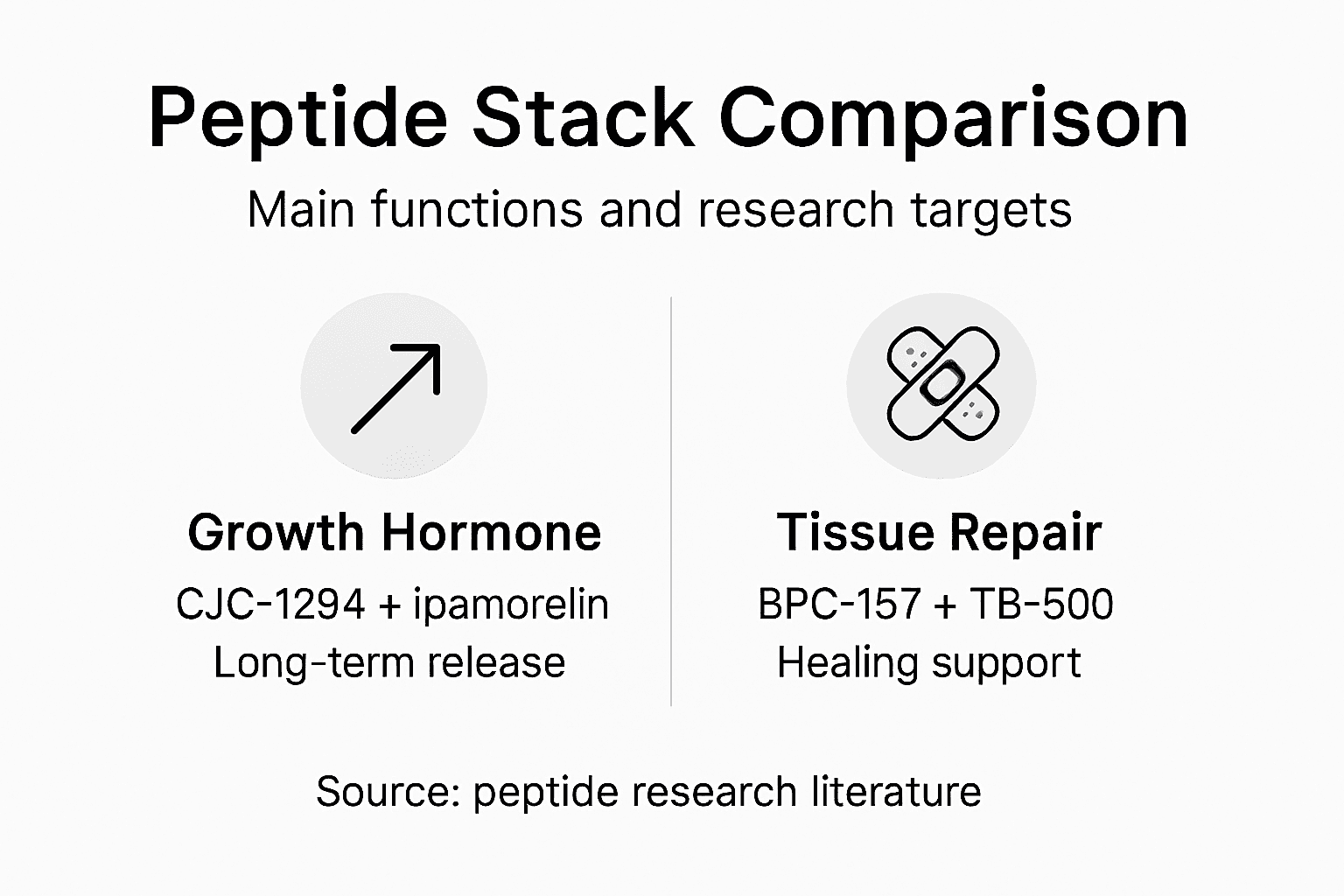
Tissue Repair Stacks take a different approach entirely. BPC-157 combined with TB-500 targets cellular healing and regeneration rather than hormone stimulation. While CJC-1294 plus Ipamorelin drives sustained GH elevation, the BPC-157 and TB-500 combination works through anti-inflammatory and tissue-repairing pathways. If your research focuses on molecular stability in damaged tissue models or glassware-based healing simulations, this stack outperforms GH-focused combinations.
Gut Health Stacks combine compounds like BPC-157 with KPV, targeting digestive system integrity and barrier function. These peptides activate different receptor pathways than growth hormone agonists. Popular alternative peptide stacks designed for tailored therapeutic goals demonstrate how researchers select combinations based on specific outcomes rather than a one-size-fits-all mentality.
The Cognitive Enhancement Stack pairs Dihexa and Semax to target neurological function. Neither compound stimulates growth hormone. Instead, they work through neuropeptide and nootropic mechanisms. If your in-vitro observation focuses on neural tissue models or synaptic integrity, this stack makes more sense than a growth hormone combination.
Immune Modulation Stacks use Thymosin Alpha-1 and LL-37 to study immune resilience at the molecular level. These peptides activate completely different cellular pathways than CJC-1294 and Ipamorelin. The stack selection hinges on whether your research targets endocrine function or immune function.
The critical insight: no single stack dominates all research categories. CJC-1294 with Ipamorelin excels at sustained growth hormone simulation. But tissue repair, gut health, cognitive enhancement, and immune modulation each demand specialized peptide combinations. Match your stack to your actual research question, not the most popular option.
For quick reference, here is a comparison of popular peptide stacks by their main lab research focus:
| Stack | Main Application | Targeted Pathways |
|---|---|---|
| CJC-1294 + Ipamorelin | GH secretion modeling | Endocrine hormone receptors |
| BPC-157 + TB-500 | Tissue repair studies | Healing and anti-inflammatory |
| BPC-157 + KPV | Gut health assessment | Digestive integrity, barrier function |
| Dihexa + Semax | Cognitive modeling | Neuropeptide, synaptic function |
| Thymosin Alpha-1 + LL-37 | Immune response research | Immunomodulatory pathways |
Pro tip: Before committing to any peptide stack, map out your specific experimental outcome first, then reverse-engineer which peptide combination actually targets those mechanisms rather than defaulting to whatever stack sounds impressive.
Experience The Power of CJC-1294 and Ipamorelin Stacks with Area 15 Labs
Working with CJC-1294 and Ipamorelin means you need research materials that match the precision and complexity discussed in the article. These peptides demand high purity, rigorous verification, and a supplier who understands the critical balance between sustained and pulsatile growth hormone stimulation. The pain points of uncertain peptide quality, slow overseas shipping, and incomplete data end here. At Area 15 Labs we offer a no-nonsense Texas-based solution that delivers verified peptides with lightning-fast same-day fulfillment.
Stop wasting time with suppliers who deliver inconsistent purity or poor documentation. Our peptides come with third-party Certificates of Analysis ensuring your stacks like CJC-1294 and Ipamorelin produce trustworthy, reproducible results. Combine this with our quick domestic shipping and you get the ideal partner for your laboratory research. Ready to elevate your molecular stability studies or kinetic response research with confidence? Explore our full range of high-purity products and see why serious researchers choose Area 15 Labs.
Dive into the future of peptide research by checking out our landing page and trust the brand that brings “Research with Swagger” right from the heart of Texas. Get the speed, quality, and transparency your research deserves now.
Frequently Asked Questions
What are CJC-1294 and Ipamorelin?
CJC-1294 and Ipamorelin are two peptides that work together to enhance growth hormone secretion. CJC-1294 is a GHRH analog with a long half-life, while Ipamorelin is a ghrelin receptor agonist that triggers rapid bursts of growth hormone release.
How do CJC-1294 and Ipamorelin work together effectively?
These peptides complement each other by producing a physiological growth hormone release pattern. CJC-1294 establishes a sustained baseline, while Ipamorelin provides targeted spikes, creating a more natural hormone secretion profile when combined.
Why is the purity of peptides important for research?
High purity levels (above 98-99%) ensure that your experimental results reflect the actual behavior of the peptides rather than contamination artifacts. This is crucial for reproducibility and reliability in your research.
What common errors should researchers avoid when using peptide stacks?
Researchers should avoid contamination through improper storage, failure to verify purity, incorrect observation intervals, and inadequate documentation. Ensuring proper handling and accurate measurement timing is essential for successful experiments.