
Precision matters when you are working with peptides in your own lab. One small misstep in preparing samples or setting up equipment can throw off your entire experiment and leave you questioning your results. American citizen scientists and DIY researchers rely on a clear understanding of peptide purity analysis from start to finish. This guide walks you through every critical detail, helping you achieve trustworthy data for your next project.
Table of Contents
- Step 1: Prepare Lab Samples And Set Up Testing Equipment
- Step 2: Execute Standard Peptide Purity Analysis Protocols
- Step 3: Validate Purity With Advanced Chromatographic Methods
- Step 4: Confirm Results With Third-Party Lab Verification
Quick Summary
| Key Insight | Explanation |
|---|---|
| 1. Proper Sample Preparation Matters | Use distilled water or buffered solutions for uniformity, avoiding contamination and ensuring accurate results. |
| 2. Essential Equipment Setup | Properly configure HPLC with correct columns and conditions to ensure reliable analysis outputs. |
| 3. Use Advanced Methods for Validation | LC-UV/MS offers detailed impurity identification beyond basic HPLC detection, increasing confidence in findings. |
| 4. Importance of Third-Party Verification | Independent labs validate findings, adding credibility through neutral analysis and documented results. |
| 5. Document Everything Thoroughly | Keep detailed records of all tests and results, including Certificates of Analysis, to ensure research integrity. |
Step 1: Prepare lab samples and set up testing equipment
You’re about to get your hands dirty with the foundation of accurate purity testing. Proper sample preparation and equipment setup aren’t just boring prerequisites—they directly determine whether your results are bulletproof or suspect. Let’s walk through this methodically.
Start by gathering your peptide sample and selecting the right solvent. Most peptides dissolve cleanly in distilled water or a buffered solution, depending on the compound’s properties. The goal here is a uniform, contamination-free solution that accurately represents your raw material.
Dissolving your sample requires patience and care. Add small amounts of solvent gradually while gently swirling (not shaking aggressively, which can denature proteins). You’re aiming for complete dissolution without unnecessary agitation. Once fully dissolved, the real cleanup begins.
Filtering is non-negotiable. Use a 0.22 micrometer membrane filter to remove particulates, undissolved matter, and debris that could clog your HPLC column or skew results. This step takes minutes but saves your equipment from catastrophic blockages.
Now for the analytical backbone. HPLC equipment setup demands precision:
- Install a C18 reverse-phase column (the industry standard for peptide separation)
- Prepare your mobile phase using high-purity acetonitrile and water with trifluoroacetic acid
- Set your UV detector to 214 nanometers (where peptide bonds absorb strongly)
- Prime all lines with mobile phase solvent to remove air bubbles
- Verify column temperature stability at your target range
Proper peptide handling for accurate lab research extends beyond just prep—your technique now matters as much as your equipment. Calibrate your HPLC system using reference standards before introducing your sample. This baseline confirms your instrument is reading accurately.
Your filtered, dissolved sample combined with a properly configured HPLC system creates the conditions for reproducible, trustworthy purity data that actually means something.
Before you inject anything, verify peptide purity analysis workflows include gradient settings that allow adequate separation time. Rushing your gradient means peaks blur together, masking impurities.
Pro tip: Run a blank injection first to confirm your baseline is clean and your system has no lingering contaminants from previous samples. A dirty baseline ruins your reference point and wastes sample material.
Step 2: Execute standard peptide purity analysis protocols
Now that your equipment is primed and your sample is ready, it’s time to actually run the analysis. This is where the real data emerges. You’ll be following established HPLC protocols that give you reproducible, defendable results.
Start by injecting your filtered sample onto the column. Most standard protocols use a 20 microliter injection volume, though you may adjust based on your equipment specifications. The sample flows through the C18 column while your mobile phase gradient gradually shifts the composition, separating peptides by hydrophobicity.
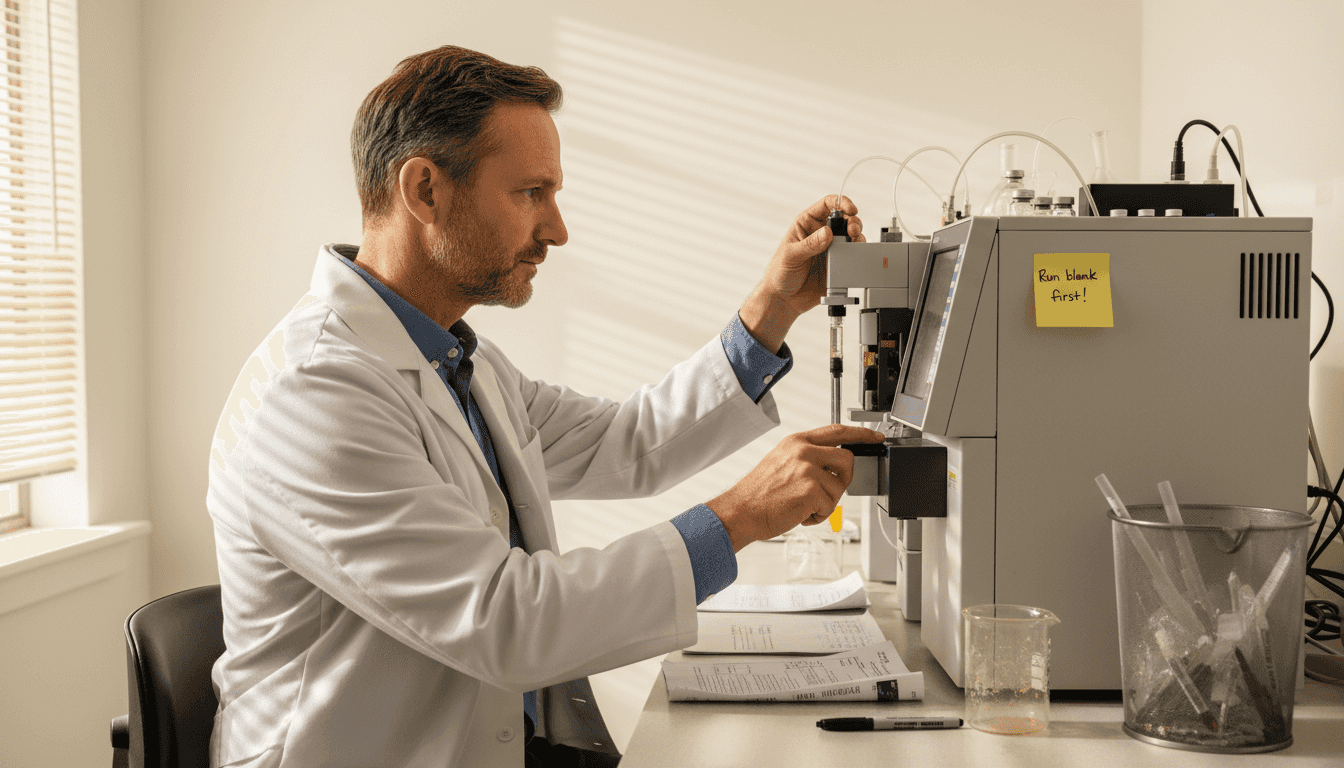
Your gradient run typically spans 30 to 60 minutes depending on your separation needs. The mobile phase starts with high aqueous content and gradually increases organic solvent concentration. This controlled shift allows different peptide components to elute at distinct retention times, creating individual peaks on your chromatogram.
Watch your UV detector output in real time. The 214 nanometer wavelength captures peptide bond absorption, giving you a clear signal for each component present. Multiple peaks indicate impurities or degradation products. A single sharp peak suggests high purity.
The analysis workflow involves these key actions:
- Monitor the baseline stability throughout the run for consistent detection
- Record the retention time of your primary peptide peak
- Note the peak area percentage relative to all peaks detected
- Compare against peptide purity benchmarks to verify your results meet expected standards
- Document any unexpected peaks that deviate from your control run
Once your run completes, the software automatically calculates purity percentages by dividing the main peak area by the total area of all peaks. A result above 95 percent is solid for most research applications, though higher purity often correlates with better experimental reproducibility.
Your HPLC run generates the hard data backing up everything you claim about your sample. Sloppy execution here undermines all the prep work you just completed.
Don’t rush through interpretation. Examine your chromatogram carefully for anomalies—tailing peaks, shoulder formations, or baseline drift all suggest technical issues requiring troubleshooting before you trust your numbers.
Pro tip: Run your analysis twice on separate sample preparations to confirm reproducibility. If your two runs show similar peak patterns and purity percentages within 2-3 percent, your protocol is solid and your data is trustworthy.
Step 3: Validate purity with advanced chromatographic methods
Your basic HPLC run gave you solid purity data, but advanced chromatographic techniques dig deeper into what you’re actually dealing with. These methods catch impurities that standard UV detection might miss and give you molecular-level confidence in your results.
The next level involves coupling your liquid chromatography with mass spectrometry. LC-UV/MS workflows combine the separation power of reversed-phase chromatography with the identification capability of mass spec. Each peak eluting from your column gets ionized and analyzed by mass, creating a fingerprint that reveals exactly what compounds are present, not just their presence.
This approach matters because two different molecules can have similar retention times. Without mass data, you might misidentify an impurity as your target peptide. Mass spectrometry eliminates that guesswork by measuring molecular weight with extreme precision.
The validation process follows these steps:
- Generate a mass spectrum for your primary peptide peak to confirm expected molecular weight
- Identify all secondary peaks with mass detection to characterize impurities by chemical structure
- Compare retention times between your sample and authenticated reference standards
- Document fragmentation patterns that distinguish your target from look-alike contaminants
- Calculate mass accuracy to ensure your peaks align within acceptable deviation limits
Advanced LC-UV and mass spectrometry workflows accelerate your method development by reducing ambiguity. You move from wondering whether your sample is pure to knowing precisely what comprises it.
When multiple peaks appear in your chromatogram, mass spec transforms them from anonymous blobs into identified compounds. This granular data reveals whether you’re dealing with aggregates, oxidized forms, or genuine contaminants from your synthesis process.
Advanced chromatographic validation converts uncertainty into certainty. You’re no longer trusting a single detection method—you’re triangulating with mass data.
Store your LC-UV/MS output as your permanent record. Screenshots of chromatograms and mass spectra become your evidence that your research material meets specification. This documentation proves critical if results ever come under scrutiny.
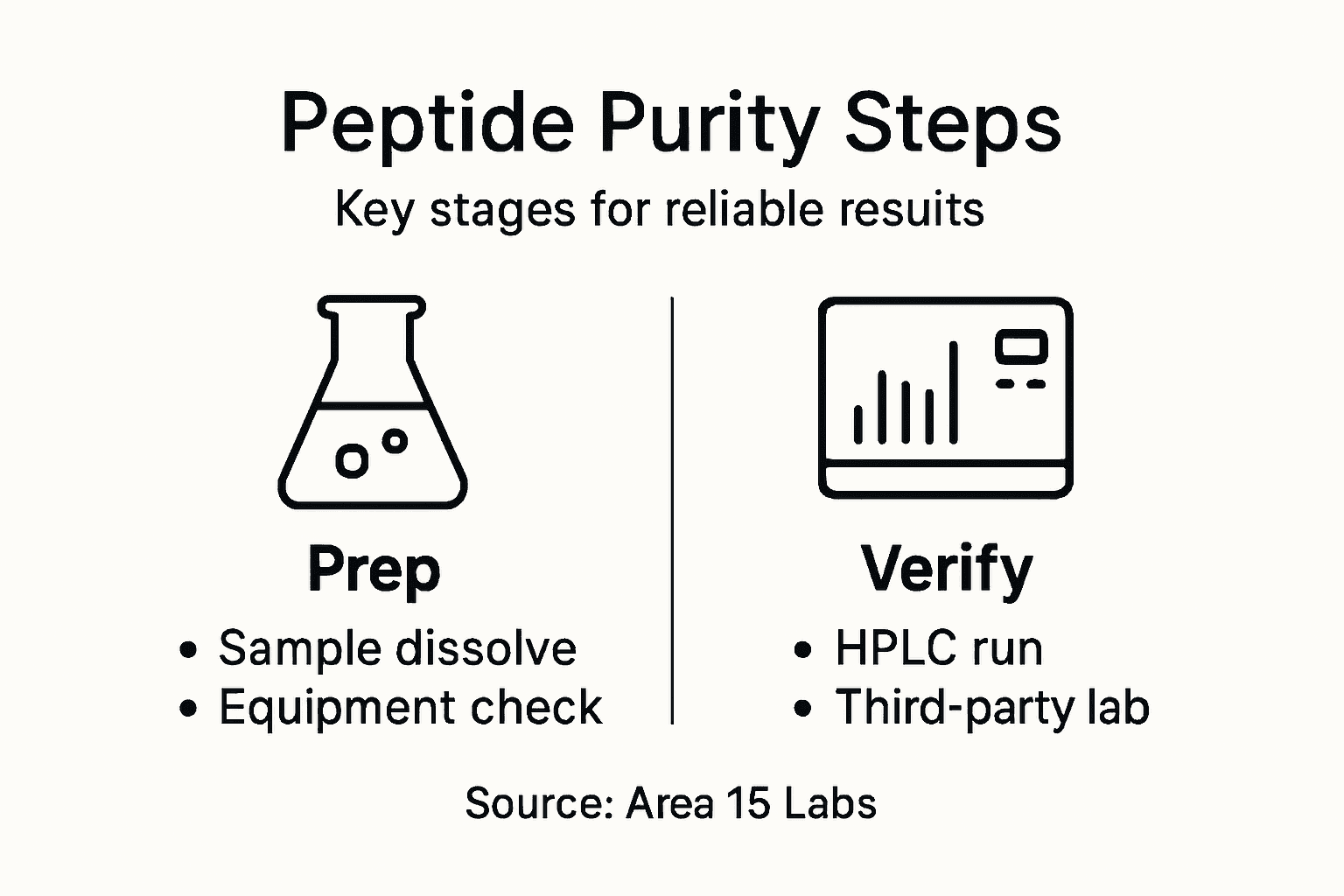
Here’s a quick summary contrasting standard HPLC purity analysis with advanced LC-UV/MS validation methods:
| Method | Main Purpose | Key Strength | Limitation |
|---|---|---|---|
| HPLC (UV detection) | Reveals sample purity | Fast, widely used | Limited to UV-visible |
| LC-UV/MS | Identifies impurities | Molecular-level detail | Requires specialized gear |
Pro tip: Run a solvent blank through your LC-UV/MS system before analyzing your sample to confirm the instrument baseline is clean. Residual peaks in the blank will ghost your sample data and create false impurity signals.
Step 4: Confirm results with third-party lab verification
Your in-house analysis generated solid data, but independent third-party verification transforms that data into bulletproof evidence. Third-party labs operate under strict quality protocols and accreditations that your bench testing alone cannot replicate.
This step is where skepticism becomes confidence. When you submit your sample to an accredited testing facility, you’re accessing standardized methods, calibrated equipment, and audited protocols that researchers globally recognize as legitimate. Their results carry weight your internal data simply cannot match.
Third-party testing serves multiple purposes beyond validation. These labs provide Certificate of Analysis documents that document purity percentages, impurity profiles, and heavy metal screening. You get a neutral third party confirming what you discovered independently. This removes any perception of bias or self-interest from your findings.
When selecting a testing partner, focus on these criteria:
- ISO or CLIA certification that proves they meet international quality standards
- Specific experience with peptides rather than generalist labs
- Transparent reporting of methods used and equipment specifications
- Reasonable turnaround times that fit your research schedule
- Pricing that aligns with your research budget without sacrificing quality
Submitting your sample requires proper packaging and documentation. Include detailed sample information like expected composition, any known synthesis conditions, and your desired test parameters. Labs with peptide authenticity testing protocols can cross-verify your molecular identity using multiple independent approaches.
Review these critical factors when choosing a third-party peptide testing lab:
| Factor | Why It Matters | Example Consideration |
|---|---|---|
| Certification | Ensures recognized quality standard | ISO 17025 accreditation |
| Peptide Expertise | Reduces risk of misanalysis | Routine peptide testing cases |
| Reporting Transparency | Enables accurate data review | Full methods disclosure |
| Turnaround Time | Keeps your research on schedule | Samples analyzed in 5 days |
Once you receive their Certificate of Analysis, compare their results against your internal HPLC data. Alignment between your measurements and theirs strengthens your confidence dramatically. Discrepancies signal either technique-specific artifacts or potential issues requiring investigation.
Third-party verification isn’t insurance against bad samples—it’s insurance that your good samples actually are what you believe they are.
Archive the Certificate of Analysis alongside your raw chromatography data. This complete documentation package becomes your evidence trail if anyone questions your research material’s integrity or quality claims.
Pro tip: Request that the third-party lab retain a sample split for six months. If you discover issues later or need to re-verify results, having a stored sample prevents expensive re-testing and preserves your testing timeline.
Elevate Your Peptide Purity Testing with Area 15 Labs
Navigating the complex world of peptide purity testing requires precision, speed, and total trust in your research materials. This article drills down on the challenges of sample preparation, HPLC protocols, and rigorous third-party validation—the very hurdles modern researchers face every day. At Area 15 Labs, we understand that incomplete or unreliable data can derail entire projects, leaving you scrambling for answers. That is why we deliver high-purity peptides verified by advanced chromatographic methods to fuel your research without compromise.
Why settle for slow overseas shipping or opaque quality claims when you can get verified, lab-ready compounds shipped straight from Texas with lightning-fast turnaround? Our commitment to radical transparency and third-party verification means your research subjects meet the highest standards of purity and consistency. Plus, our edgy, alien-inspired branding brings excitement back to the lab without sacrificing rigor. Ready to cut through the noise and get the hard data you need? Discover how our rigor meets swagger by exploring our peptide solutions and learn about peptide purity benchmarks that set the standard in research accuracy.
Get the inside edge on peptide purity testing with the no-nonsense Texas advantage. Dive into advanced analysis workflows and partner with a brand that backs every batch with science and speed. Don’t just test harder. Research smarter with Area 15 Labs.
Frequently Asked Questions
What are the essential steps for peptide purity testing?
To perform peptide purity testing, start with proper sample preparation and equipment setup. Prepare your peptide in a suitable solvent, filter the solution, set up your High-Performance Liquid Chromatography (HPLC) system accurately, and calibrate it before running the analysis.
How can I ensure complete dissolution of my peptide sample?
To ensure complete dissolution, add the solvent gradually while gently swirling the sample instead of shaking it aggressively. Aim for a uniform solution and avoid agitation that can denature your peptide.
What wavelength should I set my UV detector for peptide analysis?
Set your UV detector to 214 nanometers, which is optimal for capturing peptide bonds’ absorption. This will enhance your ability to detect the presence and purity of your peptides in the chromatogram.
How can I confirm the purity results from my HPLC analysis?
You can confirm purity results by conducting a repeat analysis on a separate sample preparation to check for consistency within 2-3 percent. Additionally, compare your data against established peptide purity benchmarks to validate your findings.
Why is third-party lab verification important for peptide purity testing?
Third-party lab verification provides an unbiased confirmation of your purity results, reinforcing the credibility of your findings. Submit your sample to a certified lab for a Certificate of Analysis that confirms the purity percentages and impurity profiles.
What should I consider when choosing a third-party testing lab for peptides?
When selecting a third-party testing lab, consider their certifications, experience with peptides, and their reporting transparency. Additionally, ensure their turnaround times and pricing align with your research needs to facilitate timely results.