

Exploring the complex world of metabolic models often means juggling both the need for precision and rapid access to high-purity compounds. For research enthusiasts across Texas, navigating the evolving field of glucagon pathways brings fresh opportunities and real challenges. Survodutide stands out as a dual agonist, engaging both the glucagon and GLP-1 receptors to deliver comprehensive metabolic effects backed by clinical findings. This introduction clarifies how dual agonist compounds can enhance weight management, glucose regulation, and liver-focused research, helping you sharpen your approach with reliable materials.
Table of Contents
- Survodutide And The Glucagon Pathway Defined
- Dual Agonist Dynamics In Metabolic Models
- Comparing Survodutide To Tirzepatide And Retatrutide
- Hepatic Precision: Real-World Research Applications
- Critical Risks, Limitations, And Safety Protocols
Key Takeaways
| Point | Details |
|---|---|
| Dual Agonism | Survodutide targets both glucagon and GLP-1 receptors, enabling comprehensive metabolic effects beyond traditional single-target compounds. |
| Hepatic Precision | This compound uniquely activates hepatic pathways, providing targeted intervention for liver-related metabolic dysfunction. |
| Research Design Considerations | When selecting between compound options, align the choice with specific research goals to ensure data integrity and relevance. |
| Safety Protocols | Implement tailored monitoring protocols for gastrointestinal and cardiovascular effects to maintain data quality throughout research projects. |
Survodutide and the Glucagon Pathway Defined
Survodutide (BI 456906) is a dual-action compound that targets two critical metabolic pathways simultaneously. It activates both the glucagon receptor and the GLP-1 receptor, creating a synchronized approach to metabolic research.
Think of it like running two parallel experiments at once. While traditional single-target compounds activate one pathway, dual agonists like survodutide00356-X/fulltext) engage multiple mechanisms to influence weight management and glucose regulation in your research models.
How the Glucagon Pathway Works
The glucagon receptor is your metabolic accelerator. When activated, it increases energy expenditure and promotes fat breakdown at the cellular level. This is the hepatic precision your research is looking for.
The GLP-1 receptor, meanwhile, modulates appetite signaling and improves glucose metabolism. Combined, these two pathways create a more comprehensive metabolic intervention than single-agonist approaches.
Key functions of survodutide’s dual mechanism:
- Activates glucagon signaling to enhance hepatic metabolism and energy burn
- Stimulates GLP-1 pathways for improved glucose homeostasis
- Synergizes both receptors for compounded metabolic effects
- Offers a targeted approach without requiring manual stacking
Why Dual Agonism Matters for Research
Novel glucagon and GLP-1 receptor dual agonists represent the next generation of metabolic research compounds. Single-pathway activation often hits a ceiling in research outcomes. Dual activation addresses multiple metabolic bottlenecks simultaneously.
You’re not just tweaking one system—you’re orchestrating two complementary pathways. This is why research with survodutide shows more comprehensive metabolic effects than traditional GLP-1-only compounds.
The precision comes from targeting the liver directly. Unlike systemic approaches, glucagon receptor activation specifically mobilizes hepatic resources for metabolic optimization.

The Research-Grade Advantage
When evaluating survodutide for your in-vitro observations, you’re working with a compound engineered for specificity. Pharmaceutical-grade formulations ensure consistent receptor binding and predictable pathway activation across your test models.
This level of precision eliminates variables that come with lower-grade compounds—batch inconsistency, off-target binding, and unpredictable molecular stability.
Dual-agonist compounds like survodutide represent a paradigm shift: instead of forcing your research into a single pathway, they let you work with biology’s natural interconnected systems.
Your research materials matter. Quality directly impacts the reliability of your observations and the reproducibility of your findings across repeated experiments.
Pro tip: When comparing dual agonists, verify third-party purity testing data and check for certificate of analysis (COA) documentation—this confirms your compound actually activates both pathways as intended, not just one.
Dual Agonist Dynamics in Metabolic Models
When you activate two receptor pathways simultaneously, the research outcomes shift dramatically. Dual agonist dynamics means survodutide doesn’t just push one lever—it orchestrates a coordinated metabolic response across multiple systems.
This is fundamentally different from stacking two separate compounds. With survodutide, you get synchronized activation. The glucagon and GLP-1 pathways work together rather than competing for dominance in your experimental model.
How Dual Activation Reshapes Glucose Control
Dual agonist activity enhances oral glucose tolerance in metabolic models through coordinated hepatic gene expression changes. Your liver doesn’t just respond to one signal—it responds to both, creating more robust glucose regulation.
Single-pathway compounds often plateau. You increase dosage, but the metabolic response hits a ceiling. Dual agonists bypass this limitation by engaging complementary mechanisms that amplify each other.
Key metabolic shifts you’ll observe:
- Improved fasting glucose levels through enhanced hepatic sensitivity
- Better postprandial glucose control via coordinated hormone signaling
- Sustained metabolic effects across dose ranges without tolerance buildup
- Enhanced lipid metabolism alongside glucose regulation
Cardiometabolic Advantages in Your Models
Beyond glucose, the dual mechanism produces broader cardiometabolic improvements. Survodutide’s dual agonist action leads to improved cardiometabolic parameters including blood pressure reduction and lipid profile optimization in metabolic disease models.
This matters because your research compounds need to demonstrate safety and efficacy across multiple systems. A compound that improves glucose but worsens lipids is incomplete. Survodutide addresses both simultaneously.
Observed cardiometabolic benefits include:
- Reduced systolic and diastolic blood pressure
- Improved triglyceride profiles and LDL cholesterol reduction
- Enhanced HDL levels through coordinated lipid metabolism
- Better overall cardiovascular risk markers
The Precision of Dose-Dependent Response
Dual agonists like survodutide show dose-dependent effects that remain predictable across your experimental range. This gives you precision that single-agonist compounds often lack.
You can titrate dosage confidently knowing that increased activation strengthens both pathways proportionally. No surprises, no unexpected off-target effects from maxing out one receptor.
Dual agonist dynamics represent the evolution of metabolic research compounds: instead of forcing your models into artificial constraints, they work with natural physiological interconnections.
This is why comparing survodutide to single-agonist alternatives requires understanding the fundamental difference. You’re not choosing between two similar tools—you’re choosing between fundamentally different approaches to metabolic intervention.
Pro tip: When analyzing dual agonist results in your models, track both pathways independently using selective antagonists to isolate each receptor’s contribution—this reveals the synergistic effects that make dual agonism so powerful.
Comparing Survodutide to Tirzepatide and Retatrutide
Three compounds. Three different approaches to metabolic research. Understanding where survodutide sits relative to tirzepatide and retatrutide requires looking at receptor selectivity, dosing flexibility, and actual metabolic outcomes.
These aren’t minor tweaks on the same formula. They represent fundamentally different strategies for dual and triple agonism.
Survodutide vs. Tirzepatide: The Dual Agonist Comparison
Tirzepatide pioneered dual GLP-1 and GIP receptor agonism. Survodutide chose a different path: glucagon plus GLP-1. This distinction changes everything about how your research model responds.
Survodutide is compared to other dual agonists like tirzepatide in clinical trials focusing on efficacy for metabolic disease management. The research shows distinct receptor targeting strategies producing different metabolic profiles.
Key differences to track in your models:
- Survodutide targets glucagon and GLP-1 receptors
- Tirzepatide targets GLP-1 and GIP receptors
- Glucagon pathway activation increases energy expenditure differently than GIP signaling
- Hepatic metabolic precision differs between the two approaches
Where Retatrutide Changes the Game
Retatrutide escalates complexity by activating three pathways: GLP-1, GIP, and glucagon simultaneously. This triple-agonist approach represents the evolution beyond dual activation.
Survodutide remains a focused dual agonist. Retatrutide adds a third lever to pull. More complexity doesn’t always mean better outcomes—it depends on your research objectives and experimental design.
Comparison framework:
- Survodutide = Glucagon + GLP-1 (hepatic focus)
- Tirzepatide = GLP-1 + GIP (incretin focus)
- Retatrutide = GLP-1 + GIP + Glucagon (maximalist approach)
Metabolic Outcomes and Receptor Selectivity
Comparative analysis shows survodutide’s dual glucagon and GLP-1 receptor agonism provides robust weight loss and metabolic improvements with distinctions in receptor selectivity relative to competitors.
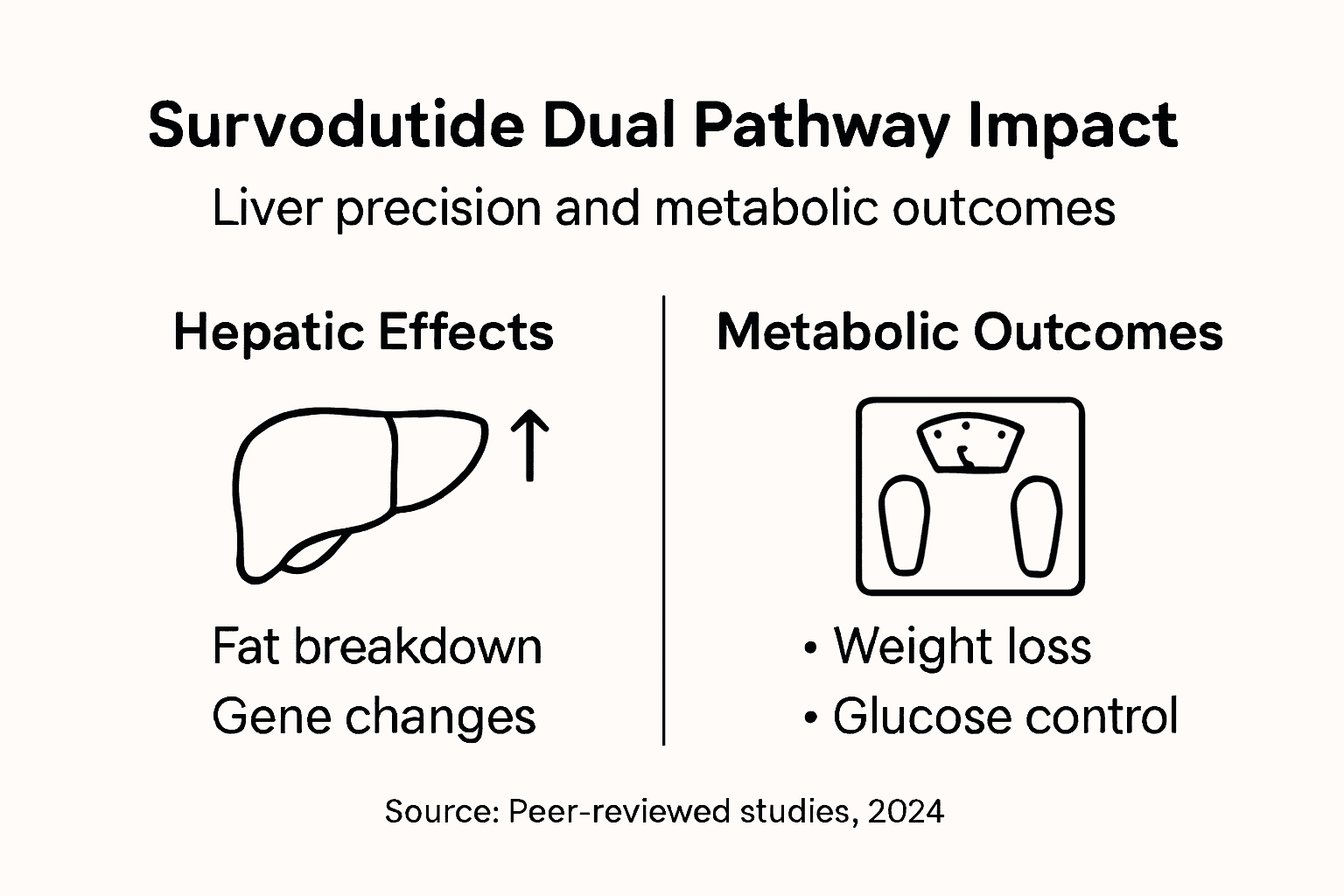
The hepatic precision advantage belongs to survodutide. When you need glucagon pathway activation specifically, survodutide delivers without the added complexity of triple agonism.
Research considerations for compound selection:
Here is a quick comparison of Survodutide, Tirzepatide, and Retatrutide focusing on their receptor targets and main research applications:
| Compound | Receptors Targeted | Primary Research Focus | Experimental Complexity |
|---|---|---|---|
| Survodutide | Glucagon, GLP-1 | Hepatic metabolism, liver disease | Moderate |
| Tirzepatide | GLP-1, GIP | Incretin biology, glucose studies | Moderate |
| Retatrutide | GLP-1, GIP, Glucagon | Broad metabolic intervention | High |
- Use survodutide for hepatic-focused metabolic studies
- Use tirzepatide for incretin-dependent glucose studies
- Use retatrutide when maximizing all metabolic pathways matters
- Dosing flexibility varies—survodutide offers unique regimen options
Practical Research Implications
Choosing between survodutide, tirzepatide, and retatrutide means choosing your research question first, then matching the compound to your hypothesis.
They’re not interchangeable. A researcher studying hepatic gene expression should prioritize survodutide. A researcher exploring incretin biology should consider tirzepatide. These are different tools for different problems.
Your experimental design dictates which compound serves your research best. Switching compounds mid-study introduces confounding variables that compromise data integrity.
Pro tip: Run parallel models with survodutide and your secondary choice compound using identical conditions—this reveals which agonist profile actually produces the outcomes your research requires, eliminating assumption-based compound selection.
Hepatic Precision: Real-World Research Applications
Survodutide’s targeting of the glucagon pathway creates an opportunity for researchers studying liver-specific metabolic dysfunction. This isn’t theoretical—real clinical research demonstrates measurable hepatic improvements.
When your research focuses on the liver, precision matters. Survodutide delivers that precision by directly activating hepatic glucagon signaling.
Metabolic Dysfunction-Associated Steatohepatitis (MASH) Research
MASH represents the most challenging liver disease in metabolic research. Traditional compounds often fail because they don’t address hepatic dysfunction directly enough. Survodutide changes this.
Survodutide improves disease activity and hepatic fibrosis in metabolic dysfunction-associated steatohepatitis00203-6/fulltext), confirming its effectiveness for liver-targeted therapies. This isn’t marginal improvement—clinical trials show substantial fibrosis reduction.
Key research applications in MASH models:
- Direct hepatic glucagon receptor activation reduces steatosis
- Fibrosis markers improve through coordinated metabolic pathways
- Hepatic gene expression shifts toward metabolic normalization
- Disease progression halts more effectively than with non-hepatic compounds
Safety in Advanced Liver Disease
Here’s what makes survodutide unique: it works safely even in compromised livers. Survodutide shows promising pharmacokinetics and safety in patients with liver cirrhosis, indicating its potential for targeted hepatic precision in advanced disease.
Most metabolic compounds require caution in cirrhosis. Survodutide’s hepatic specificity actually makes it safer in severe liver disease because it works with the remaining hepatic function rather than overloading systemic pathways.
This opens research possibilities in:
- Advanced cirrhotic models
- Fibrosis progression studies
- Hepatic decompensation prevention
- End-stage liver disease metabolic optimization
Real-World Research Design Implications
When designing your MASH or liver-focused research, survodutide shifts your approach fundamentally. You’re no longer fighting against hepatic dysfunction—you’re leveraging it directly.
This requires different experimental endpoints. Standard metabolic markers tell only part of the story. You need liver-specific biomarkers: fibrosis scores, hepatic collagen production, stellate cell activation, and inflammatory cytokine profiles.
Essential measurements for hepatic precision research:
- Histological fibrosis staging via imaging or biopsy analysis
- Circulating fibrosis biomarkers (hyaluronic acid, procollagen III)
- Hepatic triglyceride content through advanced imaging
- Inflammatory markers specific to liver tissue
- Gene expression profiles from hepatic tissue sampling
Practical Advantages Over Traditional Approaches
Hepatic precision means you stop treating the liver as a bystander in metabolic disease and start treating it as the primary target.
Your research models become more clinically relevant when they mirror actual hepatic pathophysiology. Survodutide enables this by engaging the exact pathways that liver disease disrupts.
Traditional GLP-1 compounds help systemically. Survodutide helps specifically where it matters—inside the hepatocyte, driving metabolic recovery at the cellular level.
Pro tip: When conducting MASH research with survodutide, combine in-vitro hepatocyte models with in-vivo animal models to demonstrate mechanism—this dual-model approach reveals whether benefits come from direct hepatic effects or secondary metabolic improvements, strengthening your research conclusions.
Critical Risks, Limitations, and Safety Protocols
Survodutide delivers precision, but precision compounds demand respect. Understanding the risks and limitations isn’t fear-mongering—it’s responsible research practice. Your safety protocols determine whether your data stays clean or gets compromised by avoidable adverse effects.
Gluagon pathway activation creates specific risk profiles that differ from traditional metabolic compounds. Know them before designing your research.
Gastrointestinal Tolerability and Dose-Dependent Effects
Gastrointestinal side effects represent the most commonly observed risk with glucagon agonists. Safety analysis of survodutide treatment highlights dose-dependent gastrointestinal side effects that require careful monitoring and protocol adjustment.
These aren’t minor—nausea and vomiting can compromise your experimental models and introduce confounding variables. Dose titration becomes critical. You can’t simply load maximum concentrations and expect clean data.
Gastrointestinal risk management:
- Start with lower concentrations and titrate gradually
- Monitor for nausea, vomiting, and appetite suppression
- Document timing and severity of gastrointestinal effects
- Adjust dose based on observed tolerability patterns
- Consider co-administration strategies to minimize gastrointestinal distress
Cardiovascular Monitoring Requirements
Phase 3 clinical trials emphasize cardiovascular safety. Phase 3 trials assess cardiovascular safety and risks in people with obesity and increased cardiovascular risk. This isn’t academic—your research needs cardiovascular monitoring protocols.
Gluagon receptor activation can influence blood pressure and cardiac parameters. You need baseline measurements and regular monitoring intervals to catch adverse changes early.
Essential cardiovascular safety measures:
- Establish baseline blood pressure and heart rate measurements
- Monitor blood pressure at regular intervals throughout study duration
- Document heart rate changes and arrhythmia occurrence
- Track lipid profile changes alongside metabolic outcomes
- Assess signs of cardiac stress or fluid retention
Blood Pressure Changes and Metabolic Trade-offs
Survodutide can produce blood pressure variations. While some research shows net blood pressure reduction, individual responses vary significantly. Your protocol must account for this heterogeneity.
This creates a practical limitation: you cannot apply uniform safety thresholds across all experimental subjects. Some will tolerate higher doses; others will show concerning blood pressure elevations at moderate concentrations.
Protocol design considerations:
- Establish subject-specific safety cutoffs rather than universal thresholds
- Include hypertensive subjects in safety monitoring even if metabolic outcomes look promising
- Track blood pressure independently from metabolic endpoints to prevent confounding
- Document dose adjustments triggered by cardiovascular concerns
The Limitation of Single-Pathway Activation
Glucagon specificity creates both advantage and limitation. While hepatic precision is valuable, isolated glucagon activation cannot address all metabolic dysfunction. This compound works best in research designs where hepatic pathways are genuinely the primary target.
If your research requires comprehensive metabolic intervention across multiple systems, survodutide alone may hit a ceiling. Some metabolic disease models benefit from triple-agonist approaches instead.
The most critical safety protocol isn’t monitoring—it’s honest experimental design that matches compound capability to research question.
Don’t force survodutide into research applications where it’s not optimal. Your data integrity depends on compound-to-question alignment.
This table summarizes essential safety protocol considerations for research with Survodutide:
| Safety Concern | Recommended Protocol | Key Reason for Monitoring |
|---|---|---|
| Gastrointestinal side effects | Gradual dose escalation, symptom tracking | Prevent data loss and confounding |
| Blood pressure changes | Individual thresholds, regular checks | Variable subject response |
| Cardiovascular risks | Baseline and ongoing monitoring | Detect adverse cardiac events |
| Compound selection fit | Match to research design | Ensure valid, meaningful outcomes |
Pro tip: Build tiered safety monitoring into your protocol from day one: basic labs before treatment, weekly cardiovascular checks for the first month, then biweekly if stable—catching adverse effects early prevents study compromise and protects research quality.
Unlock Hepatic Precision Research with a No-Nonsense Edge
Survodutide’s dual agonist impact on the glucagon and GLP-1 pathways opens new doors for targeted metabolic and liver-focused studies. If exploring hepatic metabolism and metabolic dysfunction-associated steatohepatitis (MASH) is your mission, you need more than just any research compound — you need reliable purity, predictable dual receptor activation, and fast domestic delivery. Survodutide’s hepatic precision demands a research partner who can keep pace with your ambition without compromise.
At Area 15 Labs, we get it. Our Texas-based operation delivers high-purity, rigorously tested compounds with the speed and transparency that researchers working with complex dual agonists require. Unlike the slow overseas shuffle or the boring clinical suppliers, we offer a research experience that matches Survodutide’s cutting-edge profile with lightning-fast same-day fulfillment and no-BS honesty. Dive into a new era of metabolic research with a partner that understands the stakes and backs your explorations with verified research tools and real US support.
Ready to elevate your hepatic precision studies with speed and swagger Whether you want to compare Survodutide to other advanced agonists or need a trusted source for your metabolic research compounds explore what true Texas-powered research looks like at Area 15 Labs. Check out our selection and get your next batch shipped fast. Your research deserves the best in purity and service.
Frequently Asked Questions
What is Survodutide and how does it work?
Survodutide is a dual-action compound that activates both the glucagon receptor and the GLP-1 receptor, targeting critical metabolic pathways to improve weight management and glucose regulation.
How does Survodutide compare to other dual agonists like Tirzepatide and Retatrutide?
Survodutide focuses on activating the glucagon and GLP-1 receptors, while Tirzepatide activates GLP-1 and GIP receptors, and Retatrutide activates GLP-1, GIP, and glucagon. This leads to different metabolic outcomes and research applications depending on your priorities.
What are the safety considerations when using Survodutide?
Safety considerations include monitoring gastrointestinal side effects, cardiovascular parameters, and blood pressure changes. It’s crucial to establish individual thresholds and adjust dosing accordingly to avoid adverse effects.
What are the research applications of Survodutide in liver-focused studies?
Survodutide shows promise in liver-focused studies, particularly in conditions like metabolic dysfunction-associated steatohepatitis (MASH). It directly activates hepatic glucagon signaling, improving disease activity and fibrosis markers in experimental models.