
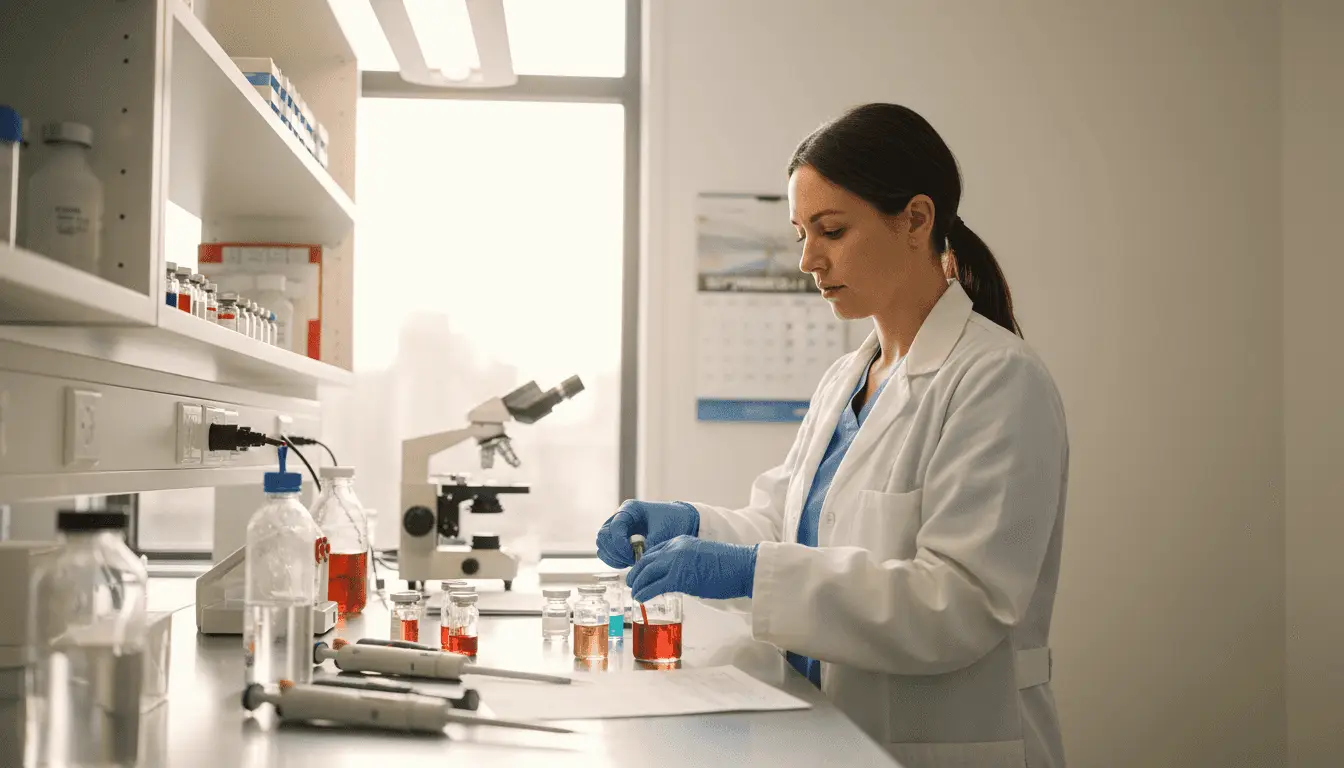
Finding reliable peptide analysis methods can be tough, especially when you need every result to stand up to scrutiny. For citizen scientists and advanced researchers across the United States, precision starts before the first sample touches your bench. Building a workspace with environmental stability and workflow separation protects your data from common pitfalls. This guide gives you the practical steps to create a lab setup that naturally supports tranparent, high-quality research from day one.
Table of Contents
- Step 1: Set Up Your Peptide Lab Workspace
- Step 2: Prepare Research Subjects and Materials
- Step 3: Run High-Purity Peptide Analysis Methods
- Step 4: Verify Results with Rigorous Quality Checks
Quick Summary
| Key Point | Explanation |
|---|---|
| 1. Organize Your Workspace Effectively | A clean, designated area prevents contamination and errors, facilitating reliable peptide research results. |
| 2. Maintain Proper Sample Preparation | Follow strict protocols for handling samples to avoid degradation and ensure integrity for accurate analysis. |
| 3. Implement Rigorous Quality Control | Regular checks and documentation catch errors early, ensuring your results remain trustworthy and reproducible. |
| 4. Use Advanced Analytical Techniques | Liquid chromatography coupled with mass spectrometry ensures precise separation and identification of peptides for reliable data. |
| 5. Document Everything Meticulously | Keeping detailed records of processes, results, and quality checks supports data legitimacy and aids troubleshooting. |
Step 1: Set Up Your Peptide Lab Workspace
Your lab workspace is the foundation of reliable peptide analysis. A clean, organized, and properly equipped space prevents contamination, reduces errors, and ensures your research produces trustworthy results. Let’s build this from the ground up.
Start by selecting a dedicated area away from high-traffic zones and direct sunlight. Peptides are light-sensitive and susceptible to temperature fluctuations, so your workspace needs environmental stability. Natural light degrades molecular integrity, so choose a spot with controlled artificial lighting or a low-light corner of your lab.
Next, set up your work surface. You’ll want a clean, flat bench made of chemical-resistant material like stainless steel or epoxy-coated laminate. The surface should be large enough to accommodate your equipment without crowding. A cramped workspace invites mistakes.
Gather your core equipment and supplies:
- Calibrated scale (accurate to at least 0.001g for precise measurements)
- Laminar flow hood or biosafety cabinet to minimize airborne contamination
- Temperature-controlled storage (refrigerator set to 2-8°C for stability)
- Lab-grade glassware including beakers, graduated cylinders, and pipette tips
- Personal protective equipment (gloves, lab coat, eye protection)
- Cleaning supplies (70% isopropyl alcohol, lint-free wipes)
Organziation matters more than you think. Designate specific zones on your bench: one for weighing, one for preparation, and one for analysis. This workflow separation prevents cross-contamination. Label everything clearly so you never mix up samples or reagents.
Proper peptide handling techniques will extend the life of your samples and improve your results significantly. Store your raw peptides in airtight, opaque containers away from moisture and heat.
A clean workspace is a reliable workspace. Contamination ruins months of research in seconds.
Install storage solutions that keep your materials organized and accessible. You should be able to locate any compound or tool within seconds without disrupting your analysis workflow. Use drawer dividers, labeled containers, and a simple inventory system so nothing gets lost.
Here’s a summary of workspace features and their impact on peptide analysis:
| Workspace Feature | Benefit to Reliability | Prevents Issues Like |
|---|---|---|
| Controlled lighting | Maintains peptide stability | Light degradation |
| Temperature regulation | Preserves sample integrity | Thermal fluctuation damage |
| Chemical-resistant bench | Ensures easy cleaning | Surface contamination |
| Organized zones | Minimizes cross-contamination | Sample mixing errors |
| Clearly labeled items | Prevents sample mix-ups | Data misinterpretation |
| Accessible storage | Maintains workflow efficiency | Lost or misplaced reagents |
Final check: ensure you have documentation space nearby. Keep a lab notebook at your bench for real-time notes on observations, dates, and any deviations from standard procedure. Digital records are great, but handwritten notes during work create an unbreakable chain of custody.
Pro tip: Set up your workspace before your first sample arrives, then document your baseline setup in photos. If results ever look questionable, you can reference your environment and rule out workspace issues as a cause.
Step 2: Prepare Research Subjects and Materials
This step separates reliable results from garbage data. How you prepare your samples and reagents determines whether your peptide analysis reveals truth or noise. Sloppy preparation destroys months of work downstream.
Start with your research subjects and biological samples. If you’re working with biological fluids or tissue extracts, proper sampling and transport protocols prevent enzymatic breakdown and chemical degradation before analysis even begins. Handle samples with care from collection to storage. Temperature matters. Time matters. Contamination kills your data.
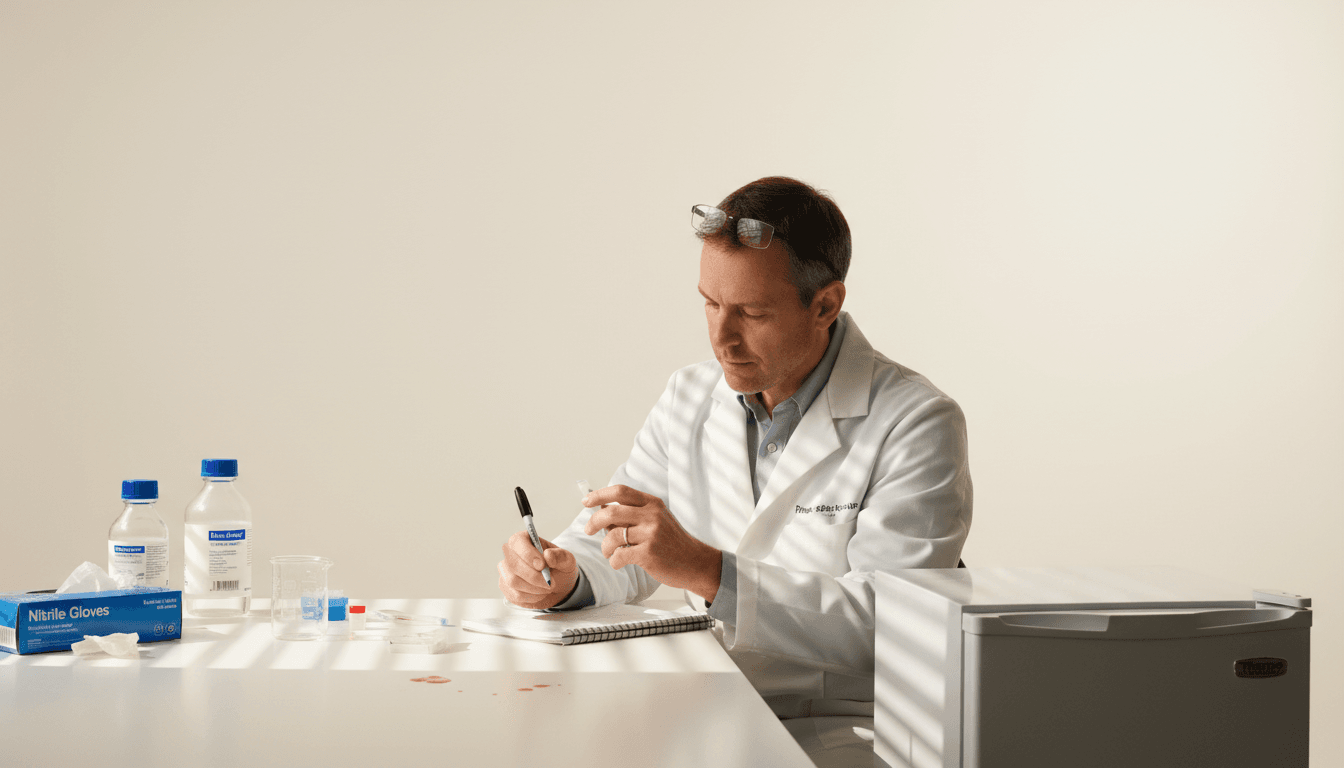
Once samples arrive at your bench, treat them with respect. Store biological materials at appropriate temperatures immediately after collection. Most peptide-containing samples need refrigeration at 2-8°C to preserve molecular integrity. Frozen samples should go to -20°C or lower if you’re not analyzing within 48 hours.
Now prepare your reagents and reference standards. You’ll need:
- Calibration standards for your analytical equipment (HPLC, mass spectrometry, etc.)
- Buffers and solvents prepared fresh according to your protocol specifications
- Enzymatic reagents for sample digestion or preprocessing if required
- Internal standards to track recovery rates and validate your results
Label everything clearly with preparation date, concentration, and expiration date. A reagent prepared three months ago is not the same as one prepared yesterday.
Thoroughness in sample processing matters tremendously. If your protocol calls for reduction, alkylation, or enzymatic digestion, follow these steps precisely and document timing. One minute of digestion time difference can shift your results. Consistency beats speed every time.
Preparation is where reliability begins. Rushed preparation guarantees unreliable results.
Organize your materials in logical order. Group all reagents for sample preparation, then analytical reagents, then cleaning solutions. Use a checklist to verify you have everything before starting. Nothing derails a research session faster than discovering mid-analysis that you’re missing a critical reagent.
Document baseline information on every sample. Record the source, collection date, storage conditions, and any preprocessing steps. This chain-of-custody documentation proves your work is legitimate when results need scrutiny.
Pro tip: Prepare duplicate reference standards and store one in the freezer as a backup. If your active standard degrades mid-analysis, you can immediately verify whether your equipment or your reagent caused the drift.
Step 3: Run High-Purity Peptide Analysis Methods
This is where theory meets reality. Your analysis method determines whether you get data or noise. High-purity peptide analysis requires precision equipment, disciplined protocols, and relentless attention to detail.
Start with your analytical instrument. Most serious peptide work uses liquid chromatography coupled with mass spectrometry to separate and identify compounds with surgical accuracy. HPLC-MS/MS gives you specificity you cannot achieve with any other method. Set up your LC gradient first, calibrate your mass spectrometer, and verify that your detector responds to your reference standards before running samples.
Calibration is non-negotiable. Run your reference standards at the beginning of each analysis day. If your instrument drifts during calibration, stop and troubleshoot before touching your samples. A drift caught now saves hours of wasted data later.
Prepare your samples using the protocol you documented earlier. The typical workflow includes:
- Denature and reduce your protein or peptide sample to unfold structures
- Alkylate to stabilize reduced cysteines and prevent reoxidation
- Digest enzymatically (usually with trypsin) to generate peptide fragments
- Clean and concentrate using solid-phase extraction or similar techniques
- Reconstitute in your LC mobile phase and load onto the instrument
Timing matters tremendously. Each step has optimal timing windows. Rush through enzymatic digestion and you get incomplete cleavage. Over-digest and you destroy larger peptides. Follow your protocol timing exactly.
Monitor your analysis in real-time. Watch your chromatogram develop. If peaks appear in unexpected positions or baselines drift, pause and investigate. Real-time observation catches problems before they ruin your entire batch.
Data quality depends on method discipline. Shortcuts create artifacts, not results.
Extract your data methodically. Use sophisticated data analysis software to identify peptides and confirm modifications with confidence. Automated software reduces human error, but verify critical results manually. Trust, but verify.
Document everything. Record instrument settings, column lot numbers, temperature, time, and any deviations from your standard protocol. This audit trail proves your work is reproducible.
Pro tip: Run a blank sample (just your solvent) every fifth sample to detect instrument drift or contamination. If your blanks show unexpected peaks, your equipment needs attention before you trust your peptide data.
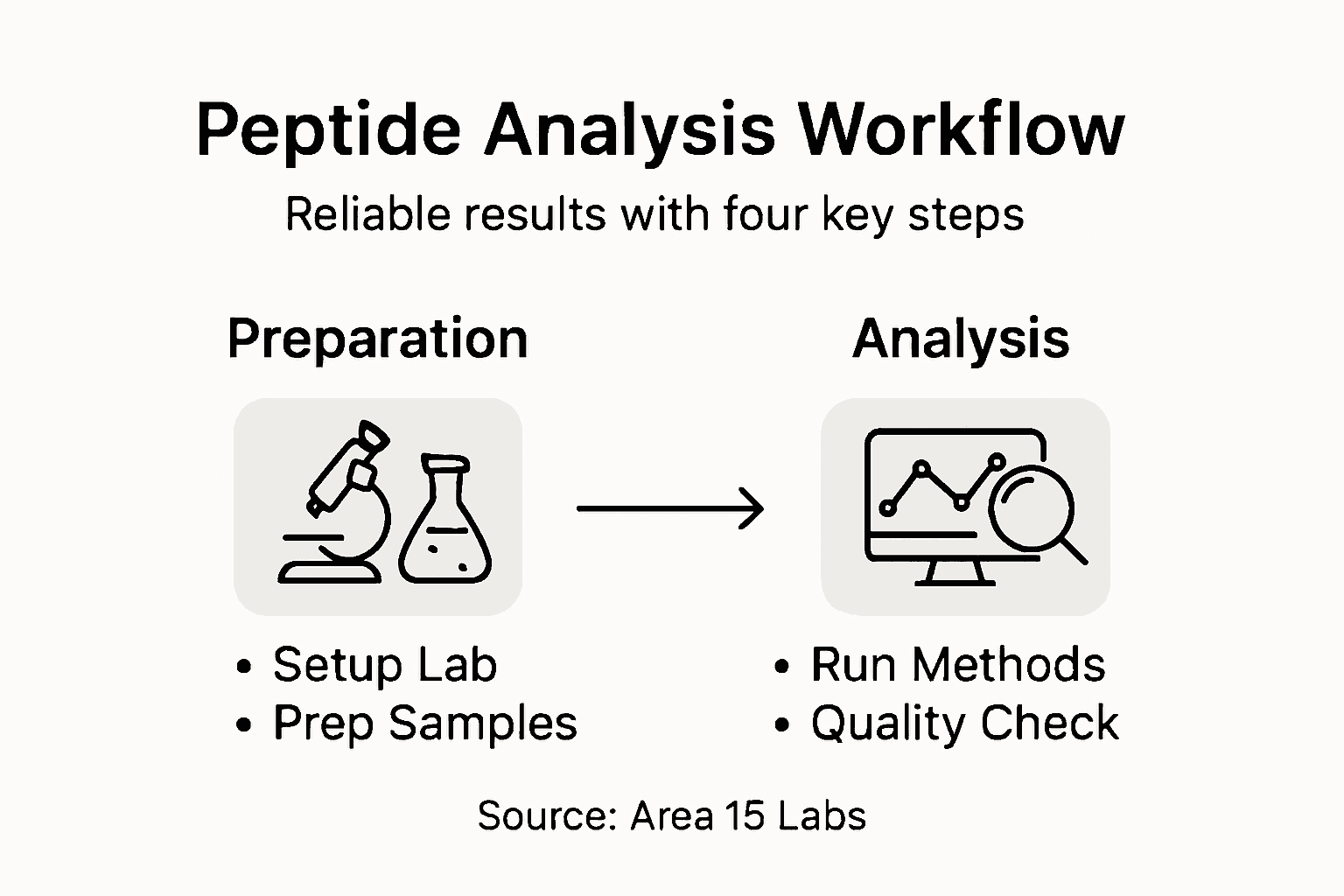
Step 4: Verify Results with Rigorous Quality Checks
Your analysis is only as good as your quality control. Results without verification are just pretty numbers on a screen. This step separates legitimate research from wishful thinking.
Start by evaluating your sample preparation reproducibility. Run your reference standard multiple times throughout your analysis batch. If your standard shows consistent peaks at consistent retention times and with consistent intensities, your sample preparation is solid. If values drift or scatter wildly, something in your protocol broke down.
Implement rigorous quality control checks including sample reproducibility assessment and instrument performance validation. These are not optional bureaucratic steps. They are your insurance policy against publishing garbage.
Check your instrument performance systematically. Review your mass spectrometer calibration curves. Verify that your detector response falls within expected ranges. Run system suitability standards to confirm your equipment is performing at specification. If anything flags outside acceptable limits, recalibrate before processing more samples.
Evaluate your data for anomalies. Look for:
- Peak integrations that look suspicious or asymmetrical
- Retention time shifts that indicate column degradation or temperature drift
- Signal-to-noise ratios that fall below your established thresholds
- Baseline irregularities suggesting contamination or instrument problems
- Missing peaks where you expect them or unexpected peaks appearing
Run blank samples to confirm you are not seeing ghost data. If your blanks show peaks matching your analytes, you have a contamination problem that invalidates your entire run.
Use this table to quickly compare major peptide analysis errors and how to catch them early:
| Error Type | Early Warning Sign | Best Quality Check |
|---|---|---|
| Contamination | Unexpected peaks in blanks | Run regular blank samples |
| Calibration drift | Shifting standard responses | Daily instrument calibration |
| Poor sample prep | Variable standard intensities | Repeatability checks |
| Instrument failure | Low sensitivity or noise | System suitability testing |
Document your acceptance criteria before you start. Know in advance what constitutes good data versus questionable data. Apply those criteria consistently and objectively to all results.
Quality checks catch problems early. Skipping them reveals problems too late, after you’ve already published.
Use automated error-checking software to flag anomalies, but do not trust it blindly. Review flagged results manually. Sometimes the software misses subtle issues that human eyes catch immediately.
If results fail quality checks, trace backward to find the culprit. Was it sample preparation? Instrument calibration? Environmental contamination? Column degradation? Once you identify the source, correct it before proceeding.
Pro tip: Create a quality control log separate from your raw data. Record every QC check, every standard run, and every acceptance or rejection decision. This log becomes invaluable if you ever need to defend your results or troubleshoot future problems.
Elevate Your Peptide Analysis with Area 15 Labs
Reliable peptide analysis demands precision from workspace setup through rigorous quality checks. The article highlights how every step, from contamination control to exact enzymatic digestion, can make or break your data integrity. If you want to avoid sample prep slip-ups and instrument calibration headaches, your research deserves the best tools backed by transparent purity guarantees and lightning-fast delivery.
At Area 15 Labs we get the struggle and deliver the solution with our high-purity peptides and lab supplies shipped same-day from Texas. Our “No-BS” approach means zero overseas delays or sketchy batch quality. Whether you need a tried-and-true peptide like BPC-157/TB-500 blend or cutting-edge compounds like Retatrutide the right materials can amplify your reliability and speed. Plus our verified research tools are packaged with swagger to make your lab workspace less boring and more badass.
Ready to upgrade your peptide workflow and banish unreliable results? Discover how Area 15 Labs makes precision effortless and research exciting. Explore our high-purity peptides and experience fast, honest Texas shipping that your lab deserves today.
Frequently Asked Questions
How can I set up my peptide lab workspace for reliable results?
Your peptide lab workspace should be clean, organized, and away from high-traffic areas. Choose a location with controlled lighting and stable temperature to prevent contamination and maintain peptide integrity. Ensure to gather essential equipment and organize your materials into designated zones for optimal workflow efficiency.
What protocols should I follow when preparing biological samples for peptide analysis?
Properly handle biological samples with attention to temperature and time from collection to analysis. Store samples at appropriate temperatures immediately after collection, typically between 2-8°C. Follow defined sampling and transport protocols to avoid enzymatic breakdown and maintain data integrity.
What should I do to run high-purity peptide analysis methods effectively?
Use liquid chromatography coupled with mass spectrometry for accurate analysis. Calibrate your instruments and verify reference standards daily before analysis to ensure precision. Follow your documented protocols meticulously to maintain consistency across your experiments.
How can I verify the reliability of my peptide analysis results?
Conduct rigorous quality checks throughout your analysis, such as running reference standards multiple times and monitoring instrument performance. Regularly evaluate your data for anomalies, including retention time shifts and inconsistent peak intensities. Create a quality control log to track all checks and findings systematically.
What steps can I take to prevent contamination in my peptide analysis?
Organize your workspace with clearly labeled zones to minimize cross-contamination. Consistently use personal protective equipment and clean surfaces regularly with appropriate cleaning supplies. Running blank samples periodically during analysis can also help identify contamination issues early on.
What documentation should I maintain during peptide analysis?
Keep comprehensive records detailing sample origins, preparation dates, and storage conditions, as well as notes on any deviations from your standard protocols. Utilize a lab notebook for real-time observations to ensure a clear chain of custody. This documentation will support reproducibility and assist in troubleshooting any issues that arise.