

Finding trustworthy research peptides feels simple until you realize how much noise and misinformation cloud the market, especially for citizen scientists in Texas driven by quality and speed. Sourcing the right compound means sorting real science from flashy marketing and empty claims. This guide helps you focus on what actually matters—like verified testing, reliable Certificates of Analysis, and consistent batch quality—so your research stays sharp, ethical, and never waits on slow shipping.
Table of Contents
- Defining Peptide Sourcing and Common Myths
- Types of Research Peptides and How They Differ
- Key Features of High-Quality Peptide Sourcing
- Legal, Ethical, and Safety Standards for Procurement
- Risks of Sketchy Suppliers and Inconsistent Purity
- Comparing Major Suppliers and Texas Shipping Speed
Key Takeaways
| Point | Details |
|---|---|
| Understand Peptide Sourcing | Peptide sourcing involves navigating a complex marketplace with both legitimate suppliers and unreliable vendors; focus on quality verification instead of marketing claims. |
| Know Your Peptide Types | Different peptides serve specific research purposes and vary in stability and synthesis methods; ensure compatibility with your experimental needs before purchasing. |
| Prioritize Quality Features | Legitimate suppliers provide Certificates of Analysis and maintain consistent quality; always verify testing documentation before placing an order. |
| Consider Shipping Efficiency | Selecting a supplier with quick shipping, particularly from Texas, can significantly impact peptide freshness and research timelines, ultimately enhancing your results. |
Defining Peptide Sourcing and Common Myths
Peptide sourcing is straightforward in concept but messy in practice. It’s the process of identifying, vetting, and acquiring research-grade peptide compounds from manufacturers for laboratory use. Sound simple? It’s not. The peptide market sits in a weird gray space where legitimate research supply coexists with sketchy vendors, overseas middlemen, and a lot of marketing nonsense masquerading as science. Your job is to cut through the noise and find sources that actually deliver what they promise.
Here’s where the myths start collapsing. The biggest one? “If it says ‘USA peptides’ or ‘domestic,’ it was made in America.” Not necessarily. Many peptides marketed as American products actually originate in China, get repackaged stateside, and slap a domestic label on them. This doesn’t automatically mean the product is garbage. Sourcing from overseas manufacturers and then testing domestically can still yield high-purity compounds. What matters is the verification process, not the patriotic marketing. When you’re evaluating a source, skip the nationalism angle and focus on what actually determines quality in peptide sourcing. Third-party testing data, Certificate of Analysis (CoA), and batch consistency are the real metrics.
Another persistent myth: “Cheaper peptides are always lower quality.” This one’s tempting to believe because price signals legitimacy in most industries. Reality? A vendor charging premium prices might just be paying for better marketing, slicker websites, and flashier packaging. Conversely, a competitive price from a reputable source with transparent testing standards absolutely can mean you’re getting solid research material without overpaying. The price itself is meaningless without context. What you’re actually buying is the sourcing infrastructure, quality control rigor, and the vendor’s willingness to stake their reputation on every batch.
Then there’s the “glassware and reagent supplier” confusion. Some researchers think they can order peptides from massive institutional suppliers like you’d order a beaker. Those suppliers do sell peptides, but they’re built for bulk institutional orders, painfully slow shipping timelines, and customer service that treats individual researchers like nuisances. Direct-to-research suppliers exist specifically to flip that script. They understand that citizen scientists need speed, transparency, and actual human support. That’s the arena where sourcing makes real progress.
Pro tip: When evaluating any peptide source, request their most recent CoA before committing to a purchase. If they hesitate or claim it’s “proprietary,” that’s your cue to find a different vendor. Clean suppliers have nothing to hide.
Types of Research Peptides and How They Differ
Peptides aren’t a monolithic category. Walk into the research space without understanding the differences, and you’ll quickly realize that ordering a peptide is like saying you want “a car”—the answer completely changes based on which type you actually need. Research peptides fall into distinct categories, each with its own structural properties, biological activity patterns, and practical applications in the lab. The key distinctions come down to how they’re built, what they do at a molecular level, and how stable they remain under different conditions.
The most fundamental split is between short-chain and long-chain peptides. Short-chain peptides (typically 2 to 20 amino acids) are easier to synthesize, cheaper to produce, and often more stable in storage. These include dipeptides and tripeptides used for preliminary research and in-vitro observation studies. Long-chain peptides, on the other hand, contain 20 or more amino acids and behave more like proteins in terms of complexity. They offer richer biological interactions but demand more careful handling during storage and testing. Beyond length, different peptide categories serve distinct research purposes based on their amino acid sequences and structural characteristics. Hormonal peptides, antimicrobial peptides, and signaling peptides each have different stability profiles, bioavailability considerations, and glassware compatibility requirements. Some peptides degrade rapidly in solution; others maintain integrity for months. This matters enormously when you’re planning experiments or setting up long-term storage protocols.
Then there’s the question of synthesis method, which fundamentally affects quality and cost. Peptides made through solid-phase peptide synthesis (SPPS) are the gold standard for research-grade compounds because the process allows precise control over amino acid sequencing and purity outcomes. Recombinant peptides, produced through bacterial or cellular expression systems, offer scalability but introduce different purification challenges. The synthesis approach directly influences the final purity percentage, the presence of byproducts, and the Certificate of Analysis data you receive. A 98 percent pure peptide made via SPPS looks different analytically than a 98 percent pure recombinant peptide because the impurities themselves are structurally different. That’s why comparing two peptide sources solely on purity numbers without understanding their synthesis methods is a rookie mistake.
What separates amateur sourcing from professional sourcing is understanding these differences before you order. A researcher studying molecular stability needs different peptide characteristics than someone running in-vitro observation tests. One might require ultra-high purity and freeze-dried format; the other might tolerate liquid suspension with slightly lower purity if the cost savings matter. Knowing your peptide type and its specific properties means you can actually evaluate whether a source’s offering matches your research requirements rather than just grabbing whatever’s cheapest or fastest.
To clarify the differences between peptide types, here’s a summary table:
| Peptide Type | Typical Length | Common Uses | Handling Considerations |
|---|---|---|---|
| Short-chain | 2-20 amino acids | In-vitro assays | More stable, easier synthesis |
| Long-chain | 20+ amino acids | Complex interactions | Sensitive, stricter storage needed |
| Hormonal | Varies | Signal modulation | Sensitive to temperature |
| Antimicrobial | Short to medium | Infection studies | May degrade in solution |
| Signaling | Short to long | Pathway research | Format affects stability |
Pro tip: Request the amino acid sequence and synthesis method details before purchasing any peptide, then cross reference those specs against your experimental protocol to confirm compatibility.
Key Features of High-Quality Peptide Sourcing
High-quality peptide sourcing isn’t some mystical thing. It comes down to a few concrete, verifiable features that separate legit suppliers from the sketchy ones playing games. The difference between a source that will serve your research and one that wastes your time and money usually shows up in the same places every time. If a supplier can’t tick these boxes, you don’t have a supplier, you have a liability.
First up is transparency around testing and documentation. Every legitimate peptide batch should come with a Certificate of Analysis (CoA) that details exactly what’s in the vial. That CoA should specify the purity percentage (measured via HPLC or Mass Spectrometry), the exact identity of the compound, and the date the testing was performed. Some suppliers treat their CoAs like classified documents. Don’t buy from them. A real source makes their testing data easily accessible before you purchase, not after. Beyond the CoA, sourcing quality peptides requires adherence to rigorous quality assurance protocols that extend throughout the entire supply chain. This means the supplier actually cares about consistency from batch to batch, not just selling you whatever they have on hand.
Another critical feature is reproducibility and batch consistency. You need a source that delivers the same quality peptide over multiple orders. If your first shipment is 99 percent pure but your second is 94 percent pure, that’s useless for research. You can’t run reliable experiments when your raw materials keep changing. Consistent sourcing means consistent results. This is where supplier reputation actually matters. Has the vendor been around for years? Do they have customer reviews that mention repeat purchases? Do they offer batch tracking so you can verify which exact batch you’re receiving? These aren’t nice-to-haves. They’re baseline requirements.
Speed and domestic availability matter more than most people realize. A source that ships from Texas with same-day fulfillment eliminates the uncertainty of international mail and customs delays. When your peptides arrive quickly, you minimize storage time before the experiment begins, which means fresher compounds and more reliable data. Finally, responsive customer support seals the deal. Real human support, not bots, matters when you have questions about storage protocols, reconstitution procedures, or technical specifications. A supplier who treats your email like it matters is one who probably treats their quality control the same way.
Pro tip: Compare the CoAs from at least two suppliers for the same peptide compound, looking specifically at purity percentages and impurity profiles to identify which source delivers consistently superior results.
Legal, Ethical, and Safety Standards for Procurement
Procuring research peptides isn’t just about finding the cheapest vial with the highest purity number. There’s a legal and ethical framework that governs where you can source from and what you’re allowed to do with what you buy. Ignoring this framework doesn’t just put your research at risk, it puts your credibility and potentially your institution’s reputation on the line. The regulatory landscape for peptide procurement has tightened significantly, and legitimate researchers need to understand the baseline rules before they make any purchase.
Federal regulations, particularly those overseen by the FDA, set the tone for what constitutes legitimate research-grade peptide procurement. Products marketed as “for research use only” exist in a specific legal category that protects both the manufacturer and the researcher, but only if you actually use them for research and nothing else. This isn’t a gray area or a technicality. Verified sources that prioritize legal compliance understand that their entire operation depends on maintaining this distinction. Proper sourcing from legally compliant vendors safeguards against contamination, mislabeling, and inconsistent purity, which are critical not just for valid results but for ethical scientific conduct. When you buy from a source that cuts corners on legal compliance, you’re also buying into their corner-cutting on quality control. These things don’t separate.
Ethical sourcing ties directly to safety standards. A supplier operating within legal frameworks typically has documented safety protocols for handling, storage, and documentation. They maintain batch records, conduct third-party testing, and can prove their claims with actual data rather than marketing speak. Safety standards also extend to how peptides are packaged and shipped. Improper packaging can degrade peptides during transit, which wastes your money and compromises your research before you even open the vial. Ethical suppliers invest in proper cold-chain logistics and protective packaging because they understand that cutting costs on shipping is cutting costs on the product itself.
The real question for researchers is simple: Are you buying from a source that treats legal and ethical compliance as a burden they resent, or as a core part of their business philosophy? Sources that resent regulations often downplay their importance or find ways to sidestep them. Sources that embrace compliance do so because they understand that it’s the foundation of trust. In peptide sourcing, trust is the difference between data you can publish and data you’ll have to discard.
Pro tip: Before purchasing from any source, request documentation proving they conduct third-party testing and maintain proper chain-of-custody records, then verify this information independently with the testing laboratory.
Risks of Sketchy Suppliers and Inconsistent Purity
Buying peptides from sketchy suppliers isn’t a minor inconvenience. It’s a research killer. The stakes are simple: garbage in, garbage out. When you source from unverified vendors, you’re not just risking wasted money. You’re risking months of wasted lab time, invalid data, and potentially publishing results built on a foundation of contamination and lies. This isn’t theoretical damage. It happens every day to researchers who cut corners or got unlucky with vendor selection.
The immediate danger is contamination and impurity variability. Sourcing peptides from illegitimate suppliers introduces contamination, impurities, and inaccuracies in amino acid sequences that jeopardize experimental results and data integrity. A sketchy vendor might claim 98 percent purity, but that remaining 2 percent could be anything. Could be harmless filler. Could be byproducts from synthesis that actively interfere with your assays. Could be heavy metals or bacterial endotoxins. Without third-party testing verification, you’re operating blind. The problem compounds when the same vendor delivers inconsistent batches. One month you get legitimate 98 percent purity. Three months later, the same catalog number comes back at 91 percent purity, and the vendor shrugs. Your experiments start failing. You spend weeks troubleshooting your protocol when the real problem was sitting in the vial the whole time.
Inconsistent purity also destroys your ability to draw reliable conclusions. Research depends on controlling variables. If your peptide quality fluctuates batch to batch, you’ve introduced an uncontrolled variable into every experiment. Your results become unreproducible. Other labs can’t replicate your work because they sourced from a different vendor or got a different batch number. This isn’t just frustrating. It’s scientifically dishonest, even if you didn’t intend it. You’re publishing data that might not hold up under scrutiny because your source material was garbage. Worse, some sketchy suppliers don’t just provide inconsistent product. They actively lie. They’ll photoshop Certificates of Analysis, claim third-party testing they never actually did, or sell you material that’s completely misidentified. You don’t find out until you run your own analytical testing weeks into your experiment.
The financial hit matters too, but less than the scientific damage. A 500-dollar mistake on a cheap peptide vial wastes money. But months of failed experiments waste months of your life and potentially your career momentum.
Pro tip: Always request the raw HPLC or Mass Spectrometry data from the testing laboratory directly rather than accepting only the vendor’s summary, then cross-reference batch numbers to confirm the data actually matches the product you received.
Comparing Major Suppliers and Texas Shipping Speed
The peptide supplier landscape is crowded, and not all crowding is equal. You’ve got the institutional giants like Sigma-Aldrich and Thermo Fisher Scientific, which operate on timelines measured in weeks and price points measured in heartbreak. Then you’ve got the specialized research suppliers scattered across the country, most of them shipping from California, New York, or overseas. And then there’s Texas. The Texas advantage isn’t just geographic. It’s logistical. When you’re comparing suppliers, shipping speed directly impacts your research timeline, your peptide freshness, and your overall costs. A peptide that degrades slightly during a two-week overseas journey is fundamentally different from one that arrives your door within 24 hours.
Major national suppliers offer breadth and institutional credibility, but they weren’t designed for citizen scientists or small labs. Peptide Sciences, for example, has solid purity credentials and excellent documentation. But their pricing runs high because they’re built for bulk institutional orders with complex approval workflows. Core Peptides operates smoothly and has earned trust in the community, but they’re based in California, which means your order is typically in transit for three to five business days minimum. Biotech Peptides carries a strong product selection but has made headlines for aggressive marketing that sometimes overshadows actual product quality data. Major peptide suppliers recognized for quality and reliability differ significantly in their logistical capabilities and shipping speed to various regions, with US-based distributors offering faster domestic delivery than international alternatives. The calculus changes when you factor in speed and domestic sourcing. A Texas-based supplier with same-day fulfillment eliminates the uncertainty of cross-country shipping. Your peptides aren’t sitting in a distribution center for three days. They’re not crossing multiple state lines and accumulating handling delays. They ship from Texas to your lab, period.
Here’s a comparison of key peptide suppliers and how shipping region affects research timelines:
| Supplier Type | Shipping Speed | Suited For | Notable Limitation |
|---|---|---|---|
| Institutional Suppliers | 1-3 weeks | Large universities | Slow, high minimum order size |
| Specialized US Vendor | 2-5 days | Independent/citizen labs | Higher unit cost, limited stock |
| Texas-Based Supplier | Same or next day | Fast-turnaround research | May have narrower product ranges |
| Overseas Supplier | 1-3 weeks, customs | Bulk, low-cost orders | Unpredictable delays, quality risks |
The speed advantage compounds when you consider peptide stability. Certain peptides degrade measurably during transit, especially if shipping isn’t optimized or temperatures fluctuate. The faster your peptide reaches you, the fresher it is when your experiments begin. This isn’t a minor detail. Fresher peptides mean more reliable biological activity and more consistent in-vitro observation results. Beyond freshness, there’s the practical reality of research timelines. If you order a peptide on Monday and need it Friday for your experiment, an overseas supplier or a three-state shipping route doesn’t cut it. Same-day Texas dispatch eliminates that stress entirely. You plan your experiment around actual availability rather than around shipping delays.
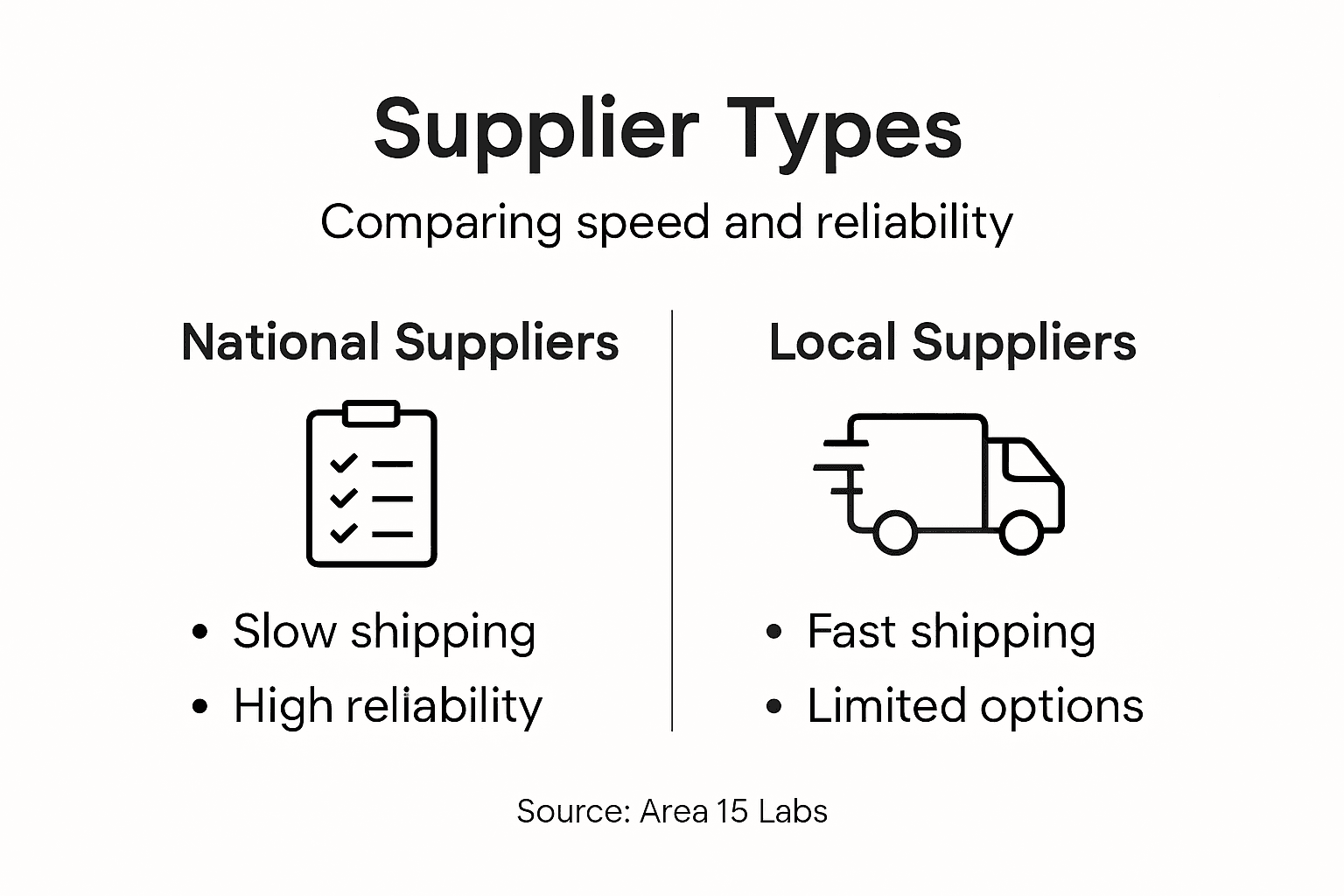
Cost per milligram matters less than total cost of ownership. A supplier charging slightly more per unit but shipping same-day from Texas might deliver better value than a cheaper option that arrives degraded or inconsistent. Your actual research cost includes wasted time troubleshooting failed assays due to peptide quality issues, not just the unit price on the invoice.
Pro tip: When comparing suppliers, calculate total turnaround time from order placement to actual experiment start, then factor in any quality loss from extended shipping to determine which option truly costs less per usable milligram.
Speed, Purity, and Texas Swagger: The Peptide Sourcing Revolution
The article nailed the real challenge researchers face: finding peptides you can trust with purity you can prove while avoiding sketchy suppliers who deliver inconsistent batches or misleading Certificates of Analysis. You want transparency, lightning-fast delivery, and ethical sourcing without the headache of overseas shipping delays or unclear origins. It called out how many vendors mask their product origins and play word games with “purity” and “quality”. It also stressed the huge impact shipping speed has on peptide freshness and experiment reliability.
That is exactly why Area 15 Labs exists. We are the “No-BS” Choice from Texas, built to serve citizen scientists who demand clean research compounds shipped same day from the heart of America. We back every batch with rigorous third-party verification and make our Certificates of Analysis easy to access before you hit buy. No hidden corners. No sketchy overseas delays. Just verified peptides with an alien aesthetic that turns boring lab supply shopping into a moment of excitement and swagger.
Don’t settle for slow shipments or questionable purity. Choose a supplier who understands that your research depends on consistency, traceability, and speed. See why more researchers trust Area 15 Labs as their go-to source for peptides by visiting our landing page. Ready to upgrade your sourcing experience? Check out our verified, high-purity products and get your order shipped from Texas same day. Research with confidence and style starts here at Area 15 Labs.
Frequently Asked Questions
What is peptide sourcing?
Peptide sourcing is the process of identifying, vetting, and acquiring research-grade peptide compounds from manufacturers for laboratory use. It involves navigating a market that includes both legitimate suppliers and less reliable vendors.
Why is purity important in peptide sourcing?
Purity is crucial because it directly impacts the reliability and validity of research results. High-purity peptides reduce the risk of contaminants affecting experimental outcomes, ensuring reproducibility and integrity in scientific studies.
How do short-chain and long-chain peptides differ?
Short-chain peptides typically contain 2 to 20 amino acids and are easier to synthesize, making them more stable in storage. Long-chain peptides have 20 or more amino acids and are more complex, requiring careful handling during storage and testing due to their sensitivity.
What are the key features of high-quality peptide suppliers?
High-quality peptide suppliers offer transparency in testing and documentation, reproducibility and batch consistency, swift shipping, and responsive customer support. Legitimate suppliers provide Certificates of Analysis and adhere to rigorous quality assurance protocols.

[…] Peptide Sourcing: Why Purity Means Progress […]