

Finding trustworthy research peptides in the United States often feels like navigating an obstacle course where a single misstep can set your project back weeks. For citizen scientists and online researchers, the stakes are high—the sourcing quality of peptides directly influences research integrity by ensuring experimental data accuracy and reproducibility. Whether you are driving innovation or verifying results, reliable sourcing means more than just quick shipping. This article guides you through the essentials of sourcing research-grade peptides, helping you make informed choices that protect both your results and your reputation.
Table of Contents
- Defining Research Peptide Sourcing And Its Purpose
- Variations In Research Peptides And Supplier Types
- How Sourcing Impacts Research Integrity And Speed
- Quality Assurance: Purity, Testing, And COA Essentials
- Legal Regulations And Compliance For Lab Use
- Risks, Pitfalls, And What To Avoid When Sourcing
Key Takeaways
| Point | Details |
|---|---|
| Research Peptide Sourcing is Critical | Ensuring high-quality peptides is essential for reliable research outcomes; poor sourcing can corrupt data and waste resources. |
| Supplier Type Influences Quality | Different supplier types (e.g., commodity, quality-focused) affect documentation, purity guarantees, and turnaround times; choose wisely based on your needs. |
| Request Proper Documentation | Always obtain a Certificate of Analysis (COA) with third-party testing data to verify purity and product integrity before purchasing. |
| Compliance is Essential | Use suppliers that adhere to ‘Research Use Only’ regulations to maintain research integrity and protect against potential legal issues. |
Defining Research Peptide Sourcing and Its Purpose
Research peptide sourcing is the process of identifying, vetting, and acquiring high-quality peptide compounds specifically designed for laboratory research applications. Unlike pharmaceutical sourcing, which involves regulated medical supply chains, research sourcing operates within a distinct ecosystem where scientists and citizen researchers source raw materials directly from suppliers who specialize in laboratory-grade compounds. The purpose is straightforward: to obtain peptides that meet strict purity standards, reproducibility requirements, and documentation specifications so that in-vitro studies, chemical analyses, and experimental protocols produce reliable, defensible results.
Why does this matter? Because sourcing high-quality peptides directly impacts your research outcomes. A contaminated batch, mislabeled compound, or supplier without proper quality controls can waste weeks of work, corrupt your data, and undermine the credibility of your findings. When you’re investing time and resources into research, cutting corners on sourcing is like building a house on sand. The integrity of your entire project depends on what goes into it from day one. Reliable sourcing ensures your peptides have been manufactured to consistent standards, come with verified Certificates of Analysis (COAs), and are traceable back to the supplier’s manufacturing protocols. This isn’t about paranoia—it’s about basic scientific rigor.
The research peptide sourcing ecosystem has two primary goals: first, to guarantee that researchers have access to compounds with documented purity levels, potency, and chemical integrity; and second, to maintain supply chain transparency so you know exactly where your materials came from and how they were produced. Unlike overseas suppliers shipping weeks later or domestic options that lack proper documentation, the best sourcing partners combine speed with accountability. They verify their manufacturing standards, maintain rigorous quality protocols, and provide full product documentation before anything ships. In essence, research peptide sourcing bridges the gap between raw chemical manufacturing and your laboratory bench.
Pro tip: Always request the Certificate of Analysis (COA) before making your first purchase from any supplier, and verify that it includes third-party testing data—this single document reveals more about a supplier’s credibility than their marketing copy ever will.
Variations in Research Peptides and Supplier Types
Not all research peptides are created equal, and neither are the suppliers selling them. The peptide research market encompasses a wide spectrum of variations in sourcing origin, manufacturing quality, pricing models, and delivery speed. Understanding these differences is critical because choosing the wrong supplier type can mean the difference between getting reliable compounds that accelerate your research and wasting resources on contaminated batches that produce garbage data.

Peptide variations start at the source. Some suppliers manufacture peptides in-house using proprietary synthesis methods, while others source from contract manufacturers and rebrand the product. The origin matters because it affects quality control consistency, documentation transparency, and your ability to trace the compound back to its manufacturing origin. You’ll find suppliers positioned across a spectrum: offshore manufacturers in Asia offering rock-bottom pricing with minimal documentation, European suppliers with stringent regulatory compliance but slower shipping times, and domestic United States-based suppliers that combine reasonable pricing with rapid fulfillment. USA-based suppliers and their offerings vary significantly in their approach to quality assurance and turnaround times.
Beyond sourcing origin, supplier types break down into distinct categories based on their business model and service level. Commodity suppliers prioritize volume and speed over documentation, often operating with minimal overhead and passing savings to customers. Quality-focused suppliers invest heavily in third-party testing, maintain detailed batch records, and provide comprehensive Certificates of Analysis. Specialty suppliers focus on rare or exotic compounds, offering deeper expertise but at premium pricing. Bulk manufacturers serve institutional clients and may not accept individual researcher orders. Hybrid suppliers blend speed with documentation, capturing the middle ground where most researchers operate. The critical insight: a supplier’s type determines what you can expect in terms of turnaround time, purity guarantees, and customer support responsiveness. Choosing based solely on price ignores the reality that a cheaper peptide from an unvetted supplier will cost you far more in failed experiments than a slightly higher price from a transparent, domestic partner would.
Another variation exists in how suppliers source their raw materials and manufacturing capacity. Some peptides labeled as domestically supplied may have originated from international manufacturers before arriving in the United States for final processing or repackaging. This sourcing model isn’t necessarily problematic—it’s the transparency that matters. Suppliers who openly acknowledge their supply chain and still provide rigorous quality testing demonstrate integrity. Those who hide their sourcing or make vague claims about origin are sending up red flags. The best suppliers clearly document where peptides are synthesized, what quality standards they meet, and provide verification through third-party testing data.
Pro tip: Request detailed sourcing information and manufacturing location from any supplier before ordering, then cross-reference their claims against their Certificate of Analysis—suppliers with nothing to hide will provide this information immediately without defensiveness or delays.
Here’s a comparison of supplier types and what researchers can expect from each:
| Supplier Type | Documentation Level | Speed of Delivery | Pricing Approach |
|---|---|---|---|
| Commodity | Minimal documentation | Fast, bulk-oriented | Lowest cost, less support |
| Quality-Focused | Extensive, third-party | Moderate, meticulous | Higher, reflects QA costs |
| Specialty | Detailed, niche focus | Variable, often slower | Highest, rare peptides |
| Bulk Manufacturer | Institutional records | Scheduled, large batch | Volume-based, contract |
| Hybrid | Moderate, balanced | Fast, reliable | Middle-range, value focus |
How Sourcing Impacts Research Integrity and Speed
Your sourcing choice is the invisible hand controlling your research outcomes. When you source peptides from a reliable supplier with rigorous quality controls, you’re essentially buying confidence in your results. When you source from the wrong place, you’re gambling with months of your time and potentially corrupting your entire dataset. The connection between sourcing quality and research integrity is not theoretical—it’s brutally practical. Research integrity depends on sourcing peptides with verified purity and identity because even minor variations in peptide composition can shift your experimental outcomes in unpredictable ways. A contaminated batch, an impure compound, or peptides that drift in potency between shipments will introduce noise into your data that you may never fully understand. You’ll spend weeks troubleshooting what you think is a methodology problem when the real culprit is sitting in your freezer in the form of substandard material.
Here’s where speed intersects with integrity. When you source from suppliers with slow turnaround times or unreliable inventory, you’re forced into workarounds that damage your research timeline. You order a compound that won’t arrive for three weeks, so you delay your entire project. Or worse, you substitute a different peptide from a questionable supplier just to keep momentum. These shortcuts seem harmless until you realize your experimental data is now fragmented across different batches with different purity profiles, making reproducibility impossible. Conversely, when you source from a fast, reliable domestic supplier, you can execute experiments on your schedule, not the supply chain’s schedule. High-quality sourcing accelerates research by providing reliable materials that support definitive conclusions while reducing troubleshooting delays. You order on Monday, receive by Wednesday, and run your experiment that week. No substitutions, no delays, no compromise on batch consistency.
The cost dynamic matters here too. A cheap peptide from an offshore supplier might save you $50 upfront, but if it forces you to repeat experiments due to ambiguous results or contamination, you’ve just invested an extra $500 in labor, reagents, and opportunity cost. Researchers who prioritize sourcing from reputable suppliers with detailed documentation and rapid fulfillment report faster project completion and higher confidence in their findings. They’re not paying more for the peptide itself—they’re paying for the efficiency and reliability that eliminates guesswork. Efficient sourcing from reputable suppliers ensures faster access to traceable batches accompanied by detailed documentation that supports streamlined research workflows. In other words, good sourcing doesn’t just protect your integrity—it accelerates your timeline and protects your budget simultaneously.
Pro tip: Track the time from order placement to usable results for your first three peptide purchases from different suppliers, then calculate the true cost per usable experiment—this metric will quickly reveal which supplier actually saves you time and money.
Quality Assurance: Purity, Testing, and COA Essentials
Purity is not a suggestion in research peptide sourcing. It’s the entire ballgame. A peptide that claims 95% purity but actually sits at 87% might look fine on paper until your experiment produces data that doesn’t replicate. That’s when you discover the hard truth: you’ve been working with a compound that was never what you thought it was. This is where quality assurance becomes your insurance policy. Quality assurance in peptide research encompasses three critical pillars: verified purity levels, rigorous third-party testing, and comprehensive Certificates of Analysis that document exactly what you’re receiving. Without these three elements working in concert, you’re operating blind.
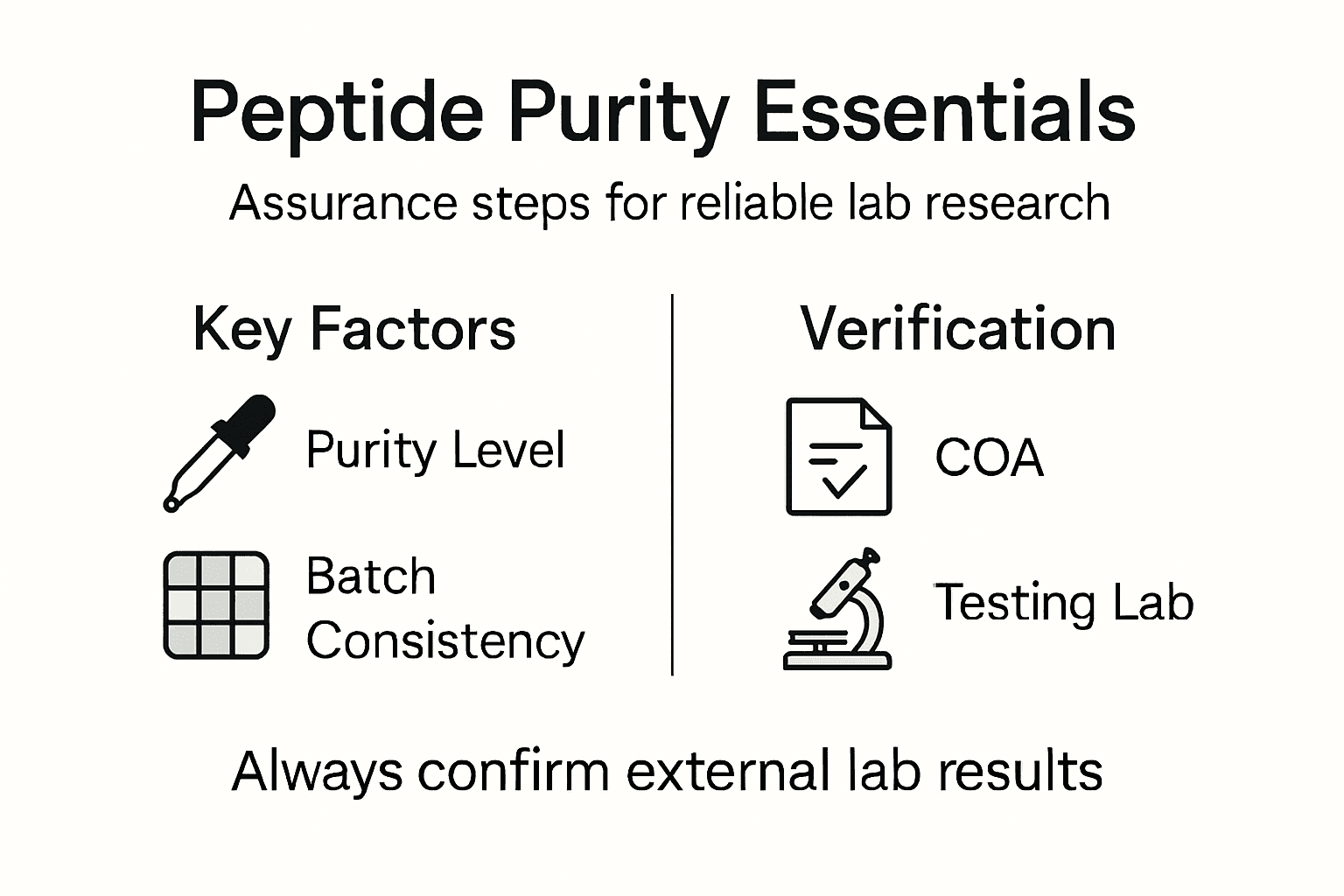
Purity testing is where the rubber meets the road. Legitimate suppliers don’t just claim their peptides are pure—they prove it through independent laboratory analysis using methods like High-Performance Liquid Chromatography (HPLC) or Mass Spectrometry. These aren’t optional extras. They’re the backbone of credibility. When you request a Certificate of Analysis from a supplier, you’re asking them to show you the actual lab results from a third-party testing facility that verified the batch composition, purity percentage, and identity of the compound. A legitimate COA will include the testing facility’s name, the analytical method used, the date of testing, and the specific purity percentage. It answers the question: “Did someone actually test this, or is the supplier just making promises?” The answer separates trustworthy suppliers from those cutting corners. Understanding peptide quality control fundamentals helps researchers recognize which testing standards actually matter and which claims deserve skepticism.
Here’s where many researchers stumble: they assume all testing is created equal. It’s not. Some suppliers use in-house testing only, which introduces bias and lacks third-party verification. Others source COAs from facilities that use outdated or less rigorous testing methods. The gold standard is independent, accredited laboratory testing using current analytical methods. When evaluating a COA, look for specific markers. Does it specify the exact purity percentage, not just a range? Does it come from an accredited third-party lab with contact information you can verify? Does it include the batch number, manufacturing date, and expiration date? Does it detail the analytical method used? A COA missing these elements is basically worthless. It’s a piece of paper, not proof of quality.
Beyond purity testing, quality assurance includes stability testing and consistency verification across batches. A reputable supplier maintains records showing that peptide batches are tested not just once, but periodically to confirm they maintain their integrity over time. They also track batch-to-batch consistency, demonstrating that what you received in January will have the same purity profile as what you order in July. This consistency matters because it eliminates one major variable from your research equation. You know that any experimental variability comes from your methodology, not from inconsistent starting material.
Pro tip: Before ordering, email the supplier requesting their most recent COA from a random batch, then call the testing facility directly to verify the report is legitimate—suppliers with nothing to hide will provide this information without hesitation, while questionable suppliers will suddenly have reasons why they can’t share it.
This summary table outlines key elements of a high-quality Certificate of Analysis (COA):
| COA Element | Why It Matters | What to Look For |
|---|---|---|
| Purity Percentage | Ensures experimental reliability | Exact value, not just a range |
| Analytical Method | Validates how compound was tested | HPLC or Mass Spectrometry |
| Third-party Verification | Removes supplier bias | Accredited, independent lab listed |
| Batch & Test Dates | Enables traceability and consistency | Both dates provided and recent |
Legal Regulations and Compliance for Lab Use
Here’s the thing that separates legitimate research from sketchy operations: compliance matters, and not just for legal reasons. When you source peptides for laboratory research, you’re operating within a framework of regulations that exists to protect research integrity and ensure quality standards. These aren’t bureaucratic obstacles. They’re safety rails that keep your research credible. The regulatory landscape is complex because peptide research crosses multiple jurisdictions and regulatory bodies. In the United States, the FDA maintains oversight. In Europe, the EMA sets standards. Globally, the ICH (International Council for Harmonisation) establishes guidelines that harmonize quality expectations across borders. Legal and regulatory frameworks for peptides are governed by these agencies and establish quality, impurity control, and characterization standards that mandate rigorous peptide stability and impurity profiling.
For researchers sourcing peptides specifically labeled as “Research Use Only” (RUO), compliance takes on a specific shape. RUO peptides are legally distinct from pharmaceutical-grade materials. They’re not intended for human use, clinical application, or therapeutic administration. This distinction is critical because it affects which regulations apply and what documentation suppliers must provide. When you purchase RUO peptides from a legitimate supplier, that supplier is affirming that the material meets research-grade quality standards appropriate for laboratory analysis, but not for any application beyond that scope. Your responsibility as a researcher is to honor that intended use classification. You’re not just buying a chemical compound. You’re entering into an implicit agreement that you’ll use it only for its stated purpose. Legitimate suppliers take this seriously because regulatory agencies take it seriously. A supplier caught selling RUO materials knowing they’ll be misused faces serious consequences. This is why reputable suppliers ask questions about your intended use and maintain purchase documentation.
The practical compliance reality for citizen scientists and research institutions involves several concrete steps. First, verify that your supplier clearly designates their products as Research Use Only and provides appropriate disclaimers. Second, ensure that any peptides you source come with complete documentation including purity certifications and stability data that demonstrate the material meets accepted quality standards. Third, maintain records of your purchases and how you use the materials in your research. Fourth, if you’re conducting research in an institutional setting, coordinate with your institution’s compliance and quality assurance teams to ensure your sourcing aligns with internal protocols. Reputable suppliers make this easier by providing clear guidance on what documentation to maintain and how to properly store and handle research materials. They understand that your compliance protects their reputation too.
One often-overlooked aspect is that compliance also protects you as a researcher. When you source from suppliers who follow regulatory guidelines and maintain quality standards, you’re reducing your risk of receiving contaminated or mislabeled material that could invalidate your research or create liability issues. Quality standards exist because decades of research showed what happens when they don’t. Using properly sourced, compliant materials means you can stand behind your results with confidence. It means if someone questions your methodology or your findings, you can point to documentation showing your starting materials met accepted quality standards. That credibility is invaluable.
Pro tip: Request that your supplier provide written confirmation that their RUO products comply with relevant quality standards, and keep this documentation alongside your research notes—this simple step demonstrates due diligence if your work is ever audited or reviewed.
Risks, Pitfalls, and What to Avoid When Sourcing
🚩 Here’s where most researchers get burned. They start with good intentions, find a supplier with rock-bottom pricing, and convince themselves the savings justify the risk. Then reality hits. The peptide arrives late. The purity comes in below spec. The COA looks suspicious. Or worse, they don’t discover the problem until six weeks of experiments produce contradictory data that forces them to start over. These aren’t freak occurrences. They’re predictable consequences of cutting corners on sourcing. Understanding the common pitfalls separates researchers who waste time and money from those who move forward with confidence.
The first major risk is price-driven decision making. Yes, peptide costs add up. Yes, budget constraints are real. But sourcing based purely on cost per milligram is like buying a parachute based on weight savings. Cheap peptides often backfire because the savings evaporate the moment you waste reagents, time, and labor on failed experiments. A supplier selling peptides at 40% below market rate isn’t running a charity. They’re cutting corners somewhere. Maybe they’re skipping third-party testing. Maybe they’re using outdated synthesis methods. Maybe they’re mixing batches. The question isn’t “Why is it cheap?” It’s “What am I not getting?” Legitimate suppliers have overhead. They invest in quality control, third-party testing, rapid shipping infrastructure, and customer support. Prices reflect that investment. Suspiciously low prices reflect the absence of it.
The second critical pitfall is trusting suppliers without verification. A professional website, smooth checkout process, and polished marketing mean nothing if the company can’t back up their claims with documentation. Too many researchers skip the verification step entirely. They see a peptide advertised, order it, and hope for the best. The right approach: request a COA before purchasing. Call the testing facility listed on the COA to verify it’s legitimate. Ask the supplier specific questions about their manufacturing standards and sourcing. Legitimate suppliers welcome these questions. Sketchy ones make excuses or ghost you. If communication is difficult before you buy, it will be impossible after.
A third serious risk is inconsistent batch quality. You source from a supplier once, get excellent material, and assume future orders will match. Wrong assumption. Some suppliers maintain rigorous batch-to-batch consistency. Others let quality drift. One batch might be 98% pure. The next is 92%. This variability introduces a hidden variable into your research that corrupts your data reproducibility. The fix is demanding batch-specific testing documentation. Never assume consistency. Always verify. Ask suppliers if they perform stability testing across batches and if they’ll provide documentation proving consistency over time.
Another dangerous pitfall involves unclear sourcing origin and supply chain opacity. Suppliers who dodge questions about where peptides originate or how they’re manufactured are hiding something. Legitimate suppliers openly discuss their sourcing model. They explain whether they manufacture in-house or use contract manufacturers. They provide traceability information. They maintain records. Sketchy suppliers make vague claims, change their story, or become defensive. This matters because it affects your ability to troubleshoot problems. If a batch fails, you need to know exactly where it came from and how it was made to understand why.
Finally, avoid suppliers who don’t honor the Research Use Only designation. If a supplier makes vague references to potential applications beyond research, or if their marketing language suggests uses that go beyond laboratory analysis, they’re walking a dangerous line legally and ethically. Legitimate suppliers maintain clear boundaries around intended use. They don’t wink at misuse. They don’t suggest their products are suitable for anything beyond their stated purpose. This clarity protects you, protects them, and maintains the integrity of the research community.
Pro tip: Create a supplier scorecard for your first three orders, rating them on COA quality, shipping speed, documentation completeness, and customer service responsiveness—this forces you to evaluate suppliers objectively instead of relying on gut feeling or a single interaction.
Elevate Your Research Peptide Sourcing with Area 15 Labs
The article highlights how crucial purity and speed are when sourcing research peptides. You know the pain: unreliable suppliers, missing or suspicious Certificates of Analysis, and slow shipping that drags out your experiments. These roadblocks threaten your research integrity and waste your precious time and resources. At Area 15 Labs, we get it. Our high-purity, third-party verified peptides ship lightning fast from Texas, cutting out delays and questionable overseas batches. We combine rigorous quality testing with the swagger of a brand that refuses to be boring or opaque.
Why choose us?
- Strict transparency with Certificates of Analysis verified by independent labs
- Same-day fulfillment from Texas to keep your research moving at warp speed
- No-nonsense customer support that speaks your language
Stop risking your data quality with cheap, sketchy suppliers. Join the ranks of citizen scientists who demand the best with Area 15 Labs. Experience research with swagger and trust that your materials come with the documentation and speed your work deserves. Curious to see how fast true Texas shipping is? Explore our alien-inspired premium peptides and find your new research edge today.
Frequently Asked Questions
What is research peptide sourcing and why is it important?
Research peptide sourcing involves acquiring high-quality peptide compounds designed for laboratory research applications. It is crucial because the quality of the peptides directly impacts research outcomes, ensuring accuracy and reliability in experimental results.
How does the purity of peptides affect research outcomes?
The purity of peptides is essential for reliable data. A peptide with low purity may lead to inconsistent results and data that cannot be replicated, wasting time and resources in the research process.
What is a Certificate of Analysis (COA) and why is it necessary?
A Certificate of Analysis (COA) is a document provided by suppliers that confirms the quality and purity of a peptide batch. It is necessary as it ensures that the peptides meet the required standards and can be trusted for experimental use.
How do sourcing choices impact the speed of research?
Sourcing from reliable suppliers with quick turnaround times allows researchers to maintain project momentum, facilitating timely experiments and results. Conversely, slow or unreliable suppliers can delay research timelines and introduce variability into data due to inconsistent sourcing.
Recommended
- Cost Per Milligram Scam—Why Cheap Peptides Backfire
- Where Can I Buy High Purity Peptides for Research Quickly? A Guide to USA-Based Peptide Suppliers and Their Offerings | Research Peptides & News | Area 15 Labs
- 7 Types of Lab Testing Methods Every Researcher Should Know
- 7 Reasons Peptide Crystallization Makes Liquid Look Frozen
- Muscle Protein Synthesis: Key to Athletic Recovery