

Even the smallest calculation error can spark a chain reaction that ruins weeks of American laboratory work. This challenge is not uncommon, as about 60 percent of laboratory mistakes involve basic procedural or mathematical missteps. For anyone involved in scientific research, understanding how these errors spiral is vital for protecting both data integrity and scientific credibility. You will find practical strategies here to shield your experiments from hidden pitfalls and keep your results trustworthy.
Table of Contents
- Defining The Reconstitution Death Spiral Phenomenon
- Spotting The Big 3 Math Mistakes In Labs
- Conversion Errors And Wrong Volumes Explained
- Impacts On Research Subjects And Data Integrity
- How To Bulletproof Your Calculations Fast
Key Takeaways
| Point | Details |
|---|---|
| Reconstitution Death Spiral | Minor procedural errors can compound, leading to cascading failures in laboratory tasks. Rigorous documentation and prevention strategies are essential. |
| Mathematical Precision | Mathematical errors can propagate silently and compromise research integrity. Implementing verification protocols is crucial for maintaining accuracy. |
| Volume Conversion Challenges | Conversion errors can stem from imprecise measurements and incorrect unit relationships. Cultivating a culture of skepticism around calculations is vital. |
| Impact on Research Integrity | Mathematical miscalculations can invalidate research, misallocate resources, and undermine credibility. Comprehensive error-checking practices are necessary to mitigate these risks. |
Defining the Reconstitution Death Spiral Phenomenon
The reconstitution death spiral emerges as a critical research challenge where minor procedural errors progressively compound, transforming a potentially straightforward laboratory task into a cascading failure sequence. Laboratory practices demand precision, and understanding this phenomenon reveals how seemingly insignificant mistakes can dramatically undermine scientific integrity.
At its core, the reconstitution death spiral represents a systematic breakdown in experimental protocols. Researchers encounter this phenomenon when initial measurement inaccuracies trigger subsequent errors, creating a self-reinforcing cycle of increasingly compromised results. Instructional strategies and meticulous documentation become crucial in preventing these destructive procedural spirals.
Key characteristics of the reconstitution death spiral include:
- Exponential error propagation
- Incremental deviation from expected outcomes
- Cumulative loss of experimental reliability
- Potential invalidation of entire research efforts
Understanding this phenomenon requires recognizing that laboratory errors are rarely isolated incidents. Instead, they represent interconnected challenges that demand comprehensive prevention strategies, rigorous training, and a commitment to maintaining absolute precision in every experimental step.
Spotting the Big 3 Math Mistakes in Labs
In the intricate world of laboratory research, mathematical precision can mean the difference between groundbreaking discovery and complete experimental failure. Comprehensive error tracking in clinical laboratories reveals three critical mathematical pitfalls that consistently undermine scientific research integrity.
The first major mathematical mistake involves preanalytical calculation errors, which occur during sample preparation and initial measurement stages. These errors often stem from imprecise volume measurements, incorrect dilution calculations, or miscalibrated equipment. Specimen processing departments frequently encounter systematic errors that can cascade through entire research protocols, rendering subsequent data analysis fundamentally unreliable.
Key mathematical mistakes in laboratory settings include:
- Decimal point misplacements
- Improper unit conversions
- Statistical calculation errors
- Rounding mistakes that compromise data accuracy
The most insidious aspect of these mathematical errors is their ability to propagate silently. A single miscalculation can transform seemingly rigorous research into a house of cards, ready to collapse under minimal scrutiny. Researchers must develop a hypervigilant approach, implementing multiple verification steps and cross-checking calculations to prevent these potentially devastating computational mistakes.

Conversion Errors and Wrong Volumes Explained
In the precision-driven landscape of laboratory research, volume conversion represents a critical junction where mathematical accuracy can dramatically impact experimental outcomes. Unbalanced splits in digital microfluidic systems reveal how seemingly minor calculation discrepancies can lead to catastrophic targeting errors in concentration measurements.
The complexity of conversion errors stems from multiple potential failure points. Calibration dependencies create intricate variances that transform simple measurement tasks into potential statistical minefields. Researchers must recognize that volume conversion is not merely a mechanical process, but a nuanced mathematical challenge requiring meticulous attention to unit relationships, decimal precision, and systematic verification.
Common volume conversion pitfalls include:
- Mismatched measurement units
- Incorrect decimal point placement
- Inadequate precision in micropipette measurements
- Overlooking temperature and pressure variations
Successful navigation of these conversion challenges demands a multifaceted approach. Laboratories must implement rigorous cross-checking protocols, utilize digital conversion tools with verified algorithms, and cultivate a culture of mathematical skepticism where every numerical translation is treated as a potential source of experimental contamination.
Impacts on Research Subjects and Data Integrity
Research data integrity represents the fundamental cornerstone of scientific exploration, where mathematical errors can create far-reaching consequences beyond simple numerical mistakes. Toxicology testing reveals profound challenges in detecting prolonged experimental errors, demonstrating how seemingly minor calculation discrepancies can dramatically compromise entire research frameworks.
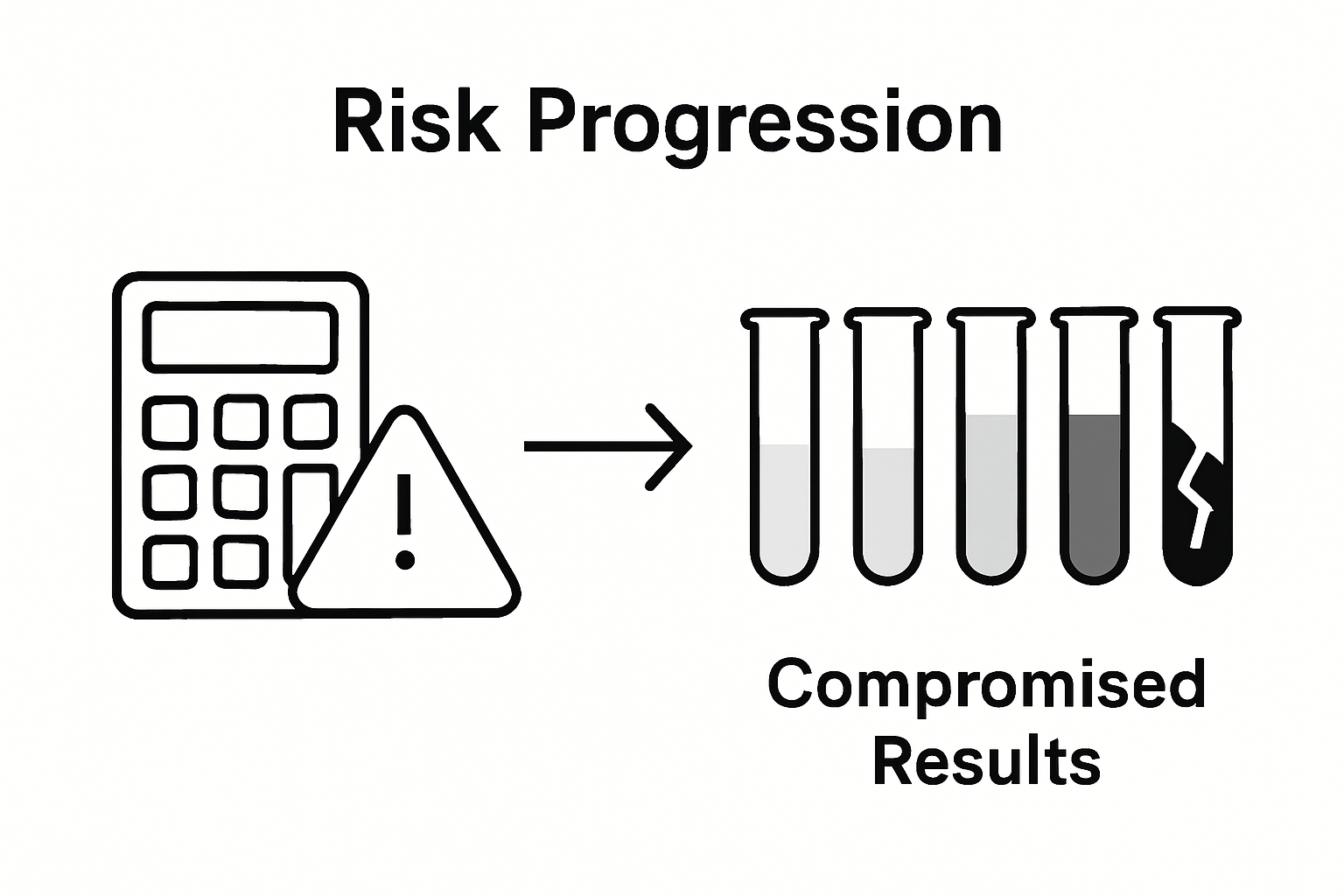
Laboratory errors pose significant hazards to research reliability, creating a complex web of potential misinterpretations that extend well beyond initial experimental parameters. These mathematical miscalculations can silently propagate through research protocols, generating false conclusions that might incorrectly inform critical scientific understanding or subsequent investigative approaches.
Key impacts of compromised research integrity include:
- Invalidation of entire research projects
- Potential misallocation of scientific resources
- Erosion of institutional research credibility
- Risk of publishing fundamentally flawed scientific findings
Mitigating these risks demands a comprehensive approach that transcends traditional error checking. Researchers must cultivate a culture of mathematical skepticism, implementing multilayered verification protocols, utilizing advanced statistical cross-referencing techniques, and maintaining an unwavering commitment to transparency and methodological precision.
How to Bulletproof Your Calculations Fast
Mathematical precision in laboratory settings demands a strategic, multifaceted approach to calculation verification. Researchers must develop a hypervigilant methodology that transforms error prevention from a mundane task into a systematic shield against potential experimental failure.
The core of bulletproofing calculations lies in implementing a triple-verification protocol. This approach involves creating independent calculation pathways that cross-reference each other, ensuring that mathematical errors are intercepted before they can propagate through research protocols. Developing this system requires a combination of technological tools, human expertise, and rigorous procedural discipline.
Key strategies for rapid calculation verification include:
- Utilize multiple calculation platforms
- Implement automated cross-checking software
- Develop independent verification workflows
- Create calculation templates with built-in error alerts
- Train research teams in systematic error detection
- Use digital tools with real-time validation mechanisms
Successful calculation bulletproofing transcends simple technological solutions. It requires cultivating a laboratory culture that views mathematical accuracy as a critical scientific skill. Researchers must approach every numerical translation with skepticism, treating each calculation as a potential source of experimental contamination that demands relentless scrutiny and verification.
Avoid the Reconstitution Death Spiral with Area 15 Labs
The “Reconstitution Death Spiral” exposes how tiny math mistakes and volume conversion errors can wreck your entire experiment. If you are tired of exponential error propagation and ruined research subjects, it is time to take control with smarter solutions. Area 15 Labs delivers a no-nonsense approach to high-purity compounds and verified research tools shipped straight from Texas with lightning-fast speed. Our triple-verification protocols and rigorous quality assurance help bulletproof your calculations and keep your research data integrity intact.
Don’t let decimal misplacements or improper conversions undermine your projects. Join the citizen scientists who trust Area 15 Labs as their go-to research command center. Experience the difference of same-day Texas shipping and a brand that combines cutting-edge science with unmatched swagger. Ready to escape the math mistakes trap? Explore our precision-tested compounds and elevate your research today at Area 15 Labs.
Learn more about protecting your experiments from critical errors in our Knowledge Hub. Research harder with confidence and style.
Frequently Asked Questions
What is the reconstitution death spiral phenomenon?
The reconstitution death spiral is a chain reaction of errors in laboratory protocols where minor mistakes compound, leading to significant degradation of experimental results and scientific integrity.
How do mathematical errors impact laboratory research?
Mathematical errors can lead to erroneous data, compromising the validity of research results and potentially invalidating entire scientific studies.
What are common types of mathematical mistakes in labs?
Common mistakes include decimal point misplacements, improper unit conversions, statistical errors, and rounding mistakes that affect data accuracy.
What strategies can be implemented to avoid calculation errors in laboratory settings?
Strategies include using multiple calculation platforms for verification, employing automated cross-checking software, and training research teams in meticulous error detection processes.
Recommended
- Battle of the Agonists: Semaglutide vs. Tirzepatide vs. Retatrutide | Research Peptides & News | Area 15 Labs
- Don’t Get Fooled: Your “USA Peptides” Likely Started in China (and that’s OK!) | Research Peptides & News | Area 15 Labs
- BLOGS – Area 15 Labs
- Peptide Stacking Research: Hype, Synergy, & Lab Reality
- The Pitfalls of DIY Trusts: Why Self-Prepared Trusts Often Fail in California – Law Office of Eric Ridley

[…] Assurance practices operate across multiple critical research phases. Advanced testing methodologies ensure that each experimental stage—from initial material selection through final data […]
[…] or miscalculate concentrations, then wonder why their data doesn’t match published references. Understanding reconstitution mathematics prevents calculation errors that contaminate your entire experiment. A simple math mistake means your “concentration” is […]