

Over 60 percent of American scientific research depends on the reliability of laboratory materials, yet many overlook the risks posed by inconsistent peptide quality control. When the tiniest impurity or miscalculation slips through, months of research and funding can unravel. Understanding what quality control truly means for peptides empowers scientists to safeguard their work and secure valid, reproducible results that drive American innovation forward.
Table of Contents
- What Peptide Quality Control Means
- Different Types of Peptide Testing Methods
- Key Standards for Lab-Ready Peptides
- Risks of Poor Quality Control in Labs
- Tips to Avoid Common Testing Mistakes
Key Takeaways
| Point | Details |
|---|---|
| Peptide Quality Control is Essential | Implement systematic testing to ensure the integrity, purity, and accuracy of peptide materials for reliable research outcomes. |
| Advanced Testing Methods are Crucial | Utilize techniques like High-Performance Liquid Chromatography (HPLC) and Mass Spectrometry for thorough evaluation of peptide characteristics. |
| Rigorous Standards Ensure Consistency | Maintain a minimum chemical purity of 95%, verifying structural integrity and stability, to ensure lab-readiness of peptides. |
| Avoiding Quality Control Failures is Critical | Address variability and methodological errors proactively to prevent significant research setbacks and financial loss. |
What Peptide Quality Control Means
Peptide quality control represents a critical scientific process that ensures the chemical, physical, and functional integrity of peptide research materials. At its core, quality control involves systematic testing and validation procedures designed to confirm peptide purity, stability, and accuracy before research utilization.
Researchers implement rigorous quality control methods to prevent potential variability that could compromise experimental outcomes. Peptide quantification techniques help scientists precisely measure molecular characteristics, identifying potential impurities or structural deviations that might impact research results. These techniques involve multiple analytical approaches, including mass spectrometry, high-performance liquid chromatography, and spectroscopic measurements.
The primary objectives of peptide quality control encompass several key dimensions:
- Chemical Purity: Verifying exact molecular composition
- Structural Integrity: Confirming peptide sequence and configuration
- Stability Assessment: Evaluating potential degradation risks
- Quantitative Precision: Measuring molecular concentration accurately
Quality control becomes especially crucial when working with research peptides, as even minor variations can significantly alter experimental results. Precise measurement methods help researchers maintain consistent standards and reproducible scientific investigations, ultimately supporting the reliability and credibility of their research work.
Different Types of Peptide Testing Methods
Peptide testing methods are sophisticated analytical techniques designed to assess the quality, purity, and molecular characteristics of peptide research materials. Peptide stacking research requires precise evaluation techniques that can detect even microscopic variations in molecular composition and structure.

Researchers utilize multiple advanced analytical approaches to ensure peptide integrity. Liquid chromatography-multiple reaction monitoring mass spectrometry (LC-MRM-MS) represents a powerful quantitative technique that enables targeted protein and peptide analysis with exceptional precision. This method allows scientists to measure molecular characteristics with remarkable accuracy, identifying potential impurities or structural anomalies that could compromise research outcomes.
Key peptide testing methods include:
High-Performance Liquid Chromatography (HPLC)
- Separates peptide components
- Identifies molecular purity
- Provides detailed compositional analysis
Mass Spectrometry
- Determines exact molecular weight
- Confirms peptide sequence
- Detects molecular structural variations
Amino Acid Analysis
- Quantifies individual amino acid components
- Verifies peptide composition
- Ensures molecular accuracy
Each testing method offers unique insights into peptide molecular characteristics, enabling researchers to maintain rigorous quality standards. Precise peptide sourcing becomes crucial in ensuring consistent and reliable research outcomes, with comprehensive testing methods serving as the foundation for scientific integrity.
Key Standards for Lab-Ready Peptides
Lab-ready peptides demand rigorous quality standards that ensure consistent, reliable, and reproducible research outcomes. Comprehensive quality control represents the critical foundation for maintaining scientific integrity and experimental precision across research environments.
Researchers must evaluate peptides against multiple stringent criteria to guarantee laboratory suitability. Sample preparation procedures play a pivotal role in determining peptide quality, with analytical protocols requiring methods that are inert, robust, and capable of high-throughput processing. Precise analytical techniques help scientists identify potential molecular variations that could compromise research reliability.
Key standards for lab-ready peptides encompass several critical dimensions:
Molecular Purity
- Minimum 95% chemical purity
- No detectable contaminants
- Verified through multiple analytical methods
Structural Integrity
- Confirmed amino acid sequence
- Precise molecular weight verification
- Consistent molecular configuration
Stability Parameters
- Predictable storage conditions
- Resistance to environmental degradation
- Consistent performance across specified temperature ranges
Each peptide must undergo comprehensive validation to meet these exacting standards. Product quality verification becomes crucial in ensuring that research materials maintain consistent performance, ultimately supporting the reproducibility and credibility of scientific investigations.
Risks of Poor Quality Control in Labs
Poor quality control in laboratory peptide research can introduce catastrophic risks that fundamentally undermine scientific investigation. Peptide research standards demand meticulous attention to prevent potentially devastating experimental failures that could invalidate months or even years of critical work.
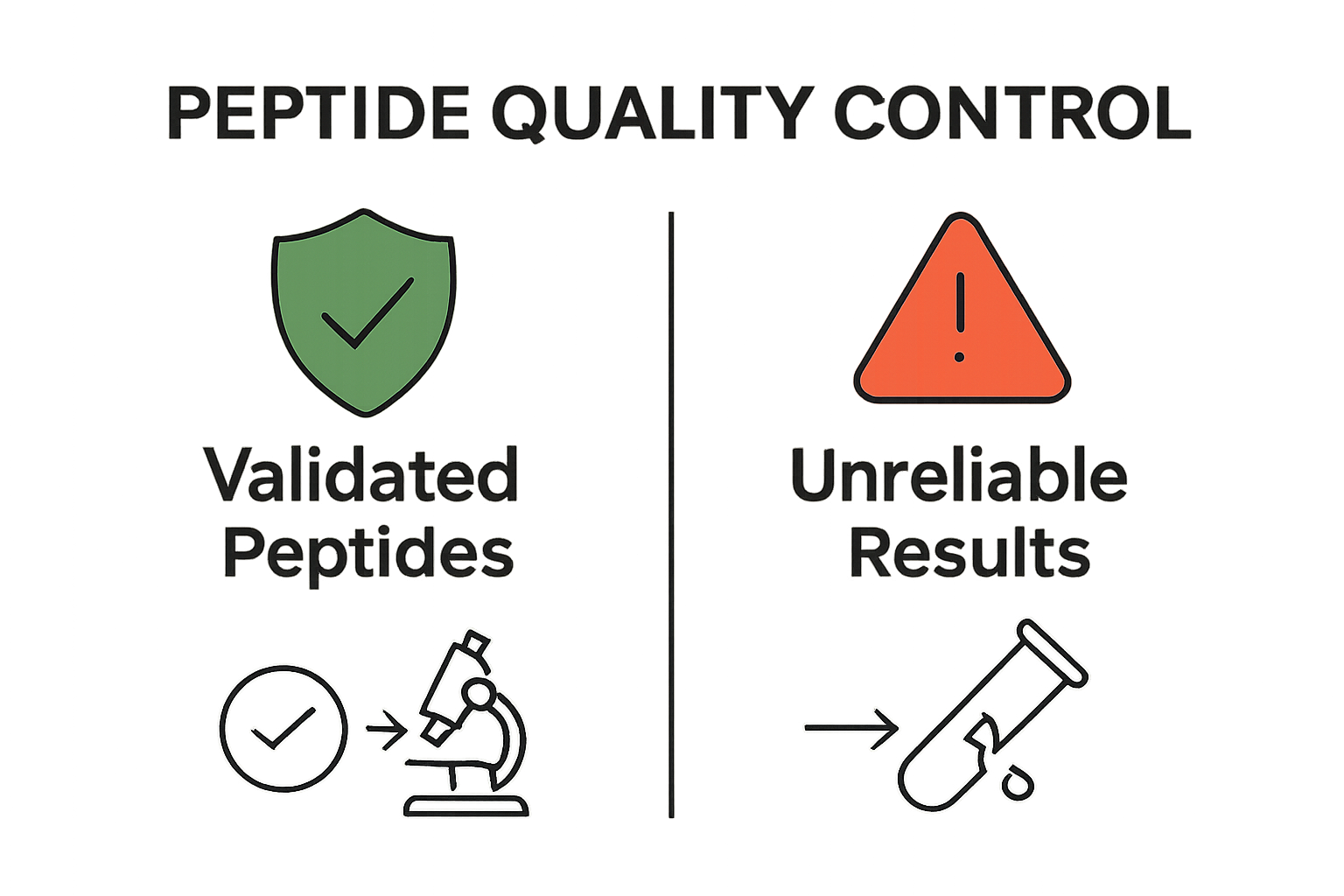
Variability in peptide content determination represents a significant scientific challenge. Research demonstrates that inconsistent measurement techniques can produce imprecise protein content knowledge, potentially compromising the fundamental reliability of research outcomes. Inadequate sample preparation procedures can induce molecular modifications that fundamentally alter peptide characteristics, creating substantial risks for researchers.
Key risks of compromised quality control include:
Experimental Invalidation
- Unreproducible research results
- Potential complete study failure
- Loss of research funding and credibility
Molecular Misrepresentation
- Incorrect peptide sequence identification
- Undetected structural variations
- Compromised research integrity
Financial Consequences
- Wasted research resources
- Potential grant funding withdrawal
- Significant time and monetary investments lost
Researchers must recognize that quality control is not optional but an essential scientific imperative. Implementing rigorous testing protocols represents the most effective strategy for mitigating these substantial risks and maintaining the highest standards of scientific investigation.
Tips to Avoid Common Testing Mistakes
Navigating peptide testing challenges requires a strategic approach that anticipates potential pitfalls and implements proactive quality control measures. Peptide research techniques demand precision and careful methodological consideration to minimize experimental errors.
Calibration strategies play a critical role in ensuring accurate peptide quantification. Targeted protein analysis reveals that the high cost of labeled peptide standards can introduce significant measurement variability, making alternative calibration approaches essential for maintaining research integrity. Researchers must carefully evaluate and select analytical methods that provide consistent and reproducible results.
Key strategies to avoid common testing mistakes include:
Methodological Precision
- Use multiple complementary analytical techniques
- Cross-validate measurement results
- Implement rigorous statistical validation protocols
Standard Selection
- Choose cost-effective calibration approaches
- Verify peptide standard authenticity
- Develop robust reference measurement procedures
Analytical Diversity
- Combine elemental analysis techniques
- Utilize varied quantification methods
- Mitigate potential measurement biases
Effective peptide testing requires a multifaceted approach that anticipates potential sources of error. Researchers who develop comprehensive, adaptable testing protocols can significantly reduce the risk of experimental inconsistencies and maintain the highest standards of scientific investigation.
Elevate Your Peptide Research With Trusted Quality Control
Peptide quality control is at the heart of reliable research. We know how challenging it can be to avoid variability in purity, structural integrity, and stability—all critical for reproducible results. When accuracy matters most, relying on peptides that aren’t rigorously tested can jeopardize your entire project.
At Area 15 Labs, we remove that uncertainty. We test every product to ensure it meets strict standards so you get consistent, lab-ready peptides every time. With fast shipping straight from Texas, you can kickstart your experiments without delay. Ready to stop worrying about peptide testing pitfalls? Visit Area 15 Labs and take control of your research today. Explore how our comprehensive quality control and clear product standards support your scientific integrity.
Don’t let poor peptide quality hold back your work. Discover reliable peptides and zero hassle ordering now at Area 15 Labs.
Frequently Asked Questions
What is peptide quality control?
Peptide quality control is a scientific process that ensures the chemical, physical, and functional integrity of peptide research materials through systematic testing and validation procedures.
Why is peptide quality control important for researchers?
Quality control is crucial for researchers because even minor variations in peptide purity or structure can significantly affect experimental outcomes, leading to unreliable or invalid results.
What are some common methods used in peptide quality control testing?
Common methods include High-Performance Liquid Chromatography (HPLC), Mass Spectrometry, and Amino Acid Analysis, which help assess purity, molecular weight, and structural integrity of peptides.
What standards must lab-ready peptides meet?
Lab-ready peptides must meet rigorous standards, including a minimum of 95% chemical purity, verified amino acid sequences, and stability parameters to ensure consistent performance in research applications.

[…] comprehensive strategies that address multiple critical dimensions of scientific research. Systematic verification protocols help laboratories maintain rigorous standards by implementing structured approaches to data […]
[…] molecular interactions become so precise that they can align into stunning geometric patterns. Peptide quality control becomes a critical process for ensuring research grade materials, and crystal formation represents one of the most elegant validation […]
[…] Peptide Quality Control: Complete Guide for Researchers […]
[…] amino acids that add stability), and molecular formula (the exact count of atoms in the peptide). Peptide quality control standards rely on understanding these specifications because they directly impact research […]
[…] just making promises?” The answer separates trustworthy suppliers from those cutting corners. Understanding peptide quality control fundamentals helps researchers recognize which testing standards actually matter and which claims deserve […]
[…] fail. You must request third-party testing documentation before finalizing any purchase. Understanding peptide quality control protocols helps you evaluate whether a supplier’s testing meets industry […]