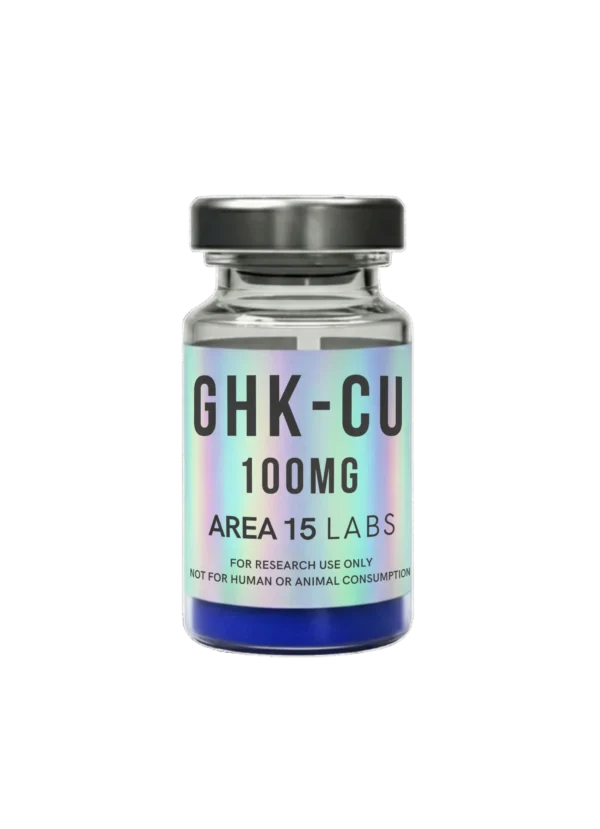
🧪 GHK-Cu 100mg: Advanced Research Peptide Profile
GHK-Cu 100mg is a synthetic complex of the tripeptide Gly-His-Lys and a copper (II) ion, precision-engineered for studies targeting systemic healing and tissue architecture. Researchers utilizing GHK-Cu 100mg focus on its ability to modulate the activity of both metalloproteinases and their inhibitors, ensuring a balanced approach to matrix remodeling in experimental settings.3
Gene Expression Regulation: The GHK-Cu 100mg peptide is researched for its unique ability to up- and downregulate at least 4,000 human genes, effectively resetting DNA to a healthier state in cellular analogs.
SIRT1 Activation: Studies on GHK-Cu 100mg identify it as a potential activator of the SIRT1/STAT3 signaling axis, which is critical for maintaining epithelial barrier function.4 1
Collagen and Elastin Synthesis: The GHK-Cu 100mg formulation is investigated for its role in stimulating the production of collagen, elastin, and glycosaminoglycans in skin fibroblast models.5
Antioxidant Dynamics: Laboratory evaluations of GHK-Cu 100mg explore its capacity to increase antioxidant enzyme levels and suppress pro-inflammatory cytokines like TNF-alpha and IL-6.6
🔬 Key Research Applications of GHK-Cu 100mg
This peptide is a primary focus for research models investigating:
🩹 Tissue Architecture & Repair: Investigations into the effects of GHK-Cu 100mg on accelerating wound healing, skin density, and connective tissue remodeling.7
🧬 Epigenetic Pathway Modulation: Research into GHK-Cu 100mg regarding its influence on gene profiling and its potential to reverse age-associated cellular destruction.8
🛡️ Mucosal and Barrier Integrity: Studies on GHK-Cu 100mg look at the restoration of tight junction proteins (ZO-1 and Occludin) and the protection of goblet cells in intestinal models. 1
🔥 Inflammatory Cascade Control: Evaluation of GHK-Cu 100mg for its ability to block NF-kB p65 and p38 MAPK signaling in acute injury research.9
✅ GHK-Cu 100mg Product Specifications
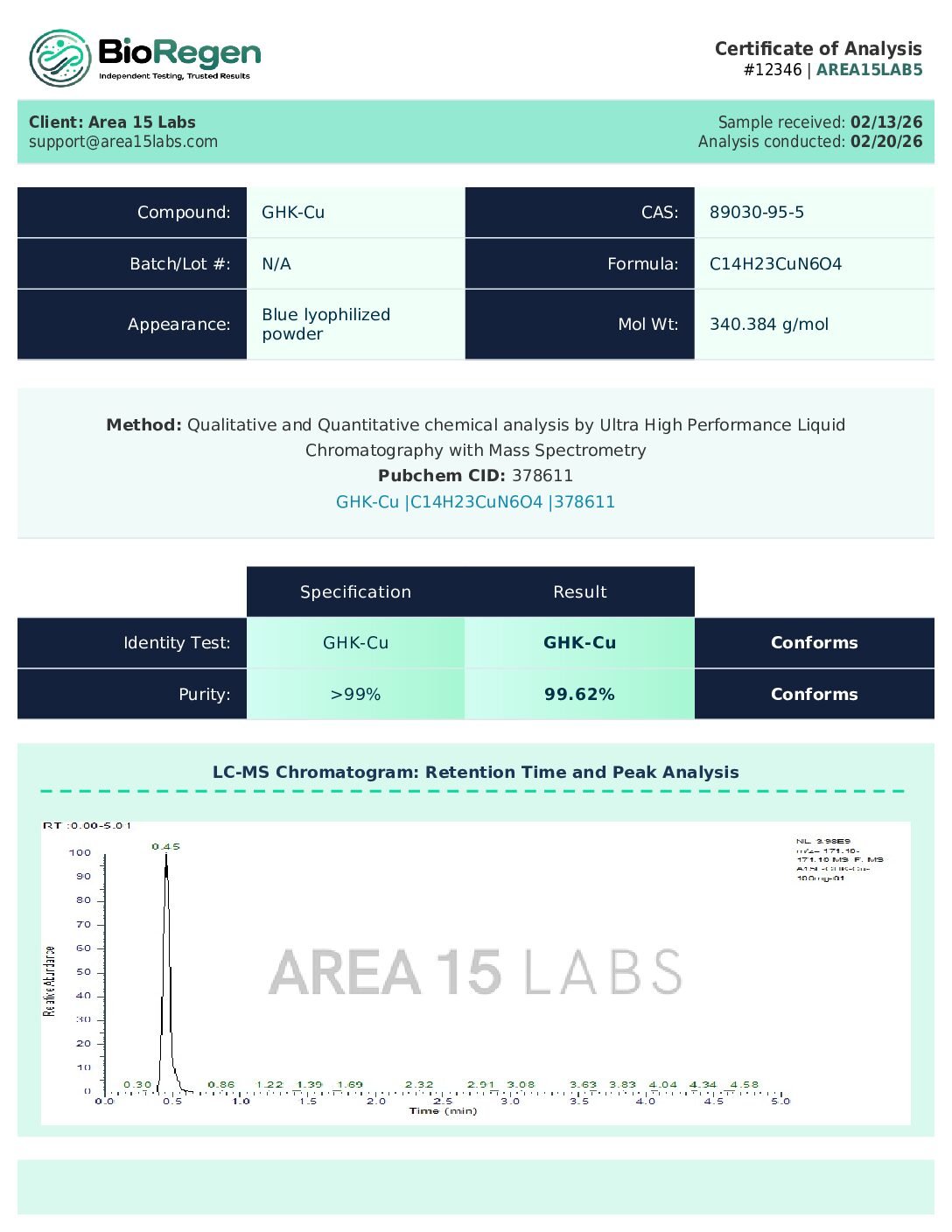
| Specification | Detail |
| Product Name | GHK-Cu 100mg |
| Molecular Formula | C14H22CuN6O4 |
| Molecular Weight | 401.91 g/mol |
| Concentration | 100 mg per vial |
| Appearance | Distinct blue lyophilized powder |
| Format | Lyophilized powder for reconstitution |
| Solubility | Highly soluble in water or PBS |
❄️ Product Care & Handling Guidelines
Proper storage is required to maintain the molecular integrity of the GHK-Cu 100mg tripeptide complex.10
Unreconstituted (Powder): Store GHK-Cu 100mg in a dry environment. Long-term storage is optimal at -20 degrees C.
Reconstituted (Liquid): Refrigerate GHK-Cu 100mg at 2 degrees C to 8 degrees C immediately; use within the established experimental timeframe for maximum potency.11
Handling Note: Peptides like GHK-Cu 100mg are sensitive to light and mechanical stress. Use gentle swirling during reconstitution and avoid repeated freeze-thaw cycles.
📚 References & Resources
NCBI PubMed: https://pubmed.ncbi.nlm.nih.gov/26236730/
NCBI PMC: https://pmc.ncbi.nlm.nih.gov/articles/PMC4508379/
NCBI PubMed: https://pubmed.ncbi.nlm.nih.gov/35083444/
NCBI PMC: https://pmc.ncbi.nlm.nih.gov/articles/PMC12263609/
NCBI PubMed: https://pubmed.ncbi.nlm.nih.gov/18644225/
⚠️ Laboratory Research Use Only Notice
The GHK-Cu 100mg product is strictly intended for in vitro and non-clinical laboratory research purposes only. It is not for human consumption, veterinary diagnostic, or therapeutic use. Statements regarding the biochemical potential of GHK-Cu 100mg have not been evaluated by the FDA. Researchers must follow established laboratory safety and ethical standards.